Blog Highlights
- Cloud vs. On-Premises: Cloud project management tools can be up and running in a matter of weeks, while on premise takes 6-12 months to implement.
- More Rapid Expansion: Cloud platforms allow expansion across projects, users, and locations, as well as fast evolution of dispersed teams – with no additional infrastructure by the enterprise.
- Lower IT Overhead Vendors are responsible for the infrastructure, backups, upgrades, patches and security – reducing the burden on your internal IT team.
- Security & Compliance: Enterprise cloud providers need to encompass encryption, access controls, audit trails, data residency, and standards like SOC 2 Type II, and ISO 27001.
- Predictable Cost & TCO: Cloud moves the spending to a subscription and filters out most of the upfront infrastructure cost of on-premises deployments, although enterprises need to compare TCO instead of license fees alone.
- Ongoing AI & Product Release: Cloud delivery enables vendors to release AI features, new capabilities, enhancements, and security updates more rapidly than traditional on-premise upgrade schedules.
- Enterprise-Wide Integration: Contemporary cloud project management solutions can bridge to ERP, HRMS, CRM, accounting and communication platforms to extend the reach of project execution throughout the enterprise.
- Select Your Cloud Platform: enterprises should assess process fit, integrations, real-project pilots, security and compliance, and customer references as part of their platform evaluation.
- Cloud, On-Premise, or Hybrid: You will find that cloud accommodates many of the latest enterprise deployments, but hybrid or on-premise configurations still make sense in some scenarios where there are difficult data residency, regulation, or infrastructure constraints.
- Enterprise & Industry Fit: Cloud project management will benefit IT services, pharma, EPC, and GCC companies by providing several use cases such as resource and margin management, regulated project execution, and global collaboration.
QUICK ANSWER
On-premise project management would take you 6-12 months to deploy. With a cloud platform, you are live in weeks. With cloud-based project management software, you get weekly AI updates, you bridge the compliance gap, and your distributed teams all see the same picture no matter where they are. On-premise can’t keep up.
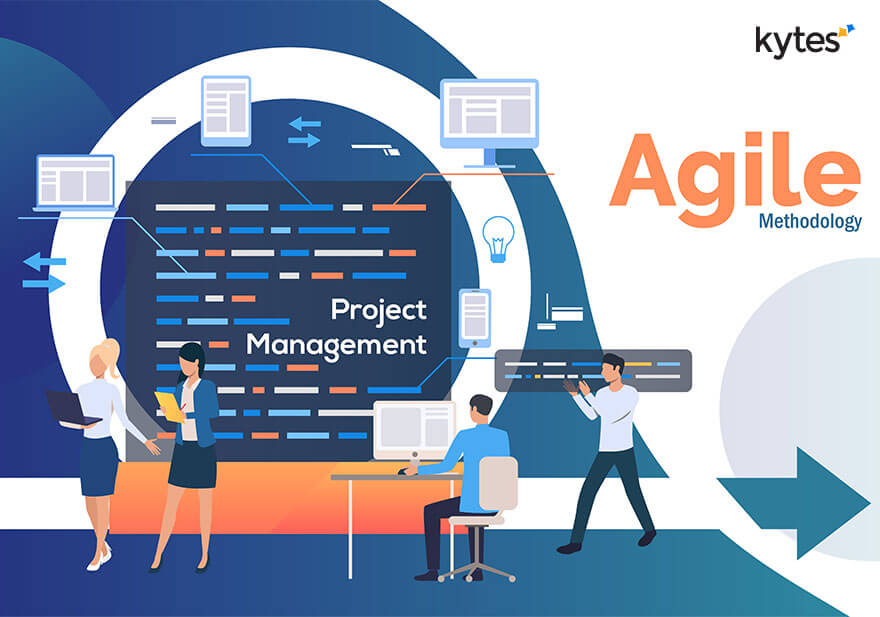
Agile project management methodology Agile project management methodology is an iterative project management methodology based on short cycles, incremental delivery, and collaboration with the customer rather than contract negotiation. The long-plan-long-build rhythm of traditional project management gave way to short iterations, rapid feedback, and visible progress. The four values and twelve principles of agile were defined by the Agile manifesto in 2001. All five current methodologies – Scrum, Kanban, Extreme Programming XP, Lean and SAFe- originate from it.
Agile project management methodology is an incremental project delivery process that emphasizes four core values, twelve principles and, of course, agile project management practices. It is an iterative and incremental approach, which radically differs from traditional project management methodology, based on the long plan-long build rhythm. With short time-frame projects, fast feedback, and visualized progress, agile methodology results in a seamless project process.
Most project failures aren’t failures of effort. They’re failures of method. A team takes on a sprint without a backlog. A product owner approves a feature that no one verifies. A release goes out without a retrospective. And the team anticipates the outcome. Rework, missed schedules, and an untrusting team.
Agile project management methodology solves this. It’s a project management methodology based on short cycles. It emphasizes constant evolution, collaboration with customers over contract, and quick delivery over planning.
It is all about: ship fast, learn fast.
Agile methodology uses short iterations to replace the long-plan-long-build cadence of traditional project management. Fast feedback. Transparent tracking.
In India & US: 2026 is the year that agile left the software box. Professional services firms are running consulting practice agile. Audit and finance teams run audit and finance team agile.
Construction PMOs run hybrid agile on certain parts.
Clients want visibility per sprint. Not the quarter.
So, what is agile in the modern age. 5 Agile Methodologies that will matter in 2026. 12 principles of agile from the manifesto. How is agile different from the norm, project managers. How to choose the right software.
What Is the Agile Methodology?
Agile Methodology. Agile methodology is a project management approach that provides value in chunks. Each chunk is an iteration or a sprint. The team plans a small batch, delivers, learns, plans the next batch. The approach values working output over complete documentation, customer collaboration over contract negotiation, and response to change over following a plan.
Agile Manifesto: 2001 The Method: In 2001 17 programmers gathered in Snowbird, Utah to write The Agile Manifesto. It articulated four principles and twelve values of agile which revolutionized software development teams. 25 years on, those 12 principles now drive finance projects, drug trials, consulting assignments and even marketing campaigns.
A basic illustration. The traditional team takes six months to create a customer portal. At the day of the launch, half the functionality of that portal is not what the customer wanted.
The agile team releases a functional portal in three weeks.
Receives customer feedback. Improves and releases the next version in three weeks. By the end of three months, the agile team has released six iterations.
This is the change. Not just a quicker project. A new relationship with the customer, the plan, the team.
The Agile Manifesto and Twelve Principles of Agile
Agile manifesto has 4 values: Individuals and interactions over processes and tools. Working software over complete documentation. Customer collaboration over contract negotiation. Response to change over a fixed plan.
Agile’s 12 Principles Guide Project Management Daily Life The Principles of Agile are how project management work should operate on a daily basis: 1. Customer satisfaction through early and continuous delivery 2. Adapt to changing requirements 3.
The function of the system is the measure of progress 4.
Frequent delivery of working software 5. Project teams must work together every day 6. Motivated individuals make successful projects 7. Face-to-face communication is the best 8.
Working software is the primary measure of progress 9.
Agility promotes sustainable work. 10. Continuous attention to technical excellence 11. Simplicity is essential 12.
Self-organizing teams create the best architectures.
Those twelve principles are the foundation of every modern method. If an organisation says it is agile but there are fewer than nine of those twelve principles present – then you’re not agile. You’re waterfall with daily standups.
The Five Agile Methodologies That Matter in 2026
Five methodologies dominate 2026 practice. Each fits a different kind of work.
Scrum-Most popular Scrum breaks work into fixed sprints, two-week iterations are typical. A product owner owns the backlog, a scrum master clears blockers and shields the team, and an agile team pulls work, commits to a sprint goal, and ships at the end of each sprint. Scrum is well suited to teams seeking predictability and clarity of roles. The four Scrum ceremonies proceed on fixed rhythm: the sprint planning on the first day of each sprint, the daily stand-up each morning of every sprint, the sprint review on the last day of each sprint, and the retro immediately following.
Kanban-The fastest. And Kanban (aka: work on a board) Trello cards, columns: To Do, In Progress, Done, and column limits prevent boat anchors and play nice with our brain. Kanban works well for continuous work streams such as support operations, Dev Ops release trains, and marketing content pipelines. No cycles, no dates, work just flows when team capacity allows.
Extreme Programming XP-Most engineering focused. XP emphasizes technical quality with pair programming, test-driven development, continuous integration and frequent small releases. XP is suited to a software development team that releases high-quality code quickly. XP is most effective when used in conjunction with Scrum for cadence.
And Lean-The oldest. So Lean comes from Toyota. It focuses on cutting waste. In project management it means dropping anything that does not add value for the customer. Lean fits product development teams that ship a minimum viable product and learn fast. The core question is: what is the smallest thing we can build to test the biggest guess?
Scaled Agile Framework (SAFe)– The enterprise body As a way to use agile enterprise-wide, you will want the SAFe body in order that it operates at a big scale……for lots of staff members, or even hundreds. SAFe is designed for giant organizations, GCCs, and large enterprise software program improvement organizations operating many parallel applications. Most teams in 2026 run hybrids. Scrum plus Kanban. Scrum plus XP. SAFe for the portfolio with Scrum teams under it. The right mix depends on the work at hand.
Agile vs Traditional Project Management