
Blog Highlights
- Project portfolio management software connects strategy, execution, resources, and financials into one unified system.
- Most enterprises struggle not with visibility, but with converting visibility into real-time control.
- Disconnected tools create gaps between execution and financial outcomes, leading to delayed decisions and revenue leakage.
- Modern PPM enables real-time data, smarter resource allocation, and continuous portfolio alignment.
- A connected approach transforms portfolio management from reporting into a proactive decision-making system.
9:30 am, it’s green on the dashboard. 6 pm, the finance team sounds the margin erosion alarm. End of month, leadership says, where did we lose command.
Project Portfolio Management Software is system that supports the organization to plan, prioritize and manage multiple projects collaboratively, integrating strategy, execution, resources and financial results in a single, holistic view. It ensures that every project meets strategic objectives while providing quantifiable results.
Still, the main difficulty of most enterprises is no longer visibility. It is control.
The Illusion of Portfolio Visibility
Most companies feel they have addressed portfolio management due to dashboards, reports, and review meetings. Portfolios of projects look well defined, and their progress is transmitted across management teams on a regular basis. But this perceived transparency hides a much more profound problem.
Portfolios remain static when execution changes on a daily basis. The projects seem steady in reports, but their financials suggest otherwise. Resource allocation looks adequate on paper but teams feel overwhelmed or underutilized on the ground. Management has all the information it needs, but only when it’s too late to make a difference.
This gulf between transparency and control is where conventional portfolio management methods start to crumble.
What CXOs and PMO Leaders Deal With Every Day
The day to day reality of portfolio management is one that does not track individual tasks, but tries to reconcile strategy, delivery and financial pressures with each other. It’s the complexity of these cross functional demands that results in the daily operational realities that separate systems fail to deliver against.
Portfolio plans are initially set with a specific strategic focus, yet become quickly out of date, because business strategy can change more frequently than plans are updated. Without an aligned and real time view of what has been agreed to, businesses will continue to execute projects, which in today’s volatile business climate, may no longer contribute to strategy.
Resource allocation represents a significant level of complexity; allocation based on availability instead of skills or urgency. Over-reliance on a few key resources and underutilization of talented individuals leads to resource bottlenecks and delayed projects.
Financial reporting and tracking suffers from a similar problem; execution is disconnected from finance information. Cost overruns and revenue erosion, if recognized at all, do not appear until it is too late for it to be proactive. Collaboration among various teams such as delivery teams, PMO, and finance contribute to problems as individual groups utilize disparate systems. This lack of unified view and information to make business decisions.
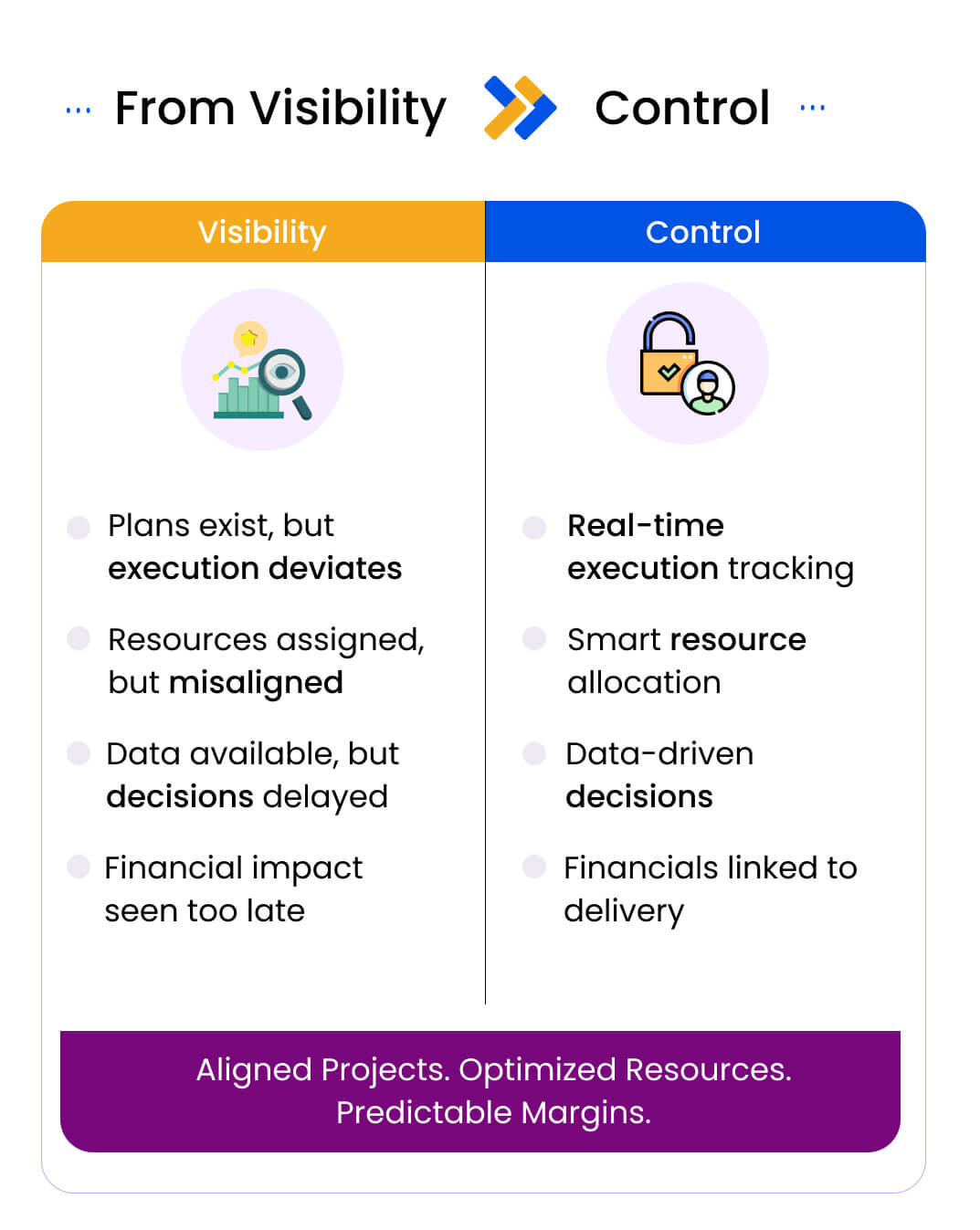
From Portfolio Visibility to Portfolio Control
Closing the Execution–Financial Gap
Today’s companies don’t want additional reporting, they want integrated systems which will allow for control.
Real portfolio control starts when plans are directly linked to execution; rather than a report reflecting current progress, we need a system that can communicate actual progress in real-time and adjust in accordance to evolving environments. Resources aren’t just assigned to tasks; they are matched according to skill sets and a comprehensive understanding of capacity and load balanced needs.
Financial views have to progress as well; beyond financial reporting at the conclusion of a cycle, organizations need a system to continuously track planned vs actual costs, projected revenue, and the effect on margins as a function of actual progress.
With these elements tied together, the portfolio management process ceases to be about reporting on the past, but begins with planning based on a comprehensive vision of the future and allows stakeholders to react effectively, re-assign resources optimally, and keep work aligned with strategic goals.
This is modern PPM maturity.
Why Existing Tools Fail to Deliver Control
Though many companies invest heavily in technology, a lack of integration between their systems cause many organizations to experience difficulties with portfolio control.
The PM software executes, the finance package doesn’t have that level of detail. ERP handles financials and disconnects to what’s going on daily with projects. Spreadsheets are utilized to help manage plans and collaboration software is employed to handle communications. Though each component has its use, taken together, they fragment the ecosystem.
A number of problems arise from a fragmented ecosystem; there is no single truth so teams have competing data sets, decision cycles take longer to get the data pulled together, actual progress does not update the financial forecast with impacts, and risk is a post-facto function.
Even with state-of-the-art PPM solutions, organizations fail because it operates as a reporting overlay rather than a functional platform for execution.
What Modern Project Portfolio Management Software Should Enable
For enterprise decision-makers, a project portfolio management system can’t be limited to simple planning and tracking. It must function as the mechanism that ties strategy and execution together in real-time.
A modern approach means aligning all projects to strategic business objectives so that resources are not wasted on initiatives that will not further the business goals. It provides the mechanism for intelligent resource management through the understanding of skills, capacity, and priority of projects so that the right resources are leveraged effectively across the portfolio.
Financial management becomes inherent in execution, providing real-time tracking of actual costs, revenues and margins, identifying and addressing any over-expenditures before they impact the balance of the portfolio.
The system enables true data-driven portfolio management and ensures that leaders make decisions based on real-time information rather than assumptions to best drive priority, mitigate risks, and improve overall performance.
Finally, the portfolio becomes dynamic, allowing leaders to continuously rebalance it based on the constantly shifting demands and needs of the business rather than just periodically assessing its current state.
How Kytes Bridges the Gap Without Adding Complexity
Almost all of the other portfolio management tools out there attempt to solve parts of portfolio management, creating more layers of complexity rather than eliminating it. Kytes attempts to pull everything together into one integrated portfolio management system.
Project planning is tied directly into execution so that projects remain in sync with progress. Resource management is tied directly into true availability and skill, and used in deciding when and how to assign resources. Financials are pulled in real-time directly into projects to provide up-to-the-minute knowledge of current costs and revenue.
All information sources, such as projects, finances and resource information streams into the single data warehouse. Leaders can instantly access information and make decisions faster than before.
The Leadership Impact: From Reaction to Control
The difference from distributed visibility to distributed control is transformative. Project execution across the portfolio improves-teams can operate with better clarity of priorities and coordinate more effectively; resources are utilized efficiently, there is no over-utilization nor under-utilization.
Financial performance also improves, through margin control and reduction in revenue leakage; decision cycles become faster to enable pro-action instead of re-action; and perhaps most critical-strategy and execution are aligned such that business goals are consistently achieved.
Instead of questioning what went wrong, leadership can focus on what to do next.
Final Thought
It’s no longer about managing more projects-it’s about managing them clearly, with alignment, and control.
If you have a system that gives you visibility but not control, then maybe you should reconsider how you’re managing your projects’ portfolios and what your project portfolio management software solution needs to be. A more integrated system can change how your organization’s strategy is executed and, ultimately, the results that follow.
And that change is worth discussing.
If visibility isn’t translating into control, it may be worth exploring a more connected approach to project portfolio management.