Blog Highlights
- Agile project management methodology allows IT & ITES companies to iterate fast and be responsive to dynamic market needs.
- Key agile concepts like customer collaboration, incremental delivery, and continuous improvement contribute to business agility.
- In IT project management, agile reduces time to market and reduces risk through timely feedback.
- Agile in ITES (BPO) assists in reengineering processes, enhancing efficiency, and increasing customer satisfaction.
- Critical advantages of agile are quicker value delivery, increased transparency, improved team morale, and scalable processes.
- Typical challenges are resistance to cultural change, scaling issues, and compliance restrictions.
- Best practices for rollout: begin small, spend money on coaching, clearly define roles, and leverage updated agile tooling.
- Upcoming future trends: AI-enriched agile, DevOps convergence, hybrid models, dispersed teams, and value-based metrics.
- Kytes AI-enabled [PSA + PPM] software supports agile transformation with real-time dashboards, backlog management, and predictive insights.
IT and ITES (Information Technology Enabled Services) companies cannot afford to operate with rigid, slow-moving project management methodologies. Even more so in a global market where technology evolves at breakneck speed.
In this very context, the agile project management approach, once confined to software development, has now become a strategic imperative across diverse operations. This blog explores how agile is not just transforming development teams, but reshaping how IT and ITES firms plan, execute, and deliver value — and why forward-thinking organizations are making this shift now.
Why Agile Matters in Today’s IT and ITES Landscape
The IT and ITES industries are marked by unending flux: changing customer requirements, new technologies, unforeseen regulatory landscapes, and fierce international competition. Conventional, plan-bloated project management processes tend to find it challenging to keep pace with these dynamics. Projects grow stale, requirements become obsolete, and delivery cycles extend past usefulness.
Conversely, embracing an agile project management approach provides the flexibility and elasticity necessary in this uncertain world. It enables teams to move fast, react to feedback, and reassess priorities continually. Instead of being tied down by long-term fixed plans, companies can rely on continuous improvement. For IT and ITES activities, which tend to cope with concurrent streams—software development, support, process outsourcing, maintenance—such flexibility is a lifeline.
Core Principles of the Agile Project Management Approach
Agile project management rests upon a series of core principles that support cooperation, adaptability, and ongoing delivery. These are derived from the Agile Manifesto but are realized in real-world disciplines:
- Customer collaboration over contract negotiation — Agile teams collaborate with stakeholders regularly. Loopback mechanisms ensure the product or service meets changing requirements.
- Responding to change over following a fixed plan — Instead of committing to a lockstep schedule, teams are receptive to shifting scope, priorities, and direction.
- Deliver working software (or service) frequently — Short iterations (sprints) deliver incremental value. This helps validate assumptions early.
- Cross-functional, self-organizing teams — Developer, QA, operations, and business analyst teams take ownership of end-to-end delivery.
- Continuous improvement — End-of-iteration retrospectives enable teams to reflect and enhance process, quality, and collaboration.
Even outside of software development, these principles find their way throughout IT services and outsourcing operations, influencing how projects are scoped, monitored, and delivered.
How Agile Reshapes Traditional IT Project Management
When we discuss IT project management — agile methods to drive value faster, it’s critical to realize how agile fundamentally transforms the operation of classical IT projects. Here are a couple of significant changes:
Greater Transparency: Resources such as burndown charts, Kanban boards, and daily stand-ups make progress transparent — to teams and stakeholders.
Incremental Delivery: Rather than building an entire system in one large release, agile breaks work into smaller, manageable increments. Each increment is potentially shippable or deployable.
Continuous Feedback: With regular demos or reviews, stakeholders can inspect and adapt. This tight feedback loop reduces the risk of misalignment.
Dynamic Prioritization: Agile teams not only prioritize features based on initial requirement, but by business value, risk, and customer impact. In case of priority changes in the middle, backlog reprioritization takes effect.
Risk Mitigation: By shipping incrementally and validating early, teams detect technical or market risks earlier, and are able to course-correct without huge sunk cost.
Improved Collaboration: Agile demolishes silos. Developers, operations, QA, business analysts, and even customers collaborate in a common cadence.
Waterfall vs Agile in IT / ITES
| Feature | Waterfall (Traditional) | Agile Project Management Approach |
|---|---|---|
| Delivery Model | One large release after full development | Incremental, frequent releases (sprints) |
| Change Handling | Change is difficult once scope is locked | Backlog is reprioritized; change embraced |
| Feedback Loop | At the end (user acceptance) | Continuous: every sprint has review/demos |
| Risk Exposure | High risk near project end | Risk reduces early via iterative delivery |
| Documentation | Heavy upfront specification | Lightweight, evolving, “just enough” documentation |
| Team Structure | Functional siloed teams | Cross-functional, self-organizing teams |
| Metrics | On-time, on-budget | Value delivery, cycle time, quality |
Adoption of Agile in ITES (Business Process Outsourcing)
While agile began in software development, numerous ITES firms have started implementing agile principles to non-development activities like business process outsourcing (BPO), customer support, and service delivery. Here’s how:
- Agile for Process Redesign: Instead of one-time redesign of a process and rolling it out in a big bang fashion, lean agile teams prototype process improvements, pilot in small batches, and iterate on actual user feedback.
- Cross-functional Staffing: Agents, process architects, quality analysts, and operations managers collaborate in close proximity and fast cycles in an agile BPO setup.
- Frequent Reviews and Adaptation:Rather than quarterly or yearly process audits, agile-facilitated ITES teams have regular reviews and fine-tune processes based on customer or stakeholder feedback.
- Value-based Prioritization: Work is prioritized not only by volume or SLA, but by value and influence — e.g., decreasing cycle time, minimizing handoffs, or enhancing quality metrics.
- Continuous Metrics and Improvement: Agile teams drive decisions, inspect performance, and change processes through actual-time metrics (e.g., first-call resolution, average handling time).
Key Benefits of the Agile Approach to Project Management in IT & ITES
Below, we delve deeply into the concrete and strategic advantages by which agile is so revolutionary in IT and ITES environments.
- Faster Time to Market / Service
Agile’s model of incremental delivery allows teams to deploy minimum viable products (MVP) or pilot services much earlier than they would with a typical project cycle. In IT, that might involve rolling out the first module of a software platform; in ITES, rolling out a new process flow to a subset of agents.
- Better Alignment with Business Goals
Through continuous stakeholder interaction and reprioritization of backlogs, agile guarantees that what is being developed or delivered is aligned with changing business strategies. This is what minimizes effort that goes into low-value features or processes.
- Increased Customer Satisfaction
Since feedback is ongoing, customers and stakeholders experience progress often and early. Their input shapes the work. This collaboration builds trust and ensures the final product or service resonates with actual user needs.
- Lower Risk
Shipping in small bites reduces risk. Teams can find technical problems, architecture errors, or poorly aligned assumptions early in the lifecycle — when fixes are less expensive and less painful.
- Improved Quality
With quicker cycles, ongoing testing, and frequent retrospectives, agile fosters higher quality deliverables. Defects are found sooner, and process improvements get fed back into the team in a timely manner.
- Greater Team Productivity and Morale
Cross-functional teams in stable, self-organizing environments feel more invested. The consistent rhythm and feedback loops promote cooperation. Retrospectives create continuous improvement, increasing productivity and team happiness.
- Transparency and Predictability
Visible metrics (backlogs, burndown charts, Kanban boards) make progress visible to all stakeholders. Stakeholders always have a clear understanding of what is on track and what is not. This transparency assists with expectation management and building trust.
- Scalability and Flexibility
Agile does scale. Regardless of whether your project is a modest dev effort, or an enterprise-wide program, you can use agile frameworks such as Scrum, Kanban, or hybrid. In ITES, agile can scale across business units, geographies, and process lines.
Common Challenges When Transitioning to Agile
Though the advantages are tremendous, embracing the agile project management style is not without challenges. Below are some typical challenges, particularly in IT and ITES organizations:
- Cultural Resistance: Organizations who are used to waterfall or command-and-control decision-making might resist the change. Transparency and self-organizing teams can be a shock to the culture.
- Misaligned Expectations: Stakeholders might perceive agile as “no planning” or utter chaos. Without education, they might find incremental delivery and uncertainty challenging to cope with.
- Lack of Agile Expertise: Companies often lack Scrum Masters, Product Owners, or Agile Coaches who are well trained. Without experts, adoption of agile tends to fail.
- Fragmented Tooling: Distributed teams, siloed tools, and legacy systems can slow down agile workflow. Implementing agile can mean new tooling that enables real-time collaboration, iteration planning, and backlog management.
- Scaling Challenges: Teams can struggle to synchronize releases, standardize practices, or coordinate cadence when scaling agile in large IT or BPO operations.
- Regulatory and Compliance Constraints: For IT operations in regulated sectors, the necessity to adhere to stringent documentation, audit trails, and compliance requirements might appear in opposition to agile’s flexibility.
- Measuring Success: Project KPIs (on-time, on-budget) in traditional projects would fail to capture agile value completely. Organizations will have to redefine metrics in terms of value delivery, iterative success, and customer satisfaction.
Best Practices for Implementing Agile in IT & ITES
Given the challenges, what practical steps help organizations adopt agile effectively? Below are proven best practices drawn from experience and expertise.
- Start with Agile Training and Coaching
Invest in training for critical positions — Scrum Masters, Product Owners, team members. Consider hiring seasoned Agile Coaches to enable teams to adopt agile mindset, practices, and rituals.
- Pilot Small, Then Scale
Start with a pilot initiative or one process within your IT or ITES business. Apply that as a sandbox to try things, learn, and develop your agile practices. Scale up once it is working in increments.
- Define Clear Roles and Responsibilities
Create Product Owner, Scrum Master (or analogous), and cross-functional team member roles. Clearly define their accountabilities. In ITES, for instance, you may require process owners and operation leads corresponding to agile roles.
- Use the Right Tooling
Agile is best supported by contemporary project management tools. Install software that facilitates backlog management, sprint planning, live dashboards, and collaboration. This enhances transparency, visibility, and coordination.
- Establish Agile Metrics
Set leading KPIs that capture value delivery: features delivered, cycle time, customer satisfaction, defect rates, process efficiency, etc. Use these together with qualitative input from retrospectives.
- Promote a Culture of Continuous Improvement
Perform retrospectives in every iteration. Get teams to discover what worked, what didn’t work, and what they will do differently. Incremental changes to the processes regularly and their effects. Make occasional changes to the processes dramatically and their effects.
- Ensure Stakeholder Involvement
Ensure regular stakeholder engagement. Schedule regular demos, backlog grooming meetings, and review sessions. Engage customers, business users, and operations stakeholders to ensure validation of work and re-prioritize accordingly.
- Scale with a Framework
If you want to scale agile for several teams or for the enterprise as a whole, take an approach to scaling — e.g., SAFe (Scaled Agile Framework), LeSS (Large-Scale Scrum), or hybrid models applicable for IT/ITES. Reinforce rituals, harmonize cadences, and synchronize cross-team dependencies.
- Manage Governance and Compliance
Include regulatory or compliance needs within your agile process. Utilize documentation as a part of your Definition of Done. Include audit checkpoints within sprints. Make sure that agile does not undermine compliance.
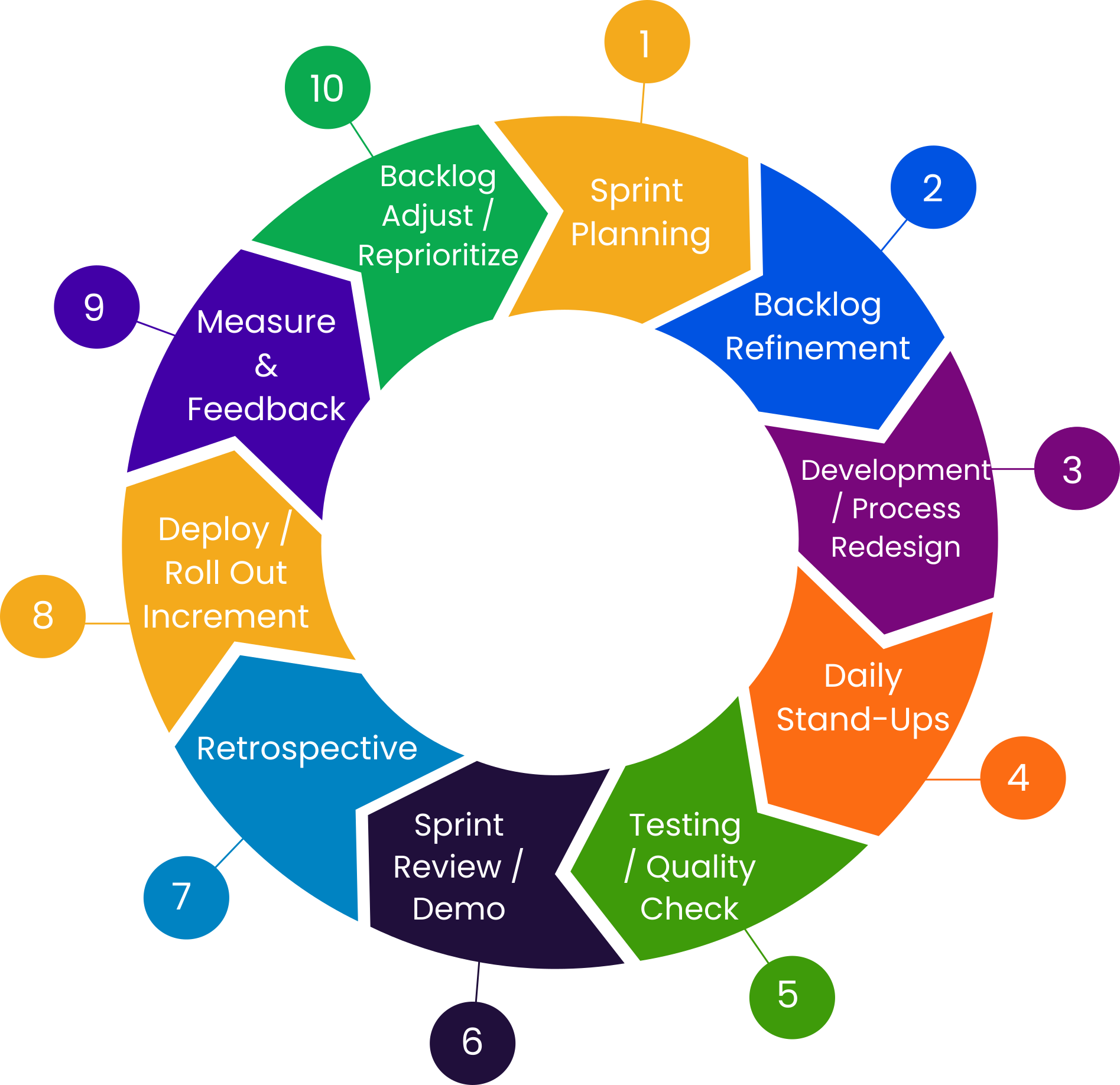
Agile Lifecycle in IT / ITES Projects
Future Trends: Where Agile Project Management Is Heading in IT & ITES
Technology is growing with every passing day, and so is agile. Below are some upcoming trends that are expected to influence the way the agile project management methodology continues to grow in IT and ITES:
- AI-Augmented Agile
Artificial intelligence will increasingly facilitate backlog prioritization, predictive forecasting, risk identification, and sprint planning. AI can look at historical iteration data, learn patterns, and recommend ideal sprint size. - DevOps + Agile Fusion
Agile and DevOps will become more integrated. Continuous integration, continuous delivery (CI/CD), and infrastructure as code will be baked into agile processes, allowing for quicker deployments and more stable operations. - Hybrid Frameworks
As companies expand, we will witness more hybrid models — Scrum and Kanban, and even waterfall — customized to organizational requirements, regulatory boundaries, and operational maturity. - Agile for Non-IT Functions
Agile will spread even more widely into non-technical parts of businesses: HR, marketing, finance, procurement. ITES firms will lead this transformation by applying agile beyond process outsourcing into broader business services. - Value-Driven Metrics
Performance measurement will continue shifting from output (features shipped) to outcomes and value (customer satisfaction, business impact). Value stream mapping and lean agile metrics will dominate. - Distributed Agile Teams
With globally distributed teams becoming normal, remote-friendly agile practices will deepen. Tools, digital ceremonies, and asynchronous collaboration will become more refined.
Conclusion
The agile project management approach is long gone as just a passing trend — it is fundamentally reshaping how IT and ITES organizations operate. By embracing the agile mindset, companies can move away from rigid plans, deliver incremental value, and adapt continuously to change. The benefits are clear: faster time-to-market, better alignment with business priorities, increased customer satisfaction, lower risk, and healthier teams.
Yet agile adoption is not a silver bullet. It demands culture change, skill building, and the right tooling. But when executed thoughtfully, with pilot programs, coaching, and metrics grounded in value, the transformation can be profound and enduring.
About Kytes [PSA + PPM]
At Kytes, we understand how demanding transformation can be — whether it’s Agile, Waterfall, Hybrid, or your own tailored framework. Our AI-enabled [Professional Services Automation + Project & Portfolio Management] software empowers organizations to manage diverse workflows, track value delivery, and scale seamlessly across teams — all aligned with your unique business needs.
With features like backlog management, real-time dashboards, predictive analytics, and resource optimization, Kytes helps forward-looking IT and ITES companies embrace agile — not just in theory, but in practice. As your partner in transformation, Kytes is committed to enabling more adaptive, value-driven operations.