Blog Highlights
- AI agents in project management automate routine tasks, monitor project progress, and take proactive actions to improve delivery efficiency.
- Unlike traditional AI copilots, AI agents can independently identify risks, analyze project data, and execute multi-step workflows within defined boundaries.
- AI agents help detect project delays, budget overruns, and resource conflicts early, enabling faster corrective actions and better project outcomes.
- Intelligent resource planning enables AI agents to optimize workforce allocation, improve utilization, and align resource availability with project demands.
- Integrating AI agents with connected project, resource, and financial data helps enterprises accelerate project delivery, improve cost control, and make informed decisions.
A PMO lead at a mid-sized IT services firm in Hyderabad reviewed the Monday dashboard. Every project showed green. By Thursday, two had slipped — one because a senior developer had been double-booked across clients, the other because a procurement dependency had gone untracked for three weeks. The dashboard had the data. Nobody had acted on it.
That gap — between seeing data and acting on it — is the problem AI agents in project management are built to close. Not another dashboard. Not a chatbot. An autonomous system that reads project signals, spots risk, and acts before a human needs to step in. The Tempo 2026 State of AI Report found that 91 percent of firms are piloting or actively using AI in delivery — but only 33 percent have deployed agents that actually do the work. The rest are still watching dashboards.
What Are AI Agents and How Do They Differ From Copilots?
AI agents are software that reads project data, makes choices based on set goals, and runs tasks without waiting for a prompt. A copilot answers when asked. An agent acts when the data says it should.
The gap matters. A copilot sums up a status report when a PM asks for it. An agent watches burn rate across twelve live projects, spots that three will run out of hours two weeks early, and moves resources before the PM checks the dashboard. One responds. The other acts first.
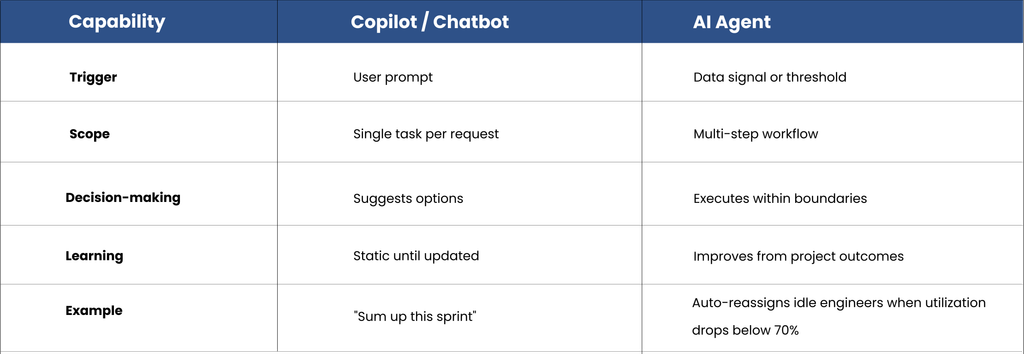
For AI project management to move past basic tooling, agents must work across the full project lifecycle — not just inside a chat window.
Why Are Most Organizations Still Stuck at the Copilot Stage?
The data is clear. The Tempo 2026 report found that only 18 out of 300 surveyed firms have agents in production with full capabilities. And 42 percent cannot tie their AI spend to ROI. Another 39 percent cannot tell AI work from human work in their current tools.
Three barriers explain the stall. First, fragmented systems. Agents need one connected data layer — projects, resources, financials, timesheets. When these live in five tools, the agent sees five partial pictures. Second, trust. Letting software move people or shift timelines needs governance most firms have not built. Third, skill gaps. Only 30 percent of teams have a tool that ties strategy to execution — so agents lack the context to act on what matters most.
This is not a tech problem. It is a data and trust problem. The firms that break through first pull their project, resource, and financial data into one layer — then put agents on top of it.
The PMI 2025 Pulse of the Profession found that 43 percent of firms actively used AI PM features, but adoption varied sharply by function. Status reporting led at 62 percent, followed by scheduling at 54 percent and risk identification at 48 percent. Budget tracking sat at 44 percent. The pattern is clear: firms adopt AI where data is clean and the task is routine. Agents need to go deeper — into the messy, cross-team calls where the real margin impact lives.
What Can AI Agents Actually Do in Project Delivery?
Agents work across five zones of project delivery. Each one replaces a manual step that costs time, accuracy, or margin.
Risk detection and early warning. Agents track schedule slips, budget burn, and blocked tasks around the clock. The Forrester 2025 analysis found AI risk tools flag risks with 87 percent accuracy, versus 54 percent for manual assessments. Early warning lead time jumps from 4.2 days to 18.6 days when AI monitoring replaces monthly manual reviews.
Resource rebalancing. When one project has idle staff and another is stretched, agents spot the gap and fix it — or flag it for a lead to approve. The PMI 2025 Pulse of the Profession found AI now handles 58 percent of routine task assignment, and scheduling conflicts fell 34 percent in firms running 50-plus concurrent projects.
Status and reporting automation. PMs spend 5.1 hours a week on status reports. With agents, that drops to 1.8 hours — a 65 percent cut — per McKinsey’s 2025 data. The agent pulls from timesheets, task boards, and financials, builds the report, and sends it. No PM has to compile a thing.
Scope and budget watch. Agents spot scope creep — new tasks added, needs changed, no budget update to match — and alert leaders before the overrun hits. Firms with AI cost tracking cut budget overruns from 16.2 percent to 9.8 percent of total project cost.
AI resource planning. For services firms staffing across multiple clients, locations, and skill pools, agents match demand signals from the pipeline to available capacity. They factor in planned leave, contractor availability, ramp-up time, and blended cost rates. This moves AI resource planning from a weekly spreadsheet exercise to a continuous, data-driven process.
How Does This Translate to Measurable Outcomes?
The numbers are sharp. Firms with AI agents in production finish 71 percent of projects within six months. Those without? Just 55 percent — even at the same project load. The typical cycle at agent-led firms is 3.5 months. At the rest, nearly six. That is a 40 percent cut in delivery time, per Tempo’s 2026 data.
Across PMI, Gartner, and Forrester research, the pattern holds. Teams using AI-assisted PM tools deliver on time 28 percent more often. Project failure rates fall 31 percent with AI risk monitoring. Median time to positive ROI is 7 months for large enterprises and 11 months for mid-market firms. And 83 percent of firms rate their AI PM deployments as successful.
For leaders in India and the US running delivery across time zones, the point is simple. A four-point margin gain or a 40 percent shorter cycle is not a tech test — it is a P&L shift.
How Should You Evaluate AI Agent Capabilities in PM Software?
Before you pick a platform, test five things. Each one splits a real agent from a chatbot with a new label.
Does it act on data without a prompt — or wait to be asked? Can it work across project, resource, and financial data at once? Does it learn from your outcomes, or rely on generic models? Can it reassign resources and flag risks without breaking approval workflows? Does it plug into your ERP, HRMS, and collaboration tools?
If the platform cannot act across these layers, it is a copilot wearing an agent label.
Ask a harder question too: what happens when the agent is wrong? If it reassigns an engineer without checking their client contract, that is a compliance problem. The fix is a tiered model — agents act freely on routine tasks (status reports, timesheet nudges, utilization alerts) but need human sign-off for high-impact moves. That split is what makes an agent enterprise-ready, not just demo-ready.
For firms in India operating delivery centres for US clients, add one more filter: does the agent understand multi-location, multi-currency, multi-time-zone staffing? An agent that optimizes utilization at one location while ignoring overlap requirements with a client in Chicago is solving half the problem.
How Does Kytes Approach AI Agents in Project Management?
Kytes is an AI-enabled PSA and PPM platform built for project-driven enterprises — IT services, engineering, pharma, EPC, and GCC firms. Its AI layer operates across three intelligence domains that function as agent capabilities within the delivery workflow.
Predictive intelligence. Kytes spots schedule delays, budget overruns, and staffing gaps before they show up in a status meeting. Risk alerts push to you — you do not have to ask. The system reads the pattern and warns early.
AI resource planning across the portfolio. Kytes matches pipeline demand and active project needs against available capacity — by skill, cost rate, location, and contractor status. When demand shifts, the system shows how to rebalance, with margin impact visible before the decision is made. Engineering services clients report 14 percent higher utilization and 21 percent faster delivery cycles within the first quarter.
Knowledge intelligence. The platform pulls skills from resumes and past projects, keeping the skills database fresh without manual entry. It helps with proposal drafts, document cleanup, and smart search across project knowledge — so tribal know-how becomes a shared, searchable asset.
Connected data layer. Kytes plugs into Oracle, SAP, NetSuite, Workday, Jira, Teams, and Slack. That single layer gives AI the full picture — projects, people, timesheets, money, and pipeline — in one place, not five.
As Vishal Rathod of Softdel noted: “Kytes has now become the pulse of our projects.” That single-system view is what allows AI to move from answering questions to making decisions.
In practice, a delivery head does not open five tabs to read project health. Kytes shows the risk, the staffing fix, and the margin impact in one view. The AI runs on one data model — not on stitched-together APIs. Naveen Bhutani of Mitsubishi Electric India said the shift moved his team from “fragmented Excel-based tracking” to an SAP-connected workflow where decisions happen at the point of insight, not after three rounds of data cleanup.
Frequently Asked Questions