Blog Highlights
- AI saves project managers hours each week by generating status reports, scoring risks, and planning staffing. Decisions based on data minimize risks, avoid delays, and maximize the utilization of resources.
- AI narrows the usage gap between high achieving firms (79.5%) and average firms (66.4%) (SPI Research 2026).
- Early risk detection can make a difference. Just 31% of projects are completed on time and within budget. With AI, you detect risks weeks before.
- Unified automation outperforms point tools. PSA-enabled companies get 19% higher gross margins.
- Contents and complexity. Pharma, EPC and CDMO businesses require compliance-ready platforms, not simple trackers.
A project manager at a mid-size IT services company spent four hours every Monday doing the same task. She ran reports from three tools, reconciled the figures on a spreadsheet, then emailed a status deck to 8 people. By the time they opened it, half of the data was out of date. She was not managing a project. She was fueling a reporting engine.
And this happens to hundreds of companies every week. AI for project managers solves this at the source. It doesn’t create a new report or dashboard. It eliminates the labour between raw data and observable decision. 2026 Benchmark (SPI Research) revealed that top tier organisations achieved up to a 33% increase in team productivity by turning on embedded AI. They achieved this by eliminating tasks that never should have been manual.
What Does AI Actually Do for Project Teams?
AI in project management has three levels. The first levels automate the work: timesheets, status roll-ups, meeting notes. The second levels forecast events: it recognizes a delay before the team has acknowledged it. The third levels recommend actions: which person to reassign, which risk to monitor, which task to reschedule.
Here is how these layers compare with traditional methods:
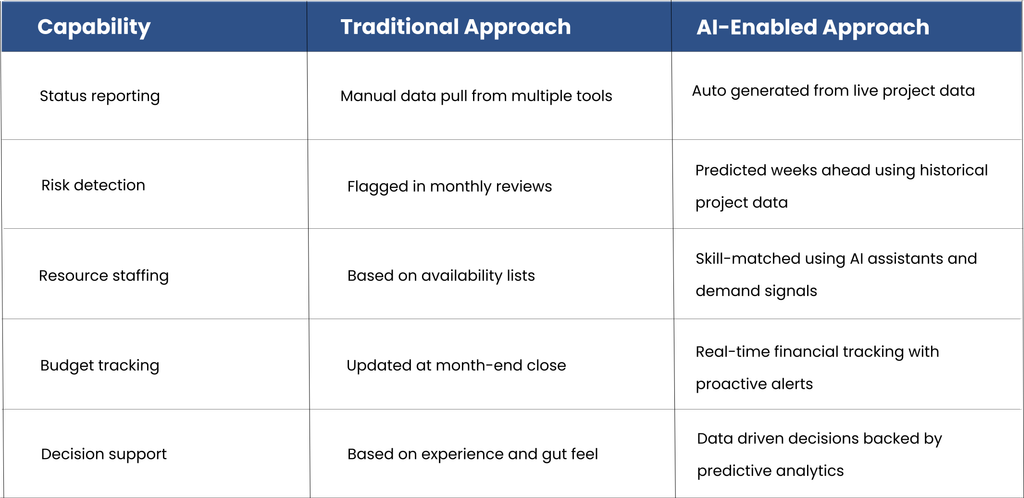
The change is obvious. The AI does not take the place of a project manager. It just kicks out the cheap jobs, so the PM concentrates on clients, teams, and decisions. Gartner’s Research Vice President Daniel Stang said that “AI will revolutionize how program and portfolio management leaders leverage technology.” Gartner expects to see 80% of the jobs done in project management today vanishing by 2030.
How Does AI Improve Resource Allocation and Staffing?
Resource allocation is the most powerful lever for project success in service firms. According to the SPI Research 2026 Benchmark, the billable use for 509 firms was at its lowest point in 19 years at 66.4%. The best firms had 79.5%. That is a 13-point gap that costs millions of dollars in lost revenue each year.
AI comes in to save the day by doing it three different ways, first by seeing which skills might be most useful for your project within seconds. Traditional staffing takes days and often overlooks individual employees in the wider organization who aren’t being utilized.
It models your sales pipeline, existing schedules, and historical staffing. It identifies shortages ahead of delays.
When a team member falls two weeks in a row below target hours, AI immediately notifies their resource lead. No report required.
Kytes, an AI-driven PSA and PPM platform for project-led firms, delivers this through its resource management engine. One IT services client saw 14% higher utilisation and 21% faster delivery cycles within the first quarter. Their delivery head shared: “We stopped guessing on staffing. Kytes showed us who was available, who was the right fit, and when demand would spike — all before we asked.” (See results.)
Can AI Predict Project Risks Before They Escalate?
Yes, and this is where AI really makes the difference. Existing approaches to risk management are review-based on a monthly cycle. The project manager populates a risk register, assigns ratings, and reports on the results at a session. By then, the risk has often become a problem.
AI comes in. It monitors the project’s live feeds – burn rates, milestones, team movement, scope shifts – and catches issues quickly. As soon as the burn rate hits 40%, at 25% completion, the AI notifies the project manager, project management officer and finance manager immediately.
According to Standish Group CHAOS data, just 31% of IT projects are completed on time, within budget and within scope. Nineteen percent are a failure. And the remaining 50 percent are late, over-budget and reduced in scope. Early risk detection allows teams to take control – not react too late.
Kytes integrates this into its risk management module and its AI engine. It rates risk and ties risks to milestones, and proactively alert. EPC companies achieved 60% better budget accuracy and 40% less variance from schedule.
How Are Firms Using Professional Services Project Management Automation?
Accounting for professional services project management automation is one that rolls up every stage of the project from bid to invoice. A single solution replaces separate estimating, staffing, tracking, and billing tools by integrating it all into a single flow.
Here’s how that works. A consulting firm receives a new client opportunity. The system references prior project information to arrive at an estimate. It searches the staffing database for the appropriate skill set and proposes a team. When the project is underway, timesheets automatically update financials. Billing is automatically triggered at the milestone.
PSA software industry size was $15.21 billion in 2026, with a 13.1% CAGR to $24.87 billion in 2030. Professional services project management automation firms attain 19% higher gross margin than those working on spreadsheets, according to the same report.
This is even more important for the pharma and CDMO industries. The complexity of compliance requirements, stage-gate approvals and regulatory timelines are simply too much for off-the-shelf solutions. Kytes is designed for these verticals, with integrated workflows that link project tracking, dossier management and audit trails. A CDMO customer saw 45% faster product launches and 50% fewer regulatory hold-ups.
Frequently Asked Questions