Blog Highlights
- Connect engineering releases, supplier commitments, validation and launch milestones in one program view.
- Assess readiness through approved evidence, dependencies and accountable owners.
- Check shared engineering and testing capacity before promising delivery dates.
- Link schedule changes with forecast costs and portfolio priorities.
- Evaluate software using a real program scenario, including ERP and PLM handoffs.
Introduction
The launch date remains the same. The tooling date is shifted. Your dashboard is still green.
That single gap can quickly become a missed prototype build, expedited testing and an unpleasant customer meeting. For each program there’s a schedule. But there’s no process that bridges the gap between function and business decisions.
Pressure over an Indian supplier for a US customer pressures across time zones. Engineering needs an approved revision. Procurement needs a firm commitment from a supplier. Finance needs the cost of recovery. Each answer impacts the other.
Your automotive project management software must make those links visible to executives while they still have a choice. Our guide outlines what to look for, how to assess, and where Kytes can facilitate connected execution.
What Is Automotive Project Management Software?
Automotive project management software. Schedule, ownership, supplier deliveries, engineering progress, costs and approvals for all vehicle or component programs. It enables teams to link development tasks to launch activities and see how a change can impact downstream processes.
For the program director, that means questions left unasked at the review table. For the CFO, it means knowing what the recovery will cost before CFOs sign them off. For the engineering leader, it means knowing whether one seemingly inconsequential change will cause a ripple through what has already been committed to suppliers. That’s where the value lies-to make the next step clearer.
Its function is more than task management. An effective system is one in which a tooling delay is associated with the build it jeopardizes, with the specialist required to recover it, and with the decision waiting for approval.
It also needs boundaries. Engineering requirements go in rigorous technical systems. Financial transactions go in authorized business systems. The platform – which means responsibilities, timing and results around them – hangs between.
Why Do Automotive Projects Need Structured Oversight?
Automotive projects require an organized management effort: various teams have to fulfill cohesive needs for a program to progress. The delivery of one activity does not necessarily qualify the next activity to begin.
Imagine the cleaning of a modified mount bracket. You may finish the drawing in engineering, but procurement will still want supplier confirmation. Tooling may need a change. Validation will need to determine which tests to re-run.
A status label does not tell that chain. Defined gates, evidence requirements and escalation rules do.
Advance Product Quality Planning or APQP, according to AIAG, is an automotive project management approach that ensures a project is moved from concept to launch. The right software will facilitate the planning and approval process that exists within your company, but it cannot grant compliance.
What Does the Automotive Development Lifecycle Look Like, From Concept to Launch?
The lifecycle progresses through feasibility, engineering, validation, industrialization and launch. Activities often overlap, so teams must manage dependencies alongside formal reviews.
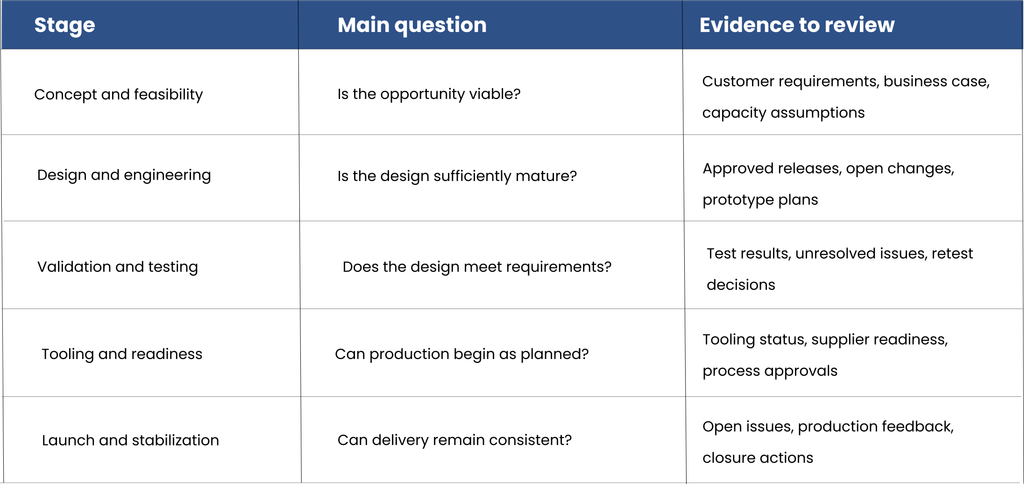
Touch all the reviews with owner, acceptance rule and decision date. When there is an incomplete gate, an exception should be visible instead of getting down behind a progress percentage.
Start of Production – SOP is the primary goal to be monitored alongside these reviews. Reverse engineer from that goal, but don’t assume that every target date is equally significant. Define the approvals, physical parts and validated processes that truly limit readiness. When work advances prior to a gate closing, record the exception, the customer and the impact of the expedient solution.
Use this layout. The exact hardware/software deliverables are determined by the program, the customer needs and the quality processes.
What Warning Signs Show Your Automotive Project Management Process Needs Improvement?
The clearest warning is a growing gap between reported progress and verified readiness. Teams spend increasing effort explaining yesterday’s position while emerging risks remain unclear.
Look for these patterns:
- Engineering and procurement report different milestone dates.
- Supplier updates stay in email until the program review.
- Testing starts without confirmed samples or approved specifications.
- Several programs reserve the same specialist for the same week.
- Purchase commitments appear after leaders approve a forecast.
- Gate approvals lack clear evidence or named accountability.
Choose one recurring problem and trace its information path. Where did the update originate? Who needed it? What decision waited? This identifies the workflow to fix before selecting software.
Which Key Capabilities Should Automotive Project Management Software Provide?
The strongest capabilities connect an operational change with its schedule, capacity, approval and financial consequences. Evaluate that connection through the six areas below.
How Should Project Planning and Dependency Tracking Work?
Schedules must link the deliverables with believable dependencies, milestones and accountable owners. Teams require an established baseline for comparison and an up-to-date forecast that includes approved changes.
A Gantt chart is helpful if it reveals the reasons for a change of date. It is less useful when managers overwrite it several times without preserving the explanation.
Have the system tell you which of the later tasks are contingent on a late prototype. Then verify that it separates a schedule contingency available from a real launch threat.
Employ hybrid planning in that way: engineering detail work may be placed onto shorter cycles. Program gates could be kept as formal approval points.
How Should Supplier and Tooling Coordination Work?
Supplier commitments should connect directly to the program activities they support. Track promised dates, evidence received, acceptance status and recovery ownership separately.
For tooling, distinguish manufacture, dispatch, receipt, trials and acceptance. Calling all five steps “tool complete” hides important differences.
An illustrative scenario: a supplier postpones a fixture delivery. The program team should see the affected trial, review another slot and assign an owner to confirm revised readiness.
Give external partners access only to the information they need. Procurement and quality teams should retain control over commercial terms and acceptance decisions.
How Should Budget and Cost Management Work?
Project budget management should connect approved funding, committed spend, actual costs and remaining work. An apparently healthy actuals report can hide purchase obligations and expensive recovery activities.
Review four figures together: baseline budget, actual spend, open commitments and forecast cost at completion. Define how commitments become actuals so the forecast avoids double counting.
For example, an additional validation cycle can change engineering effort, external testing charges and freight costs. Record the estimate and approval before the costs arrive.
Explore Kytes’ project budget management guide for related financial controls. Apply them using your organization’s costing rules and program structure.
How Should Resource and Capacity Planning Work?
Resource management should show that the timemanagement project schedules are based on the availability of the people and facilities that support them. The unscheduled task dates are not sufficient to make a realistic schedule.
Check skills, current allocations, leave, calendars and planned effort. Review test benches and lab slots as a separate entry where there constraints impact on delivery.
For India and US teams, local holidays and working hours are relevant. An approval request made on a Friday can result in a queue waiting for the following working day.
Compare options with allocation views don’t reconcentrate specialists. Cover one hole and put yourself in the position of suddenly causing a bigger hole.
How Should Document Control and Approval Workflows Work?
Document control should keep decisions linked to the correct revision, owner and approval record. An attachment marked “latest” is insufficient when several versions circulate.
Keep authoritative drawings and specifications in the appropriate controlled repository. Link the project activity to that record and its approved status.
Define what happens when evidence changes after approval. Does the gate reopen? Who assesses the impact? Which teams receive the update?
Traceability supports reviews, but the quality team must still determine whether evidence meets applicable requirements. A completed checkbox cannot substitute for technical acceptance.
How Should Collaboration and Reporting Work?
Collaboration should preserve the context of decisions. Discussions, risks and actions need links to the relevant deliverable rather than another disconnected message thread.
A leadership dashboard should answer: What changed? What is exposed? Who owns recovery? When is a decision required?
Show update timestamps and overdue actions. A polished report based on stale information can create false confidence.
For engineering effort, connect approved time entries with program activities. Kytes’ timesheet management article explains why recording hours becomes more useful when connected to delivery and financial workflows.
How Do You Manage Multiple Automotive Programs Without Overcommitting?
Portfolio Manage demand, strategic priority, launch exposure, and shared constraints by comparing across programs. Multiple schedules may hide conflicts that are seen when schedules are combined.
Check the business case, the engineering demand, the tooling needs and potential testing windows before evaluating another programme. Don’t overlook existing work by laying change programmes next to new developments.
What if the same validation specialist is required for two vehicle programs Leadership needs to compare the ramifications of to sequencing work, ramping qualified support, or changing scope.
Record the tradeoff and share it with owners impacted. For priority changes, create new commitments not changed color on an executive slide.
How Should Project Management Integrate with ERP and PLM?
Integration should exchange defined information between systems while preserving ownership. The goal is reliable coordination across engineering, operations and finance.
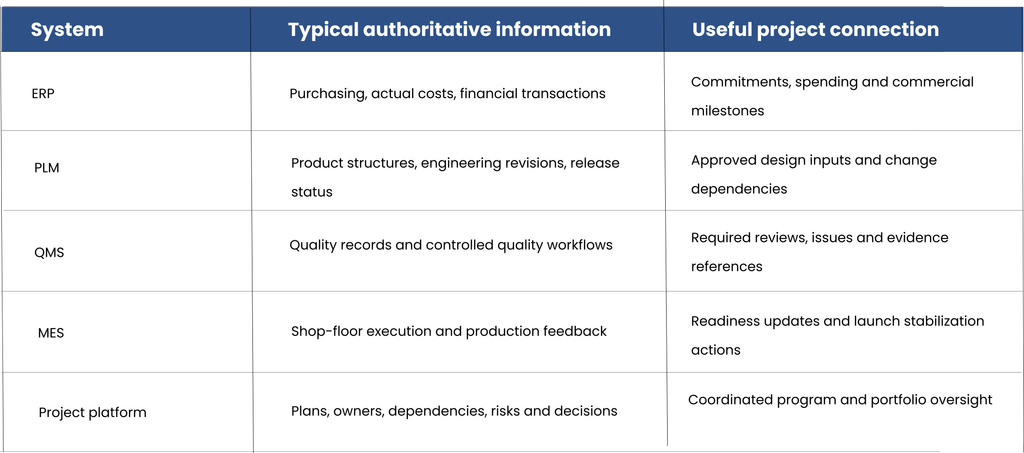
Agree identifiers, synchronization frequency, permissions and exception handling before implementation. Test a failed interface as carefully as a successful transfer.
Do not assume that a vendor’s “integration available” statement means your specific system, version and workflow are included.
How Do You Choose Automotive Project Management Software?
Choose software by testing whether it improves a real decision across functions. A scripted demonstration should follow one representative program from a changed input to an approved response.
Use five selection checks:
- Dependencies: Can it show the effect of a delayed supplier milestone on testing and launch?
- Capacity: Can it expose conflicting assignments across programs and locations?
- Financial visibility: Can it distinguish actual costs, commitments and forecast changes?
- Governance: Can it enforce evidence, ownership, permissions and approval rules?
- Implementation fit: Can your teams maintain it, integrate it and use it consistently?
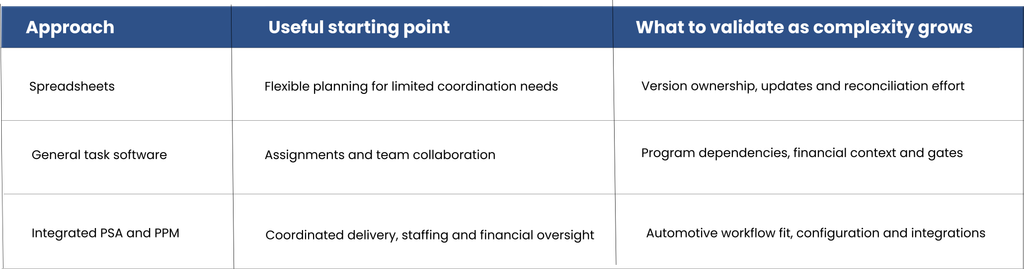
These categories describe evaluation considerations, not universal limitations. Compare specific products and deployment requirements.
Build the demonstration around an exception, not only the expected sequence. Move a tooling date, introduce an engineering revision and remove an approver for a working day. Watch how the platform handles each event. Can users understand the impact without exporting several reports? Can they distinguish a recommendation from an approved action? Ask the future users to perform the update themselves. Their experience often reveals adoption problems that a polished presentation misses.
For a pilot, select one program and establish a baseline. Measure approval turnaround, overdue critical milestones, forecast variance and time spent preparing reviews. Agree success criteria before rollout.
Review pilot results with the same definitions used at the start. Approval turnaround should measure elapsed working time between a complete submission and a recorded decision. Forecast variance should compare the approved forecast with the eventual outcome using consistent cost categories. For milestones, distinguish an agreed rebaseline from an unexplained slip. Add a short user review: did the system reduce chasing, or simply move the chasing elsewhere? These checks make the business case more credible and help teams decide what to simplify before expanding to additional programs, plants or delivery locations globally.
For cross-border buyers, include implementation support, access controls, hosting requirements, currencies and local calendars in the evaluation. Validate these against actual operating needs.
How Does Kytes Support Automotive Project Management?
Kytes is an AI-enabled Professional Services Automation and Project Portfolio Management platform connecting delivery, people and financials. For automotive teams, the relevant question is how those capabilities fit their program workflows.
Kytes’ published project planning capabilities include work breakdown structures, Gantt views, multiple delivery methods, issue tracking, approvals and portfolio analytics. Its AI can help generate planning artifacts for human review.
Its resource management capabilities include skills matching, allocation views, demand forecasting and availability planning. Evaluate these against your engineering staffing scenarios; confirm any equipment scheduling requirements separately.
For project budget management, Kytes publishes planned versus actual tracking, cost allocation, budget controls and ERP integration. Its project financials capabilities help teams connect execution reviews with financial information.
During discovery, involve program leadership, engineering, procurement, finance, quality and IT. Each function should bring one current handoff that causes rework or delay. Translate those examples into acceptance criteria and assign an internal process owner. This gives the implementation team a concrete basis for configuration, training and rollout decisions. It also helps leadership assess whether the proposed scope addresses the original problem rather than adding another reporting layer.
Ask Kytes to demonstrate your gates, supplier handoffs and system interfaces. Confirm PLM and automotive quality requirements during discovery rather than assuming native coverage. The strongest fit is established through a working scenario and agreed implementation scope.
Conclusion: Connect Every Stage of Automotive Delivery
A launch becomes more predictable when teams can see what a change means before it reaches the next handoff.
Project Management Software for the Automotive Industry earns its place by connecting commitments with evidence, capacity and financial consequences. Start with the visibility gap that repeatedly slows your programs. Test it, measure the improvement and expand from there.
Request a Kytes demo using one real program scenario. Bring the dependency that concerns you most and ask to follow its impact from concept to launch.
Frequently Asked Questions