Blog Highlights
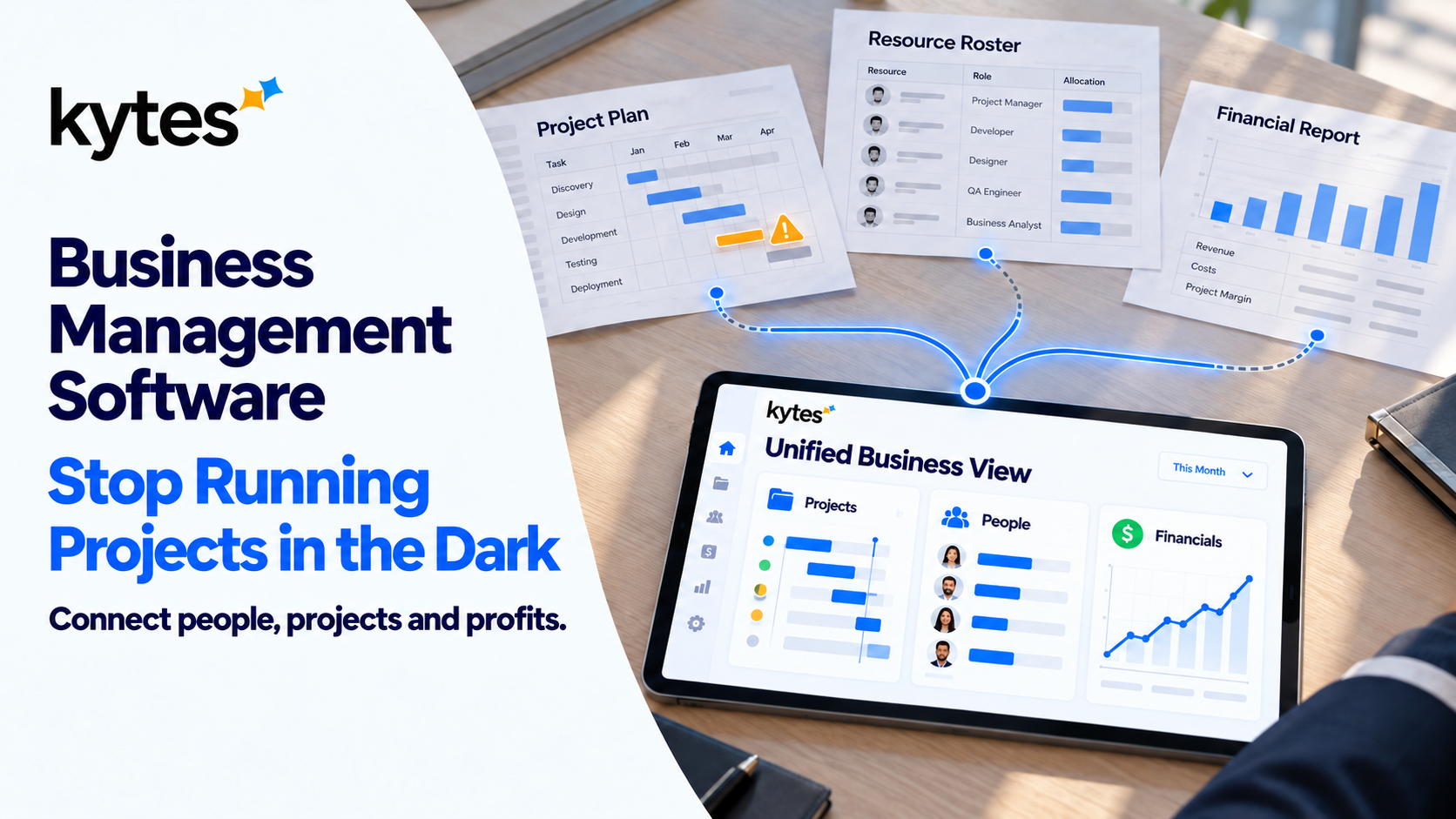
- Connect projects, resources, and financials in one platform for consistent, real-time visibility.
- Match people to projects based on skills and availability to reduce resource conflicts.
- Track project costs, revenue, billing, and margins to identify financial risks early.
- Use AI to flag potential delays, support staffing decisions, and retrieve knowledge from past projects.
- Choose business management software based on industry needs, integrations, scalability, and measurable outcomes.
Picture this. It is Monday morning. Your delivery head is on a client call, promising a go-live date. Your resource lead is in a different meeting, telling HR that the bench is too high. Your CFO is staring at a sheet that says the same project is both on budget and bleeding cash — depending on which tab he reads. Three leaders. Three versions of reality. One firm.
This is not a broken team. This is a broken system. And it is far more common than most leaders want to admit. A unified management platform exists to fix exactly this — to give every leader in your firm the same set of facts, in real time, from one single platform that links people, projects, and money.
Yet the SPI Research 2026 Benchmark (certinia.com) tells a harsh story. Across 509 firms, billable use fell to 66.4% — the lowest in 19 years. That means one-third of your talent sits idle or works on tasks that will never show up on an invoice. At the same time, Gartner’s April 2026 forecast (saastr.com) puts global software spend at $1.44 trillion, up 15.1% year over year. Firms are buying more tools than ever. They are just not buying clarity.
The problem is not the tech. It is the gap between the tools.
In short:The only project management platform that links project delivery, staffing, financials, and collaboration in a single system-so all leaders have access to the same data, anytime. For project-driven IT services, pharma, EPC, and CDMO organizations, it replaces software silos that drive margin leakage and delays.
Why Do Most Firms Outgrow Their Tools Before Their Market?
This is a pattern you’ll probably see within your own company. It begins with a sheet. Then finance needs a project tracker. Then sales needs a CRM. Then the PMO creates staffing plans in still another system. Five years later, eight tools and no visibility down the line.
The project lead sees the work. The CFO sees the expenses. The resource lead sees the names. But no-one – not a soul in the entire firm – can look at a single screen and say: this is the right way to complete this project and hit the margin goal.
Imagine the impact. Your delivery head agrees to an estimated completion date – but has no idea if all key resource is available. Your resource lead allocates a resource – but has no idea how much the project is costing. Your CFO detects a margin error – two months after it happened – because no one knew about it.
The Standish Group’s CHAOS data (pmstudycircle.com). Just 31% of IT projects are completed on time, on budget, and within scope. Twenty percent are not completed at all. And 50% are completed late, over budget, and/or with less than the desired features and functions.
It’s not bad people. The root cause is undisclosed data. Your leaders are making decisions every day with half the facts, because the other half is locked away in a system they don’t have time to open.
What Should a Unified Platform Actually Do?
Where do most companies go wrong? They get duped into purchasing a task tracker that simply adds a billing tab and labels itself a platform. Or they spend big dollars on an ERP system that clumsily inserts a project view, and assume it will somehow handle delivery flawlessly. Six months later: Same problems, only in a more high-tech wrapper.
And here’s the thing: a real system is better. It links the work. If a milestone falls out, the forecast changes by itself. If someone goes on vacation, the staffing plan updates by itself. If a client signs a change order, the revenue line updates by itself.
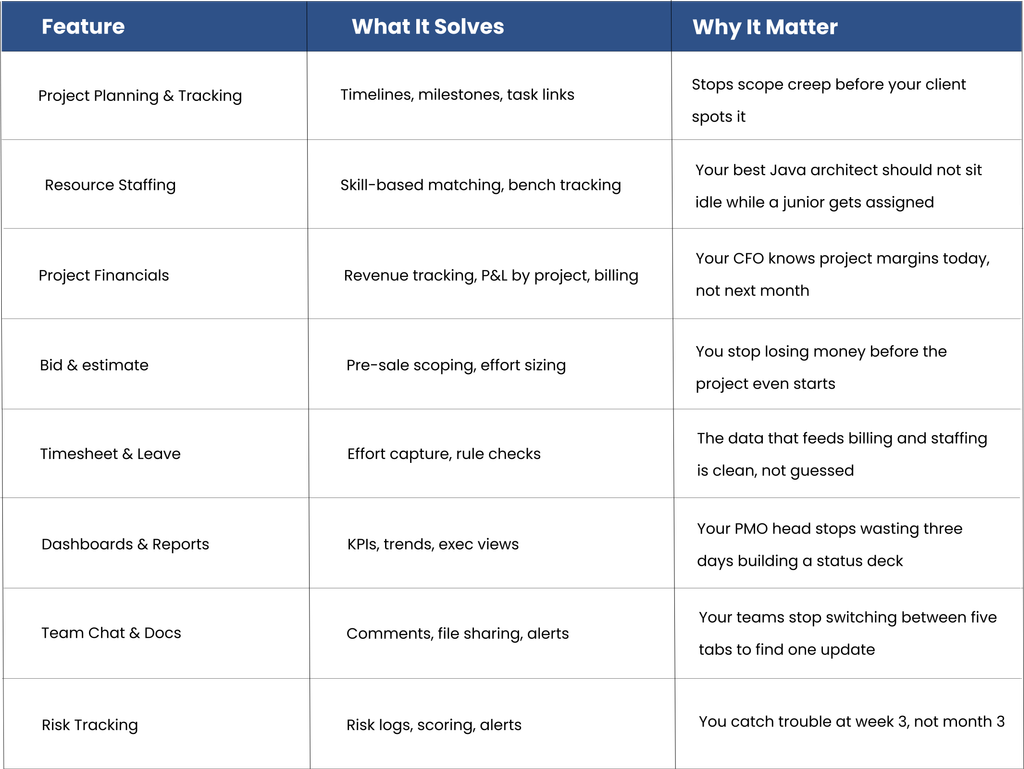
Core Feature Matrix
How Should You Pick the Right Platform for Your Firm?
Forget the feature checklist. Every vendor will tick every box. The real question is fit — with your sector, your project mix, and the specific way your firm loses money.
Start with your blind spots- Ever run into surprises? If your CFO detects quarter-end margin leaks, you require project financial management application that reveals live project P&L – not a billing tracker that adds up hours. Fact of the matter: If your delivery managers determine schedules without sight into staffing, you require project plan within skill-based matching, not a hidden sheet.
Test it against your hardest project– Do you ever see how each product performs during a demo with three projects and five users? However, the true test is whether it performs with 200 projects, 1,500 team members in three time zones, and a new client scope every two weeks. Will it work then? Top firms have an average 79.5% of their people on billable work versus 69.9% on average as reported by SPI Research (diabsolut.com). That 10-point differential results in hundreds of thousands of dollars in revenue, and professional services automation software is the critical component in closing the gap.
Check for sector depth– Are you on pharma, EPC, or CDMO projects? Then you know generic tools easily break apart. You require FDA compliant audit trails, milestone billing associated with project gates, and go/kill stage gates that do much more than mere checkbox. The thing is: a weak interface layer won’t survive your first audit.
Ask about AI — but ask the right question-According to SPI Research 2026 (certinia.com), between 26% and 38% of projects use AI now, and 40% of companies sell AI. However, the key question is not “Does your tool have AI?” It’s “Does the AI let you know about a risk before you saw it, or does it just make a text wall of the info you already knew?”
Ask what happens at month six-Have you ever noticed that most vendors disappear after go-live? But the truth is that by month 6 your team is ready for a new dashboard. By month 9 you’ve decided you need to add a new line of business. Who’s going to do it? How fast can they? And for what cost?
Most vendors go quiet after go-live. But month six is when your team wants a new dashboard. Month nine is when a new business unit needs to be added. Ask the vendor: who builds that? How fast? At what cost?
How Are Service Firms Closing the Visibility Gap?
Running a service company and feeling the squeeze? No, you’re not selling a product sitting on a shelf. You’re selling hours. And every hour you spend on a poor assignment, invoiced late or not at all, is money lost forever.
Your quality talent is most likely to be misaligned because its in high demand. If you’re lacking a skills needs match system, your best workers find themselves allocated not to the project where they’re most valuable but to the one that screams loudest.
So, why has PSA software gone from being ‘nice to have’ to ‘must have’? Numbers! Researchandmarkets.com states the PSA software industry will reach $15.21 billion by 2026 and will be growing at a CAGR of 13.1% up to $24.87 billion in 2030. Furthermore, did you know firms that utilize PSA tools have gross margins 19% higher than firms that use spreadsheets?
So what is the difference between the top 20% and everyone else? They’re not measuring hours. No, they’re linking staffing to project P&L, client margins and sales pipeline. So when staffing adjusts, project P&L is instant, and a bench report is passed to the bid team to identify who to price into the next deal.

Ever wondered how big changes happen? They’re not from getting a better sheet. They’re from a platform that combines bid work, delivery, staffing and project financial management software into one continuous flow, from pre-sale to invoice.
Now pharma. Think about a global CRAMS company integrating drug sourcing, regulatory compliance management, and project work into one platform. What do you think? They introduced products 45% faster and cut regulatory delays by half. Then, in EPC, one customer improved budget accuracy by 60% when the milestone billing was aligned to live project info.
Frequently Asked Questions