

Blog Highlights
- By automating the process of capturing, approving, distributing and reconciling project expenses, companies can achieve greater precision and efficiencies.
- Incorrectly distributed project costs, late payments to suppliers and subcontractors, un-invoiced expenditure and disparate finance platforms all erode company profits.
- Being able to track project expenditure as it occurs allows companies to manage their budget, limit spend and flag any issues prior to affecting overall project P&L.
- Automatic identification of billable vs non-billable items prevents lost income, increases the speed and reliability of billing, and allows more accurate project cost capture.
- Using AI to flag fraudulent or erroneous expenditure, ensure compliance and optimize the time taken to process and approve expenditure can significantly reduce time spent on finance activities.
- Combining these technologies with existing project and corporate accounting, ERPs and foreign currencies will deliver further improvements to project and corporate financials.
Expense management software enables companies to record, sign-off and distribute their spend. In project-based organizations, a good solution will allow them to associate each spend with the relevant project, stage and cost bucket immediately. This allows spend to feed into margin calculations proactively, rather than retrospectively.
A Finance Director overseeing ~350 employees for an IT company based in Bangalore came across this gap while reviewing their QTR. They were hitting target delivery, had happy customers and a utilization rate of 72%. However, once they compared the cost of these projects to the billings, there was a material gap. Spend such as employee travel was being charged to general overhead rather than to individual customer projects. Vendor payments were taken 2+ months lag from the period incurred. And software spend was distributed across multiple unrelated project cost buckets. As a result, the company was undercharging its customers by c.4.2% of total project billings. None of this was down to malpractice – the spend and project management functions simply didn’t talk to each other.
It is therefore no surprise that expense management software tailored to the needs of project-based businesses has emerged to address this. Clearly there is a need to enable frictionless capture and routing of spend, but as we move towards 2027, the key differentiator is the ability to map all spend to the corresponding project, stage, team member(s) and budget. And crucially, for the Project Manager and Finance person to be able to view identical and contemporaneous profitability metrics.
According to Technavio, the global expense management software market will reach >$7.5bn in 2029, driven primarily (>40%) by demand in North America. This trend points towards greater adoption of PMFS to manage spend as a concurrent element of project decision making.
What Do Expense Platforms Actually Do in 2027?
Expense management solutions allow organizations to manage the entire lifecycle of an employee’s spend: capturing, reviewing, assigning and reporting their expenses. These can range from staff daily expenditure to purchasing and third-party (contractor) bills and SaaS subscriptions. In its most rudimentary form, these systems will simply remove the need for Excel and email. Employees log expenses via an app, senior team review and sign off based on pre-set guidelines, and finance can issue payments and maintain a record of activity.
By 2027, the minimum expected functionality will be significantly greater than simply processing and checking expenses. If you are delivering a series of client engagements, your system should enable you to link each individual expenditure to the relevant project(s), stage of the engagement, and determine if the spend will be recovered or impact the overall profitability of the deal.
According to SPI’s 2026 benchmark, the mean EBITDA achieved by the 509 service companies was only 9.9%, while billable hours per employee reached their lowest point over the last 19 years (66.4%). As such, misallocated spend, un-invoiced staff time, delayed payments etc. will compound month-on-month, further eroding profits.
Why Do Project-Driven Firms Need a Different Approach to Expenses?
SaaS companies will typically allocate their spend by team and budget. An organization with a portfolio of projects (IT, Pharma, EPC, Professional Services etc.) needs to allocate spend to each opportunity, workstream and agreement. Fundamentally these are dissimilar. Off-the-shelf solutions won’t cut it.
Every expense carries a project context-Booking a flight to Chennai to attend a meeting is not simply an ‘expense’ line. It should be attributed to a particular project, stage, and ultimately charged back to the customer in accordance with their agreed T&M pricing. If this is captured as an overall company-level ‘Travel’ cost, it will inflate the reported profitability of the project and potentially not be recoverable from the customer.
Expenses affect live project margins-Cost management has been identified year-on-year in the PMI Pulse of the Profession report as one of the key factors contributing to successful project delivery. Should a PM need to source additional capacity to plug a shortfall, that spend should flow through to the project within the same business day. Allowing Finance to capture this ~45 days down the line will almost certainly result in ‘false’ positive project P&Ls that erode significantly once the quarterly results are finalized.
Billable versus non-billable must be decided at the point of capture-If your company recovers spend from customers, determining if an individual cost can or cannot be charged will impact its ability to contribute to the bottom line. Doing this as part of your month-end process means you could miss the opportunity to invoice the relevant period entirely.
Between 4-5% of revenues are currently ‘leaking’ from service businesses (Certinia, 2026). At a $50m run-rate, that equates to $2-$2.5m of reduced profit. This will largely be due to spend being recorded after the fact, allocated incorrectly or omitted from any customer chargeback.
Where Do the Biggest Expense Leaks Hide?
There are 5 leaks responsible for the bulk of these losses. They all stem from the fact that costs are recorded in a different system to where the work (projects) is undertaken.
Leak 1: Travel, Procurement etc. in Overhead
As set out above, if you have 2 discrete systems, your team will record their cost and project activity separately. Consequently, no cost is attributed to individual projects, such that the full amount falls to company-wide costs. As a result, the reported profit on the project(s) will be higher than actual, and the client will not be invoiced.
Leak 2: Contractor Payments Received with Lag
Invoices received from contractors many weeks after the relevant period. A contractor may complete ~3 weeks’ worth of activity against a given project, only for the corresponding invoice to be raised and recognized by Finance ~30 days afterwards. During this period, the PM will have taken forward plans based on an apparent project cost that excludes this $45k+ of contractor spend.
Leak 3: Licenses Spread by FTE vs Actual Demand
Licenses distributed by average number of FTE per project. If a $120k p.a. software package is averaged over 10 projects, then 3 of those projects (accounting for ~80% of total demand) will appear to have materially lower associated costs.
Leak 4: Client site expenses lodged post-billing period
Client-related expenses raised outside the applicable billing period. An Engineer may return from a client engagement and raise a bill for $3,200, 3 weeks after leaving site. It is unlikely the relevant client invoice will be re-issued, and given the terms of engagement, the organization will carry this cost.
Leak 5: Foreign currency and tax issues
Where businesses transact in multiple jurisdictions e.g. India and USA, there can be significant “tear-out” between the cost base and any corresponding revenue due to FX and various levels of taxation (including GST, State taxes, inter-company charges). Finance departments will routinely find themselves performing a task that should be automated within the financial system.
What Should You Look for in an Expense Platform?
It will depend on whether you charge by project or not. If you do, there are 6 key differentiators between good solutions and run-of-the-mill ones.
Project-level cost allocation-All project-related spend should be categorized at the time of expense submission. You don’t want to rely on a back-office process at the end of each month to reconcile these. Ideally, all projects spend should be identifiable at project level from the moment it’s incurred.
Budget visibility upon approval-Upon an expense being signed off, the associated project budget should automatically decrease. Your Project Manager should therefore know immediately that e.g. $4,800 has been deducted due to a supplier payment being accepted.
Flagging billable vs non-billable at time of entry-Whether this is done by the person submitting the expense or the approver, it needs to occur prior to any downstream processes. Again, subject to certain business logic around customer contracts, this avoids billable expenditure ‘falling through the cracks’ and not being charged to the customer.
Support for multiple currencies and legal entities-If your organization operates in both India and the US, you’ll need to accommodate multiple currencies (and their respective exchange rates), taxes such as GST, and aggregation of figures across entities.
Use of AI to apply expense policy-Through AI, submitted expenses can be tested against the organization’s policies, identify duplicates and anomalies, etc. This enables companies to move beyond manual checks and build self-service capabilities for project costing.
Connectivity to ERP, HRMS, Billing-Finally, data should seamlessly transfer from the project expense tool to the wider finance stack (e.g. SAP, Oracle, NetSuite, Tally, QB etc.) and billing system to ensure consistency.
How Does Project Expense Tracking Change Financial Visibility?
Once you implement project expense tracking, there are 3 immediate impacts:
Your team will focus more closely on project margins-Because costs will be monitored continuously at the individual project level, the PM will see their project’s current margin each time a cost enters the system. Rather than having to wait 45+ days (after month end) to receive this information via Finance, they will be alerted immediately if e.g. their margin slides from 32% to 26%. They will then take action to remediate.
You will be able to bill the appropriate costs to the relevant client-As costs enter the system and are attributed to the specific project, they can be marked up and added to the subsequent invoice raised to the customer. There will be less requirement for the Billing team to seek information from the PM about what to include, and the Client will have no grounds to query the invoice received.
The ability to analyze cost data across the wider portfolio opens up-Provided that all projects are recorded within the same platform with consistent categorization, the CFO will be able to interrogate how each project category incurs expense. E.g. identify the highest spend per project type on Travel, Contractors, etc., or flag areas of non-compliance. At this stage, Project Expense Tracking delivers true value beyond ensuring that Policy has been met.
Generic Expense Tool vs Project-Connected Platform: What Changes?
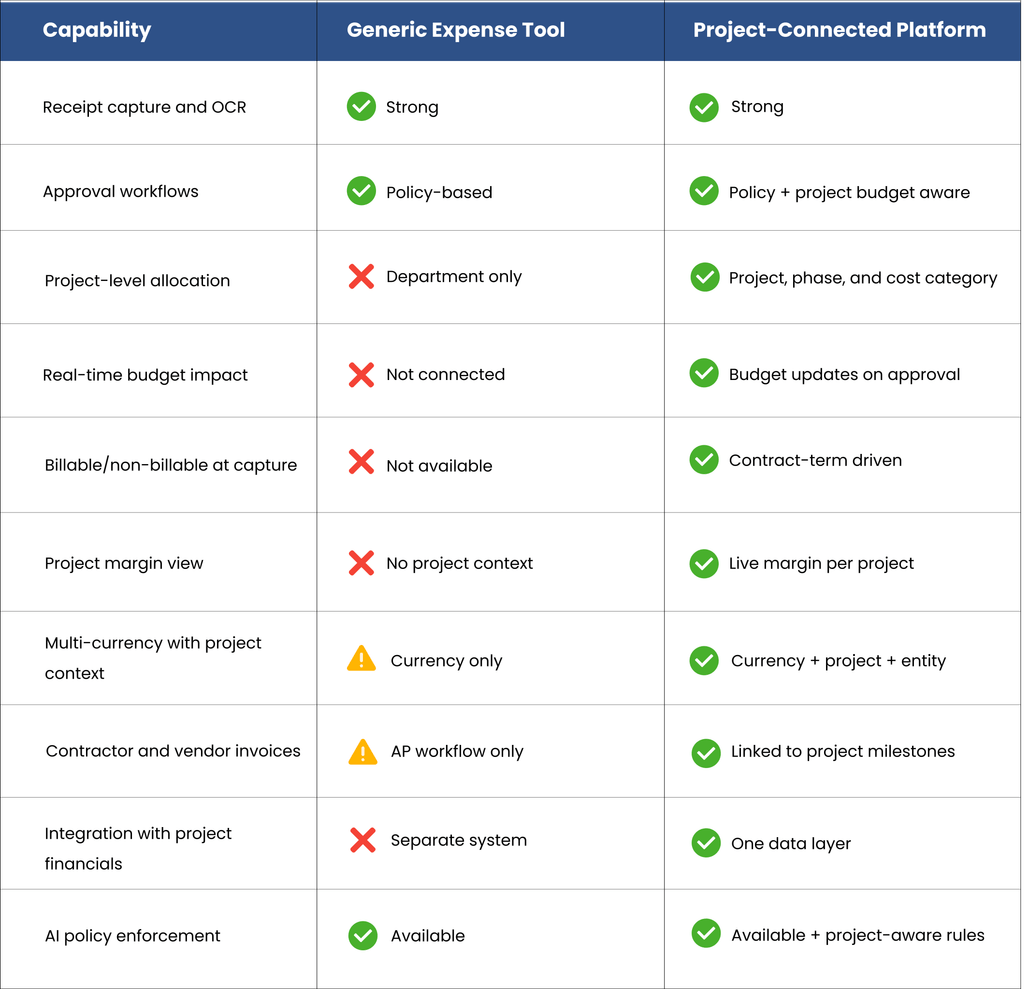
Margo Visitacion, Forrester’s VP and Principal Analyst, suggests that today, companies who operate task-and-project driven businesses should be asking themselves: “Are we investing in the correct activities to drive our desired results?”. Of course, the parallel for expenses is obvious. Without project-level visibility of those costs, the answer cannot be determined.
Of course, if a company is billing and managing <10 projects and their billing requirements are straightforward, they may find that an off-the-shelf solution meets their needs. However, once they scale to 30-200 live projects (globally), working to various commercial models (T&M, FFP, Milestones), linking back to the associated Project becomes essential.
How Should You Evaluate Project Financial Management Software?
Once you’ve established these 5 criteria, you’ll be in a good position to begin short-listing suitable platforms for your business.
Question 1: Is the platform able to book expenses directly to a specific Project?
Should you only assign expenses to Projects as part of the monthly P&L close, then all Project profits reported from the time of booking until the end-of-month will be incorrect. You can easily make material errors if acting on these figures.
Question 2: Will the Project Manager know how an additional cost affects their available budget and profit?
The PM needs to understand the implications on the outstanding Project balance and profit as soon as they sign off the cost. If this information is only available via a downstream Finance-led process, then the PM will not have full visibility of their Project.
Question 3: Is there an automated mechanism to convert these to a Bill to Customer?
You want the system to take signed-off billable costs and prepare them for the relevant customer. Should your Billing function still need to seek out e.g. a flight ticket booked 3+ weeks prior, you will continue to lose revenue.
Question 4: How well does the solution interface with your existing back-office systems?
If you use a major ERP (SAP, Oracle, NetSuite, Tally etc.), you need the project management system to pass through costs to the GL automatically. Having to re-key these will inevitably lead to error.
Question 5: What about multiple currencies and entities?
With delivery occurring across e.g. India and the USA, you’ll need a system capable of converting between INR and USD, applying GST and US taxation requirements and aggregating the financials appropriately. Any element requiring user intervention here defeats the purpose of introducing the system.
Where Does Kytes Fit in This Picture?
Kytes is an AI-powered PSA/PPM solution designed for project-centric businesses. This includes but is not limited to IT & Engineering Services, Pharma, EPC and GCC. It sits within the deal-to-cash process, enabling companies to track all project costs from the point they are raised.
Project expenses from the get-go-All costs captured through Kytes will be associated with a (sub-)project, stage and cost code. Upon submission of a staff traveler’s expenses or receipt of a vendor payment, the relevant project budget, profitability and billings position can be monitored by both Project Manager and Finance.
Streamlined billable expense processing-At point of entry, Kytes identifies whether each cost should be billed or not, using pre-defined criteria (e.g. contractual provisions). These can then be readily actioned for customer invoicing, eliminating the need for follow-up and improving the quality of billings issued.
Reduced risk via Kytes’ AI-Policy breaches, double-entry and aberrant behavior can all be detected by the Kytes AI prior to any cost being paid out, freeing up time for Finance and minimizing loss.
Allocate resources with visibility of cost-A key use case of Kytes is the ability to assign a person to a project while seeing their cost, effect on margin and budget position. In addition, the natural skill set and availability of the person can also be assessed. Engineering Services customers have seen 14% uplift in people utilization and 21% reduction in project durations over the first 3 months.
Compatible with your existing systems-Whether you operate on SAP, Oracle, NetSuite, Tally or Workday, Kytes allows you to continue feeding data into your GL and maintain consistent project-level budgets. One of our large Japanese E&E clients operating in India moved from maintaining budgets in Excel to viewing these in SAP through Kytes. One Director of Delivery for a major provider of IoT and Embedded Engineering commented: “Kytes is effectively our central nervous system for all our projects”.
Support multiple currencies and legal entities-If your business delivers in both India and the US (and elsewhere), Kytes allows you to transact in local currency (INR, USD etc.), apply appropriate FX rates, GST and consolidate figures across your group. No more end-of-month reconciliations!
Frequently Asked Questions