Blog Highlights
- From Automation to Assistance: Generative AI moves beyond basic task automation to become an intelligent collaborator for project managers.
- Smarter Planning: AI instantly generates project plans, WBS structures, reports, and meeting summaries — saving hours of manual effort.
- Integrated Intelligence: Embedded within project management software, AI connects delivery, resources, and financials for real-time decision support.
- Empowered Managers: Project managers gain time to focus on leadership and strategy while AI handles documentation and analysis.
- AI-Ready Project Systems: With adaptive planning, conversational interfaces, and agentic AI, the future of project management will be co-created with intelligence.
Project managers today handle more complexity than ever — distributed teams, tighter deadlines, and higher client expectations.
Even with advanced project management software, many still spend hours updating reports, chasing approvals, and realigning schedules.
Automation made these processes faster but not necessarily smarter. Traditional tools follow commands; they don’t interpret intent or generate solutions.
That’s where Generative AI redefines this dynamic. Unlike predictive models that analyse trends, Generative AI creates — project plans, reports, summaries, and dashboards that adapt to context. It acts like an intelligent assistant that understands objectives, connects the dots, and produces actionable outputs in seconds.
For project managers, this means less time spent on administration and more time driving strategy.
Generative AI is reshaping how projects are planned, executed, and communicated — amplifying, not replacing, human intelligence.
From Plain Automation to Intelligent Assistance
Traditional project management tools improved efficiency but lacked contextual understanding. They automated repetitive work — assigning tasks, tracking progress, and sending reminders — but they couldn’t reason or create.
Project managers still had to interpret data, make sense of changes, and compile updates manually. In short, automation solved the how but not the why.
Generative AI introduces a new dimension: intelligent assistance. It interprets intent, learns from context, and generates artefacts automatically.
Imagine entering a project objective like “Implement CRM for North America” and instantly receiving a structured plan with milestones, dependencies, and estimated effort. Or uploading meeting notes and receiving a client-ready summary with clearly marked actions and owners.
This isn’t automation — it’s collaboration. Generative AI becomes a creative partner, helping project managers build, document, and communicate at scale. It recognises patterns from historical data, aligns plans with business goals, and provides ready-to-use content for real-world scenarios.
By automating the routine, Generative AI amplifies the human touch — freeing project leaders to focus on creativity, clarity, and client success.
What Is Generative AI for Project Management
Generative AI is a branch of artificial intelligence capable of creating new content — text, visuals, reports, or plans — using learned data and context.
Unlike predictive AI, which forecasts what might happen, Generative AI produces what’s needed next.
In project management, it acts as an intelligent co-pilot. It can generate project artefacts on demand — from a Work Breakdown Structure (WBS) to a risk log or an executive summary.
For instance, a project manager can input a short description like “Develop a web platform for healthcare clients” and receive a detailed project outline with deliverables, milestones, and estimated effort.
It can also generate dashboards, meeting summaries, or stakeholder reports directly from live data — all formatted for immediate use. Generative AI understands how tasks, resources, and outcomes connect. It turns scattered inputs into coherent insights and actionable documents aligned with organisational goals.
Modern AI-enabled project management platforms, such as Kytes PSA + PPM, already embed these capabilities, allowing teams to leverage generative AI within their workflow. It’s not just about efficiency — it’s about elevating how projects are planned, communicated, and executed.
Core Use Cases of Generative AI for Project Managers
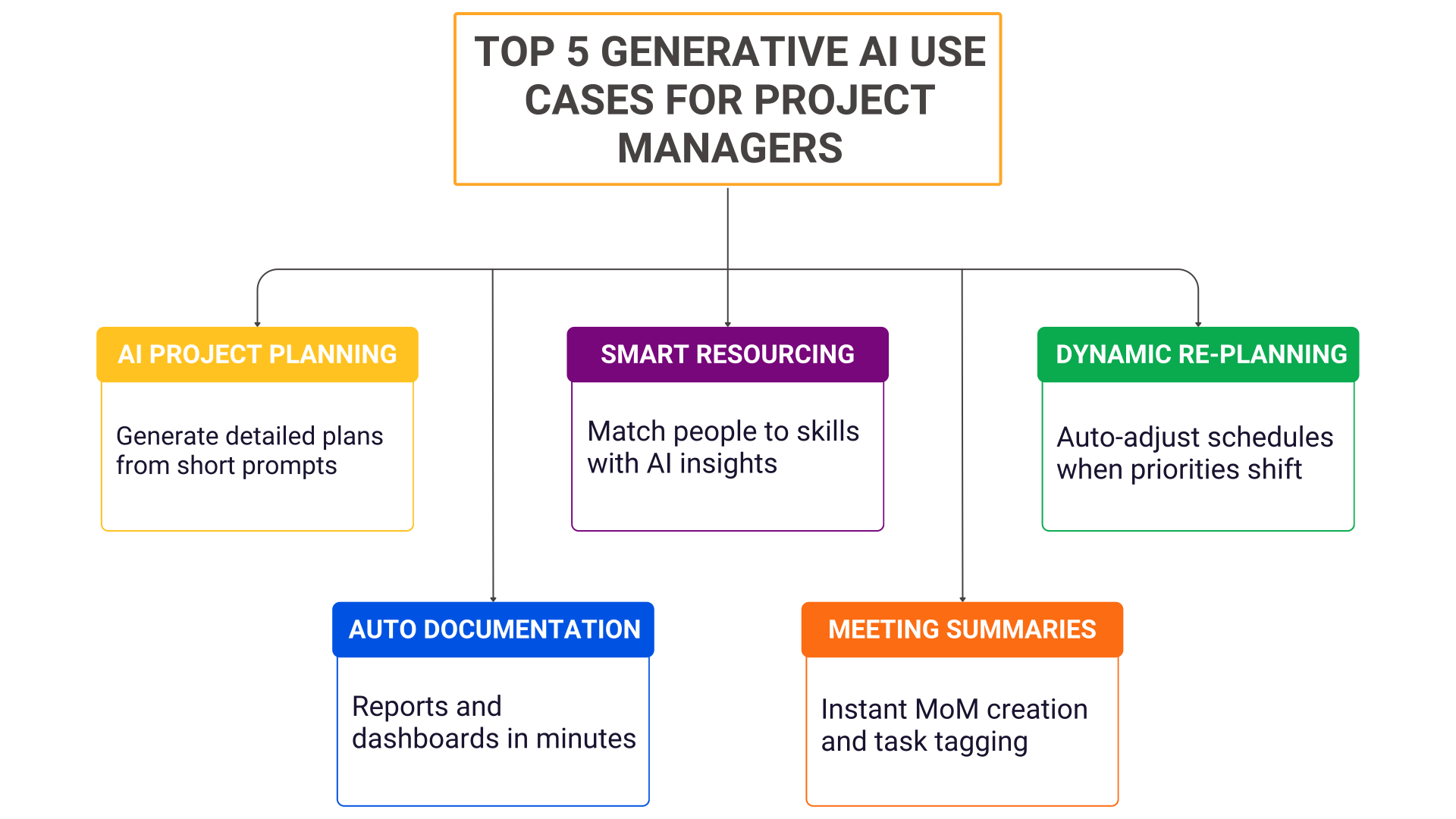
Generative AI is already reshaping how project managers plan, execute, and communicate. Its strength lies in automating creativity — transforming raw data into usable, structured intelligence.
1. AI-Generated Project Planning
Project planning often consumes the most time. Generative AI instantly translates a business requirement or proposal into a detailed plan.
Enter a prompt like “Launch a mobile banking app,” and AI can create a Work Breakdown Structure, timeline, and dependency chart — even recommending task owners based on prior projects. This saves hours of setup and promotes consistency.
2. Automated Documentation and Reporting
Status reports, dashboards, and summaries are essential but repetitive. Generative AI collects live project data and drafts comprehensive reports ready for review or sharing — freeing project managers to focus on insight, not formatting.
3. Resource Allocation and Skill Matching
AI analyses project requirements, resource profiles, and workload data to recommend optimal team combinations. It highlights skill gaps, prevents over-booking, and ensures better utilisation across projects.
4. Meeting Summaries and MOM Generation
AI listens to or analyses meeting transcripts, summarises discussions, and produces clear Minutes of Meeting (MoM) with tagged responsibilities and due dates — improving traceability and follow-through.
5. Change and Impact Management
When scope or timelines shift, Generative AI recalculates schedules, dependencies, and resource needs instantly, providing revised dashboards and forecasts for proactive alignment.
Collectively, these use cases elevate productivity and decision-making, enabling project managers to spend more time analysing outcomes and less time preparing updates.
How Generative AI Integrates into Modern Project Management Software
Generative AI delivers maximum value when embedded directly within project management software, not used as an external add-on. Integration gives it access to the full project context — data, capacity, timelines, and budgets — enabling outputs that are both relevant and intelligent.
1. Data Capture and Synchronisation
AI connects with enterprise systems such as CRM, HRMS, and ERP to gather live data — ensuring every generated report or schedule reflects real-time accuracy.
2. Contextual Understanding
It comprehends relationships between scope, cost, and effort. When a milestone changes, AI knows which dependencies or budgets are affected and regenerates updated timelines or impact reports instantly.
3. Intelligent Content Generation
AI creates artefacts such as charters, risk logs, and dashboards — formatted to company standards and tailored for different audiences, from team members to CXOs.
4. Continuous Learning and Improvement
With each project, AI learns what worked best, which risks are repeated, and which reporting styles improve decisions — building organisational project intelligence over time.
By enabling automatic document creation, dynamic reporting, and contextual insights, these systems free managers from repetition — enabling faster, data-driven governance and greater confidence in every decision.
The Real-World Impact for Project Managers
Generative AI redefines how project managers spend their day. By offloading administrative work, it empowers them to lead with strategy and foresight instead of routine reporting.
Before AI:
Managers spent hours compiling data, chasing updates, and maintaining alignment.
With AI:
Reports are generated with a click, dashboards update in real-time, and task assignments adjust dynamically.
Tangible Benefits
- Speed: Reports and project summaries generated in minutes.
- Accuracy: Automated updates reduce human error.
- Consistency: Every document follows standard templates.
- Transparency: Real-time dashboards ensure stakeholder clarity.
- Engagement: Teams collaborate better when administrative friction disappears.
The result: measurable gains in productivity, accountability, and morale.
When project managers spend less time firefighting and more time analysing, mentoring, and innovating, projects finish faster, stronger, and with higher client satisfaction.
Generative AI brings clarity to complexity — helping managers think with data, not drown in it.
Challenges and Considerations
While Generative AI offers enormous potential, success depends on responsible adoption and governance.
1. Data Privacy and Security
AI relies on project and client data. Protecting this information with strong encryption and access controls is essential to maintain compliance and trust.
2. Human Oversight
AI outputs need validation. Project managers should use them as decision support — not replacements for professional judgment.
3. Domain-Specific Training
Generic AI models can miss industry nuances. Training them with domain-specific data ensures relevance, accuracy, and consistency.
4. Change Management
Teams need structured onboarding to adapt to new workflows and build trust in AI-enabled collaboration.
When handled correctly, these challenges turn into opportunities — improving governance, speed, and quality.
Generative AI doesn’t remove people from the process; it amplifies their impact.
The Road Ahead – What’s Next for Generative AI in Project Management
Generative AI is still evolving, but its direction is unmistakable — toward more adaptive, autonomous, and connected project ecosystems.
1. Adaptive Project Planning
Future tools will automatically realign schedules as dependencies shift, ensuring delivery continuity without manual updates.
2. Conversational Interfaces
Project managers will soon interact with AI using natural commands such as “Generate a risk log for Project Apollo” or “Create a weekly summary for leadership.”
3. Financial and Delivery Intelligence
AI will unify operational and financial data, connecting delivery performance with profitability, cost, and margin metrics.
4. Cross-Project Learning
AI will analyse lessons across portfolios, using insights from completed projects to guide new ones.
5. Agentic AI Collaboration
AI will evolve from passive assistance to proactive engagement — scheduling reviews, flagging risks, and initiating updates autonomously.
Generative AI is becoming the creative and analytical layer of modern project management — one that learns continuously, collaborates seamlessly, and empowers project managers to lead with intelligence.
Kytes AI-Enabled [PSA + PPM] Software — Intelligence that Connects People, Projects, and Financials
Kytes is an AI-enabled Professional Services Automation (PSA) and Project & Portfolio Management (PPM) platform built to help project-led organisations digitise, automate, and optimise their end-to-end delivery lifecycle — from opportunity to invoicing.
The platform is purpose-built for complex delivery environments across IT/ITES, Pharmaceuticals, Engineering, GCCs, and Professional Services. It unifies every aspect of project operations — project delivery, resource management, financial governance, and new product development (NPD) — into one intelligent, connected system.
Its AI engine powers a wide range of advanced capabilities, including:
- Generative Project Intelligence: AI-driven WBS creation, risk analysis, and automated report generation.
- Predictive Resource Planning: Forecasting demand, bench visibility, and skill-to-project matching.
- Financial Control: Automated cost sheets, margin intelligence, PO/SOW management, and DSO tracking.
- Compliance & Governance: End-to-end timesheet accuracy, audit readiness, and labour-law adherence.
- Agentic AI Features: Meeting-minute generation, enterprise-level status presentations, and dynamic dashboards.
Kytes is available on cloud or on-premise deployments, offering scalability, multilingual interfaces, and seamless integration with leading CRM, ERP, and HRMS systems.
By combining AI automation, domain depth, and real-time analytics, Kytes provides a single version of truth across all business functions — enabling executives, delivery heads, and project managers to make faster, smarter, and more profitable decisions.
Conclusion
Generative AI for project management represents a defining shift — from automation to intelligent collaboration.
Systems no longer just follow commands; they contribute to decisions.
Project managers gain freedom from repetitive documentation and greater control over outcomes. They can spend less time collecting data and more time interpreting it — aligning strategy with execution.
The result is a more agile, confident, and insight-driven way of working. Teams become proactive, risks are mitigated earlier, and communication becomes seamless.
Generative AI isn’t replacing project managers — it’s empowering them to lead with intelligence, precision, and creativity.
As AI evolves, organisations that embrace it early will redefine success — measured not only by timelines and budgets but by foresight, adaptability, and impact.