Blog Highlights
- Capacity Planning Software helps enterprises balance project demand, resource availability, and delivery readiness before growth creates execution risk.
- Hidden capacity blind spots such as skill shortages, overload, bench cost, and poor forecasting directly impact delivery timelines, margins, and revenue predictability.
- Traditional tools like spreadsheets, disconnected HR systems, and basic project management platforms fail because they do not provide real-time, connected capacity visibility.
- Modern capacity planning requires demand forecasting, skill-based allocation, workforce planning, and real-time decision support across projects and business functions.
- Better capacity planning protects revenue and margins by improving utilization, reducing allocation conflicts, and preventing reactive hiring or delivery delays.
- Kytes connects capacity planning with project execution, resources, timesheets, and financial outcomes to help enterprises scale with stronger control and confidence.
A growing IT services firm can win more projects, hire more people, and still miss delivery timelines. This may sound unusual, but it happens often. Growth becomes risky when leaders cannot see whether the business has enough skilled capacity to deliver what it has promised.
Capacity Planning Software helps enterprises forecast demand, check available resource capacity, and allocate the right team members to the right projects before delivery risks affect revenue. It gives COOs, PMO leaders, resource heads, and CXOs a clear view of future workloads, team availability, skill gaps, and delivery readiness.
For growing enterprises, capacity planning is no longer only a resource planning task. It has become a leadership control system. It helps businesses balance demand, resources, utilization, delivery timelines, and revenue commitments with more confidence.
When capacity planning works well, leaders do not wait for delivery delays to appear. They can see risks early, plan resources better, and make sharper decisions before revenue or margins are affected.
What Is Capacity Planning Software?
Capacity Planning Software helps businesses compare upcoming project demands with available resource capacity. It shows whether the organization has enough people, the right skills, and the required bandwidth to support current and future work.
In simple terms, it helps leaders understand whether they can deliver what the business has already sold or plans to sell. It shows which team members are available, which skills are in demand, where workloads are rising, and where capacity gaps may appear.
This is important for IT services, consulting, professional services, engineering services, and EPC businesses. These industries depend heavily on people, skills, timelines, and billable work. When leaders do not have a real time view of capacity, they often make decisions based on assumptions.
That is where project delays, low utilization, bench cost, hiring pressure, customer dissatisfaction, and margin leakage begin.
A good capacity planning tool helps enterprises move from reactive resource allocation to proactive workforce and project planning.
Why Capacity Planning Is Now a Leadership Priority
Growth looks positive on a dashboard. More deals are moving forward. More projects are getting approved. More customers are entering the pipeline. More revenue opportunities are visible.
But behind this growth, delivery pressure starts building.
Sales teams may close large deals without knowing whether delivery has enough skilled resources. PMO teams may approve multiple projects without seeing total project demands. Resource managers may allocate people based only on availability, not skills, cost, location, or project priority. HR may begin hiring only after demand has already become urgent.
This creates a gap between what the business sells and what the business can deliver.
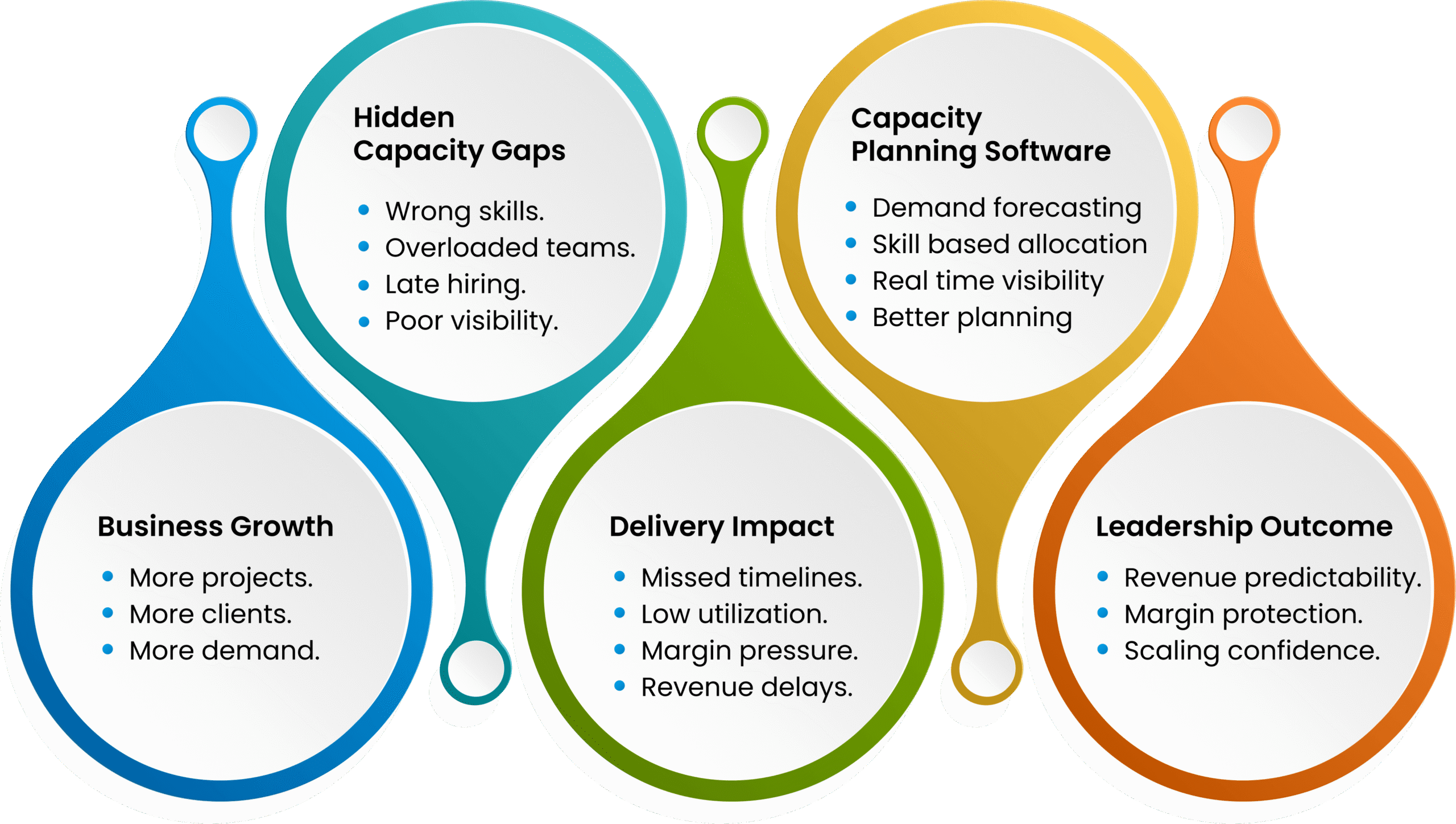
That gap is no longer only a delivery issue. It affects revenue predictability, margins, customer commitments, employee productivity, and leadership confidence. When resources are planned late, delivery schedules slip. Billable utilization drops. Bench costs rise. Key people get overloaded. Hiring becomes rushed. Revenue forecasts become unreliable.
This is why capacity planning has moved from an operational task to a leadership priority.
Enterprise Capacity Blind Spots That Hurt Growth
Most capacity problems do not look serious at first. A project may look on track because the plan is updated. A team may look fully staffed because people have been assigned. A pipeline may look strong because demand is increasing. A revenue forecast may look healthy because deals are moving forward.
But hidden risks may already exist.
A business may have enough people overall, but not enough people with the right skills. A delivery unit may look available on paper, but key team members may already be stretched across multiple projects. A project manager may request resources too late because demand planning was not linked to opportunity planning. A resource manager may approve allocation without a real time view of future workloads.
These are enterprise capacity blind spots.
They create a gap between business commitments and delivery capacity. For IT services and consulting firms, this can affect client delivery. For engineering and EPC companies, it can affect timelines and cost control. For professional services firms, it can affect utilization, billing, and profitability.
Capacity planning software helps leaders expose these risks early. It gives them better visibility into project demands, resource allocation, future demand, and skill based capacity before small gaps become business problems.
How Capacity Planning Prevents Delivery Risk
Daily Challenges Without Capacity Visibility
Capacity planning may sound strategic, but its challenges appear in daily decisions.
A PMO leader may need to approve five new projects but may not know whether the current workforce can support them. A resource manager may spend hours checking spreadsheets to find available team members. A COO may ask why delivery is delayed even after hiring more people. A finance leader may see lower margins but may not know where the issue started. A delivery head may see high utilization, yet projects may still miss deadlines.
These problems usually come from disconnected data.
Resource data may sit in one system. Project demands may sit in another. Timesheets may be tracked separately. Hiring plans may stay with HR. Revenue forecasts may sit with finance. Project management tools may show tasks and timelines, but not true resource capacity.
This creates operational noise.
Teams spend more time collecting updates than making decisions. Leaders receive reports after the damage has already started. Resource allocation becomes a negotiation instead of a structured process. Forecast resource planning becomes difficult because there is no single version of truth.
A real time view helps solve this issue. It shows who is available, who is overloaded, which skills are needed, and where future demand may exceed available capacity.
Why Traditional Tools Fail at Capacity Planning
Many enterprises still use spreadsheets, basic project management tools, HR systems, and finance tools for capacity management. These tools help in parts, but they do not solve the full problem.
Spreadsheets are flexible, but they create manual work. They also lead to multiple versions of the truth. When teams update different sheets at different times, leaders lose trust in the data. This makes real time visibility almost impossible.
Project management tools are useful for tracking tasks, timelines, and milestones. But many of them do not connect resource capacity with skills, utilization, project financials, and future demand.
HR systems show employee data, but they may not show project demands, delivery load, or billable capacity. Finance systems show cost and revenue, but they often show the impact after execution has already gone off track.
This is the main issue. Existing systems show different parts of the business, but capacity planning needs a connected view.
Enterprise leaders need to see demand forecasting, resource allocation, project demands, skill based planning, real time visibility, and long term capacity in one place. Without this view, capacity management becomes reactive.
What Modern Capacity Planning Software Should Do
Modern capacity planning software should help leaders plan before problems occur. It should not only show whether a person is available. It should help the business understand whether the right skills, capacity, and delivery bandwidth are available for current and future project demands.
It should support demand forecasting so leaders can see future workloads based on pipeline, approved projects, and upcoming work. This helps the organization prepare for demand before it becomes urgent.
It should support skill based planning because availability alone is not enough. A team member may be free, but may not have the right capability, experience, cost fit, location fit, or project background.
It should also provide real time visibility into team members, allocation, utilization, and capacity gaps. This helps leaders identify overload, underuse, and allocation conflicts early.
Long term workforce planning is equally important. Enterprises need to know when to hire, train, reassign, or use contractors. They also need to understand when project commitments should be adjusted based on actual capacity.
A strong capacity planning tool does more than manage people. It helps leaders connect resources, delivery, and business outcomes.
How Kytes Helps Enterprises Plan Capacity Better
Kytes helps enterprises connect project planning, resource management, delivery execution, timesheets, and financial visibility in one system. This matters because capacity planning does not work well when demand, resources, workloads, and billing sit in separate tools.
With Kytes, leaders can get a real time view of resource capacity, future demand, project workloads, and team utilization. This helps teams plan allocation before delivery pressure builds.
PMO leaders can check whether projects have enough capacity before approving delivery timelines. Resource management heads can improve skill based allocation and reduce bench time, overload, and utilization gaps. COOs can see how demand and capacity affect delivery, revenue, and margins. CXOs can understand whether the business is ready to support growth without putting customer commitments at risk.
This connected approach is useful for IT services, consulting, professional services, engineering, and EPC businesses. These industries depend on people, skills, timelines, utilization, and delivery predictability.
Kytes fits naturally into capacity planning because it connects capacity with the larger project execution system. It does not treat resource planning as a separate activity. It links resources, projects, execution, timesheets, billing, and financial outcomes.
From Reactive Allocation to Proactive Planning
In many organizations, resource allocation starts after project approval. By then, the pressure has already started.
Project managers need people quickly. Resource managers negotiate availability. HR receives urgent hiring requests. Delivery teams stretch existing capacity. Finance teams try to protect margins. Leaders then ask why execution is slower than expected.
This reactive model creates stress across the business.
Capacity planning software changes this process. It helps leaders forecast resource needs earlier. It shows future workloads before they become delivery risks. It helps teams decide whether to hire, train, reassign, outsource, or adjust project timelines.
This shift is critical for enterprise growth.
Growth without capacity control can create burnout, delivery delays, and margin pressure. Growth with capacity visibility creates confidence. It helps enterprises scale without turning every new project into a firefighting exercise.
Why Real Time Visibility Matters
Capacity planning cannot depend only on monthly reports. Project demands change quickly. Clients change priorities. New opportunities enter the pipeline. Skills become scarce. Team members move across projects. Delivery risks can appear without warning.
If leaders depend only on static reports, they may see problems too late.
Real time visibility helps them act faster. It shows who is available, who is overloaded, which skills are in demand, and where capacity gaps may appear.
For example, three high-value projects may need the same skill set in the same month. Leaders should see that risk early. A key team member may be assigned to too many projects. Managers should know before delivery quality drops. Future demand may be higher than available capacity. Hiring and training plans should start early.
This turns capacity planning from a reporting exercise into an active decision-making process.
Capacity Planning and Revenue Predictability
Revenue depends on delivery. If projects get delayed because capacity was not planned well, revenue can also get delayed.
If teams are overloaded, quality may drop. If resources are underused, margins may fall. If the wrong people are assigned, delivery costs may rise. Each issue affects the business beyond project execution.
Capacity planning software helps leaders see these risks early.
When demand forecasting, resource allocation, project progress, and financial data are connected, leaders can see whether the business can deliver its forecasted revenue. They can also make better decisions around hiring, allocation, project sequencing, and delivery commitments.
This is especially important for IT services, consulting, and professional services businesses. In these industries, revenue depends on billable work, resource efficiency, and timely delivery.
Capacity Planning and Margin Protection
Margins do not fall only because costs rise. They also fall when resources are planned poorly.
A skilled employee may work on low-priority tasks. A project may use more effort than planned. A team may stay on the bench because demand was not forecasted. A project may need urgent hiring at a higher cost. A manager may assign whoever is available instead of the best-fit resource.
Each decision affects profitability.
Capacity planning software helps improve resource efficiency. It helps leaders allocate people based on skills, availability, cost, demand, and project priority. This reduces allocation errors, bench time, overutilization, and last-minute hiring pressure.
For enterprise leaders, margin protection is not only a finance goal. It is an execution discipline. Better capacity planning helps align people, projects, and business priorities.
Capacity Planning and Strategic Scaling
Scaling does not mean taking on more work blindly. It means knowing whether the business can deliver more work without losing control.
Capacity planning gives leaders that confidence. It helps them decide which opportunities to pursue, which skills to build, where to hire, when to use contractors, and how to balance multiple projects across teams.
Without this visibility, growth becomes guesswork.
A company may accept too much work and delay delivery. It may hire too early and increase bench cost. It may delay hiring and lose customer confidence. It may overuse top performers and create burnout.
Strategic scaling needs clear capacity visibility. Leaders need to know what the organization can realistically deliver before they commit to growth.
Leadership-Level Impact
Capacity planning software creates value across leadership roles.
For COOs, it improves operational control by helping them balance business demand with delivery capacity. For PMO leaders, it improves project governance by ensuring that projects are supported by the right resources. For resource heads, it improves allocation, utilization, and workforce planning.
For HR leaders, it gives better visibility into hiring and skill development needs. For CIOs and CTOs, it supports better system integration and data-driven decision-making.
For CXOs, the biggest impact appears in three areas.
Revenue Predictability: Leaders can see whether the organization has enough capacity to deliver forecasted revenue.
Margin Protection: Teams can reduce bench cost, overutilization, allocation errors, and delivery delays.
Strategic Scaling Confidence: Businesses can grow with better control over demand, resources, skills, and project delivery.
This is why capacity planning is now a boardroom-level topic, not just an operational process.
Final Thoughts
Capacity planning is no longer about filling open slots in a project plan. It helps enterprises balance demand, resources, project delivery, and financial outcomes.
As businesses grow, disconnected tools create blind spots. These blind spots affect timelines, utilization, margins, customer commitments, and revenue confidence.
A connected capacity planning approach helps leaders see what is coming. It helps them prepare for future demand, allocate resources better, and scale with control.
For enterprises that want better visibility across demand, resources, and delivery, Kytes may be worth exploring. It brings capacity planning into the larger project execution system, so leaders can make clearer decisions before revenue or margins are affected.
Turn capacity visibility into better resource decisions, stronger project delivery, and confident enterprise growth.