Blog Highlights
- The best collaborative project management software enhances business agility and responsibility through outcome, rather than feature, focus.
- Collaborative project management software brings people, projects, and profitability under one roof.
- Leaders must consider tools on factors such as flexibility, integration, scalability, forecasting capabilities, and the capacity to minimize administrative burden.
- Use cases by industry indicate quantifiable improvements in technology, consulting, construction, and creative industries.
- The correct software selection provides quicker time-to-market, enhanced utilization of resources, better cost control, and increased trust.
- The future of the best project management and collaboration software involves AI-based insights, pre-emptive project health, and fully integrated ecosystems.
Enterprises today are under greater pressure than ever to deliver outcomes at speed while maintaining precision. Distributed workforces, changing client expectations, and volatile markets have not left much space for waste. It is in such a scenario that the function of project management software has transmuted from being an operational resource to an enterprise command center.
But here lies the challenge: many organizations are still assessing tools by surface-level checklist — does it include a Kanban board, a Gantt chart, or a dashboard? The bigger question that gets lost is: does the tool empower the enterprise to be agile, accountable, and future-ready?
The ideal collaborative project management tool does not only handle work. It establishes the environment for linked execution, open governance, and smart decision-making. When approached correctly, it becomes the single version of truth across people, projects, and profits.
This blog explores how collaborative project management software, when designed for enterprises, redefines agility and accountability — and why that distinction matters for leaders who expect not just delivery, but lasting value.
Why Agility and Accountability Define Enterprise Success
Agility and accountability are frequently addressed separately. But in reality, they walk hand in hand. Agility without accountability produces speed with no direction. Accountability without agility produces rigidity. When combined, they become the pillars of enterprise success.
Why agility matters: Businesses work within fast-changing environments where priorities continuously shift. Without the capacity to change — re-allocating resources, adjusting scope, or re-prioritizing deliverables — projects become stagnant, and competitive edge is lost. Agility keeps organizations in sync with the market pace.
Why accountability matters: Speed without monitoring is expensive. Absence of accountability typically takes the shape of ambiguous ownership, redundant efforts, and projects that exceed budgets. Businesses require visibility at every level — from task-level to multi-million-dollar portfolios — in order to ensure responsibility and alignment.
What holds both together is a single version of truth. When every stakeholder — finance and HR, product and delivery teams — start from one version of the truth, decisions are quicker, risks are anticipated, and results are predictable. Collaborative project management software then becomes not merely a repository, but the facilitator of that truth.
What Makes Project Management Collaborative in Enterprises
Collaboration is often misunderstood as communication. In enterprises, collaboration means far more: it is about creating a unified ecosystem where every action is connected and traceable.
The best project management collaboration software provides:
- Project and Portfolio Visibility
Project leaders and executives require a bird’s-eye view, not piecemeal updates. Proper software delivers uncluttered visibility into how projects overlap, where dependencies pose potential risk, and how delivery timing relates to financial exposure. Such an integrated view converges disparate data into actionable insights, enabling leaders to make strategic priorities and invest resources wisely.
- Communication Tied to Execution
In big companies, communication tends to fall through email threads or isolated messaging systems. Not only does this weaken responsibility but also makes decision-making sluggish. Contemporary collaboration software roots communication in the work itself — all conversations, decisions, or approvals are tied to related tasks and projects. This provides clarity, continuity, and transparency between stakeholders.
- Documentation Within Workflows
Knowledge capture must be easy and context-rich. By integrating documentation into workflows themselves, companies avoid losing valuable information when individuals move on or teams reorganize. Onboarding is quicker, and teams have immediate clarity not just about what is occurring but also why it is occurring. Documentation is no longer a static repository but rather an ongoing aspect of execution.
- Resource and Financial Accountability
True agility requires linking people, projects, and profitability into one ecosystem. The best collaboration platforms don’t treat them as separate silos — they show how resource allocation affects delivery, and how project performance impacts financial results. This interconnected view ensures accountability flows across all dimensions, from team utilization to revenue outcomes, making decisions more precise and aligned with enterprise goals.
True collaboration in project management is about ensuring that no decision exists in isolation. Every task, every approval, and every dollar is connected — creating a system where agility and accountability are not aspirations but daily practice.
The Pillars of Agile, Accountable Project Management Software
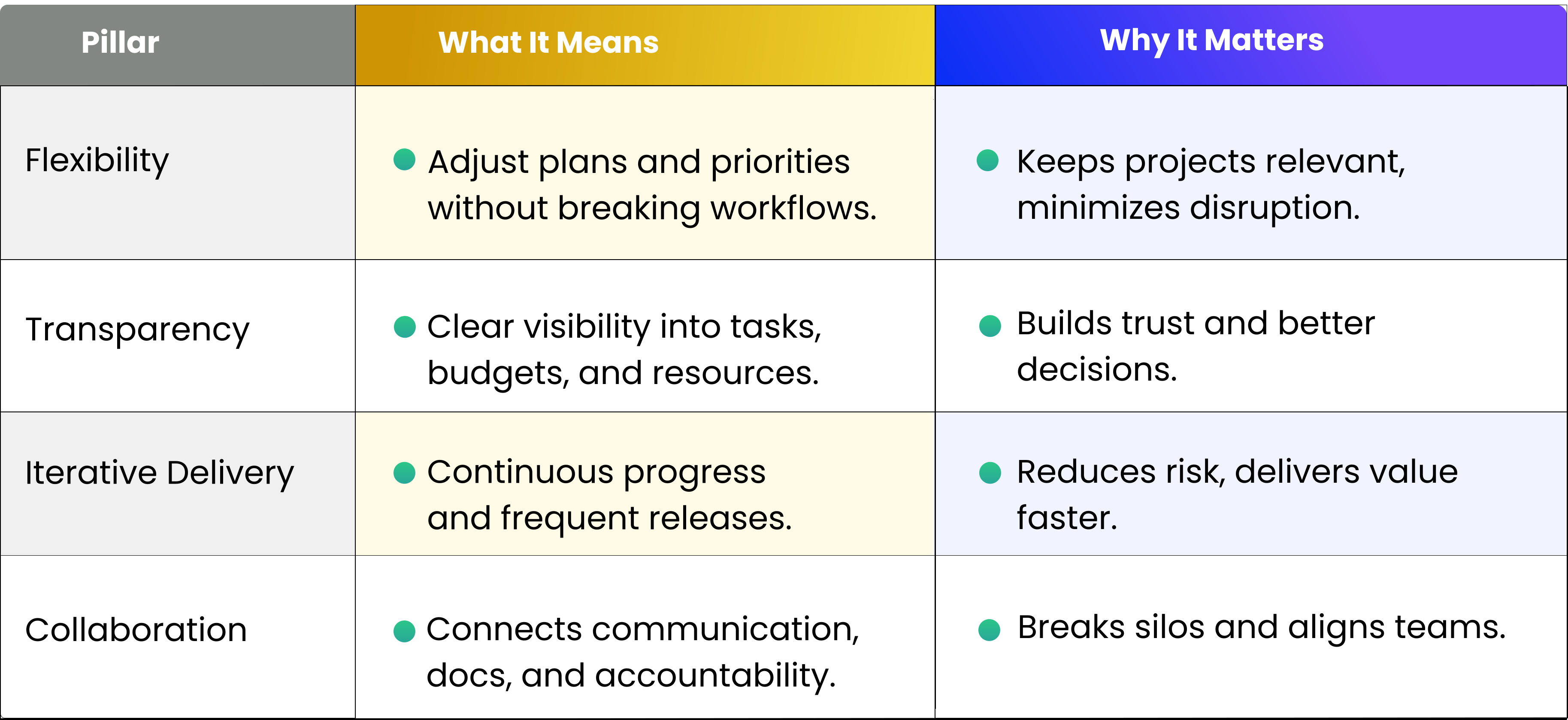
To separate surface-level tools from enterprise-grade solutions, decision-makers should look for four fundamental pillars.
1. Flexibility
Companies cannot afford software that traps them into inflexible methodologies. Flexibility equates to adaptive planning, scenario planning, and changing priorities without upsetting current structures. It allows the company to react to both market opportunities and internal changes without chaos.
2. Transparency
Transparency is more than dashboards. It is seeing how resources are being used, where budgets are spent, and if promises are realistic. For executives, transparency instills trust in decision making; for teams, it eliminates uncertainty and empowers ownership.
3. Iterative Delivery
Massive projects fail because organizations get stuck on milestones instead of progress. Iterative delivery lets teams deliver value in small batches, gather feedback, and course-correct. This minimizes risk, maximizes predictability, and keeps stakeholders on board.
4. Collaboration
Collaboration at its essence is about alignment. Great collaborative project management software makes sure communication, documentation, and accountability reside within one ecosystem. This eliminates fragmentation and creates clarity at scale.
All four of these pillars convert project management from a tactical activity to a strategic facilitator of agility and accountability.
Agility Across Industries: A Universal Value
Agility is often associated with technology and software development. Yet, its benefits extend across industries.
Technology & Software Development
Drives faster, more reliable releases by aligning engineering and product roadmaps. With clear sprint predictability and dependency management, teams can deliver value continuously while reducing release risk.
Consulting & Professional Services
Offers real-time visibility into utilization of resources and billable hours to ensure that projects remain profitable. Transparent client reporting and utilization tracking build confidence and enhance long-term client relationships.
Construction & Engineering
Empowers teams to manage intricate dependencies, changing timelines, and supply chain interruptions with dynamic scheduling. This reduces overcost, minimizes downtime, and keeps projects on schedule despite environmental obstacles.
Creative & Marketing Teams
Bridges campaign assets, approvals, and multi-channel delivery onto a single platform. Teams can work quicker, eliminate rework, and remain agile in delivering campaigns that address changing market and customer needs.
The common thread: agility is not industry-specific. It is a discipline that, when supported by collaborative project management software, drives accountability and value in any domain.
Key Evaluation Checklist for Decision-Makers
For leaders evaluating options, the question is not “which tool has more features,” but “which software drives the right outcomes.” A practical evaluation checklist includes:
1. Adaptive, Scenario-Based Planning
Markets change, customer requirements change, and priorities shift rapidly. The ideal platform must enable leaders to model several scenarios, re-prioritize without disrupting current processes, and retain project relevance in uncertainty.
2. Multi-Methodology Support
Most businesses don’t work in one project methodology. The software must accommodate Agile, Waterfall, or blended methodologies without imposing homogeneity, allowing the team to work as they work best.
3. Predictive Analytics and Proactive Risk Alerts
Executives require foresight, not hindsight. An effective system recognizes potential risks, gives advance warning, and provides actionable insights ahead of problems becoming major issues.
4. Seamless Enterprise Integration
Project management cannot be standalone. Finance, HR, CRM, and product development applications need to integrate seamlessly to produce a single version of truth and dispense with information silos.
5. Scalability with Growth
The software must grow alongside the organization. What works for one division should also work for multiple geographies, larger portfolios, and expanding teams without loss of performance.
6. Reduction of Administrative Load
Collaboration tools should simplify, not complicate. Automation, efficient workflows, and integrated documentation mean less time devoted to administration and more to effective execution.
This checklist separates software that is agile in name from software that is agile in practice.
The Enterprise Outcomes of Getting It Right
When companies select the appropriate project management collaboration tool, the effect can be quantified.
- Faster Time-to-Market
By linking planning, execution, and communication within a unified ecosystem, organizations can go from idea to delivery with less lag. Products and services hit the market earlier, without losing quality, allowing companies to gain a competitive advantage in fast-paced markets. - Higher Resource Utilization
With complete visibility into workloads and priorities, resources can be assigned with accuracy. Not only do this improve billable utilization in service-oriented industries but also reduce downtime and inefficiencies across departments. - Stronger Cost Control
Complete transparency through budgets, dependencies, and timelines assists businesses in avoiding expensive overruns. Executives are empowered to catch and correct early, reallocate, and stay profitable without perpetual firefighting. - Improved Trust and Accountability
When coordination is directly connected to delivery, stakeholders have growing confidence in process and results. Customers observe progress in real-time, boards get accurate projections, and internal teams work with a greater sense of ownership and responsibility.
Discover how leading enterprises align people, projects, and profits through agile collaboration.
The Future of Collaborative Project Management Software
Looking ahead, project management will be reshaped by technology and organizational expectations. The best project management and collaboration software of the future will:
AI as a Decision Partner
Artificial intelligence will extend beyond dashboards and reporting. It will aid leaders in predictive risk modeling, smart resource recommendations, and auto-scheduling. Rather than responding to issues, enterprises will optimize outcomes ahead of time.
Automation of the Mundane
Status updates, reminders for timesheets, and tracking dependencies will be taken care of by the system itself. Teams will have less time spent on maintaining the tool and more time to innovate, execute, and deliver value to clients.
Predictive Project Health
Next-generation platforms will provide warning signs in advance through predictive analytics. Executives will not only see what is currently happening, but also what might go wrong next — having the ability to step in early to prevent risks before they turn into failures.
Unified People–Project–Profit Ecosystem
Discrete systems separating project delivery from financial and resource information will no longer be adequate. Companies will require consolidated ecosystems that bridge talent, delivery, and profitability, creating accountability at all levels.
These are not changes in features but in consequences: facilitating agility, assuring accountability, and protecting profitability.
Conclusion
Agility and accountability are not nice-to-haves anymore. They determine if businesses are able to fulfill promises, respond to change, and maintain profitability. Team project management software is the channel by which these attributes are achieved — not as theoretical ideals, but as tangible realities.
The best collaborative project management software doesn’t just enable teams to work together; it revolutionizes the way enterprises deliver, govern, and evolve. It gives them the transparency of one version of truth, the assurance of accountability, and the velocity of agility. Enterprises that embrace this change will not only remain current with the market but will lead the benchmark for enterprise excellence.
Kytes: Enterprise-Grade PSA + PPM
Kytes is an AI-enabled Professional Services Automation (PSA) + Project Portfolio Management (PPM) software that brings project delivery, resources, and financial management into one unified system. Built for enterprises, it goes beyond task management to deliver true agility and accountability at scale.
By harmonizing collaboration with financial governance, resource management, and predictive intelligence, Kytes provides leaders with the confidence to execute strategy with precision. For organizations that seek not just to deliver projects, but to transform outcomes, Kytes is the natural partner.
See how Kytes empowers enterprises to deliver with agility and accountability.