

Blog Highlights
- A structured project initiation framework establishes the business case, financial estimates, stakeholder governance, and initial scope boundaries.
- Feasibility assessments validate technical viability, operational capacity, and expected financial outcomes before project approval.
- Early resource forecasting and cost modeling improve delivery predictability and prevent staffing or budget conflicts.
- Portfolio level evaluation ensures new initiatives align with strategic priorities and available organizational capacity.
- Platforms like Kytes enable integrated proposal management, estimation workflows, approval governance, and financial planning within a single project initiation environment.
Disciplined project initiation ensures that the shift from opportunity to delivery occurs with operational clarity. It connects the commitments made during presales with the execution capabilities of the delivery organization.
Understanding what is project initiation in this context therefore becomes essential for IT services companies managing complex project portfolios and client engagements.
This blog explores how project initiation fits within the Opportunity-to-Cash lifecycle, the operational steps involved in converting opportunities into projects, and why a structured initiation process is critical for successful delivery in IT and ITeS organizations.
Why Projects Face Problems Before Delivery Even Begins
Delivery leaders in IT and IT-enabled services companies recognize a familiar pattern. A new project begins with a signed contract and strong enthusiasm from the client and delivery teams.
Within the first few weeks, however, questions begin to surface. The effort estimates differ from what sales proposed. Resource availability becomes uncertain. Financial projections require adjustment. Delivery teams ask for clarification on scope commitments that were finalized during presales discussions. None of these issues originate during project execution. They originate earlier, at the point where the opportunity transitions into a project.
In IT and ITES organizations, this transition sits at a critical point within the Opportunity-to-Cash (O2C) lifecycle. Sales teams secure opportunities and develop proposals. Delivery teams are then responsible for executing those commitments.
If the transition between these stages lacks structure, organizations experience predictable challenges. Delivery plans change frequently. Financial projections lose accuracy. Resource utilization becomes difficult to manage.
Project Initiation Within the Opportunity-to-Cash Cycle
In IT and ITeS organizations, projects begin as client opportunities.
These opportunities move through several stages before delivery begins.
- Opportunity identification
- Proposal development
- Estimation and pricing
- Contract finalization
- Project initiation
- Delivery execution
- Billing and revenue realization
Project initiation acts as the operational bridge between sales commitments and delivery execution.
At this stage, the organization translates commercial agreements into structured delivery plans.
This phase validates several critical elements.
- Delivery scope commitments
- Financial assumptions made during presales
- Resource requirements and skill availability
- Governance structures for the client engagement
Once these elements are confirmed, the engagement transitions from opportunity management into formal project execution.
Without this structured transition, delivery teams often inherit projects with incomplete context.
Also Watch:
Why Project Initiation Determines Delivery Success in IT Services
Project-driven organizations operate in an environment where margins, utilization levels, and delivery timelines must remain tightly controlled. Even small gaps in project definition can quickly affect delivery performance and financial outcomes.
When presales commitments are not carefully validated during project initiation, several operational challenges begin to surface during execution. A structured initiation process prevents these disruptions by ensuring that commercial agreements translate into realistic delivery plans.
- Misaligned Scope Expectations
Clients and delivery teams sometimes interpret proposal documents differently. What sales commits during presales may not always reflect the detailed execution perspective of delivery teams.
Project initiation provides an opportunity to validate scope commitments, clarify deliverables, and ensure that both client and delivery teams share the same expectations before work begins.
- Estimation Variance
Effort estimates prepared during presales are often developed under time pressure. Delivery leaders therefore review these estimates during initiation to confirm whether timelines, staffing assumptions, and effort projections remain realistic.
This validation helps prevent significant deviations during execution.
- Resource Allocation Conflicts
Many IT projects require specialized technical skills. If resource planning occurs only after project approval, teams may struggle to find the right expertise at the required time.
Early resource validation during initiation ensures that delivery teams can realistically staff the project.
- Financial Visibility
Pricing decisions made during presales must remain viable once delivery begins. Project initiation allows organizations to examine cost structures, effort estimates, and revenue models in greater detail.
This ensures that expected project margins remain achievable.
- Governance Alignment
Client engagements involve multiple stakeholders across account management, delivery leadership, and client organizations.
Project initiation establishes governance frameworks that define decision authority, escalation paths, and communication structures.
Organizations that manage these aspects during project initiation create stronger alignment between sales commitments and delivery execution. This alignment improves predictability across project timelines, resource utilization, and financial outcomes.
Core Initiation Activities in IT and ITeS Engagements
Project initiation in IT services environments typically involves several structured steps.
These steps ensure that commitments made during the sales process translate into realistic delivery plans.
Opportunity Validation
Before converting an opportunity into a project, organizations validate the opportunity details.
This includes reviewing:
- client requirements
- contractual scope definitions
- pricing structures
- service level expectations
This validation ensures that delivery teams clearly understand what has been committed.
Proposal and Estimation Review
Presales proposals usually include effort estimates, pricing models, and high level delivery timelines.
During initiation, delivery leaders review these estimates to confirm feasibility.
This review typically examines:
- effort assumptions
- resource skill requirements
- timeline commitments
- dependency risks
Any necessary adjustments are addressed before the project moves forward.
Financial Model Confirmation
Projects in IT services environments must maintain profitability while meeting client expectations.
Initiation includes a detailed review of financial assumptions.
Teams examine:
- project cost structures
- billing models
- revenue projections
- margin expectations
This validation ensures that delivery plans align with financial objectives.
Stakeholder Alignment
Client engagements involve multiple stakeholders.
These include:
- account management teams
- delivery managers
- technical architects
- client sponsors
Project initiation defines governance structures and communication channels across these stakeholders.
Project Charter Development
The final outcome of initiation is the project charter.
This document formalizes the delivery framework for the engagement.
It typically defines:
- engagement scope
- delivery objectives
- governance structure
- timeline expectations
- resource allocation
Once approved, the engagement transitions into structured project planning.
The Opportunity-to-Project Transition Workflow
Within IT services organizations, project initiation represents the midpoint of the broader O2C lifecycle.
The typical transition sequence follows a structured pattern.
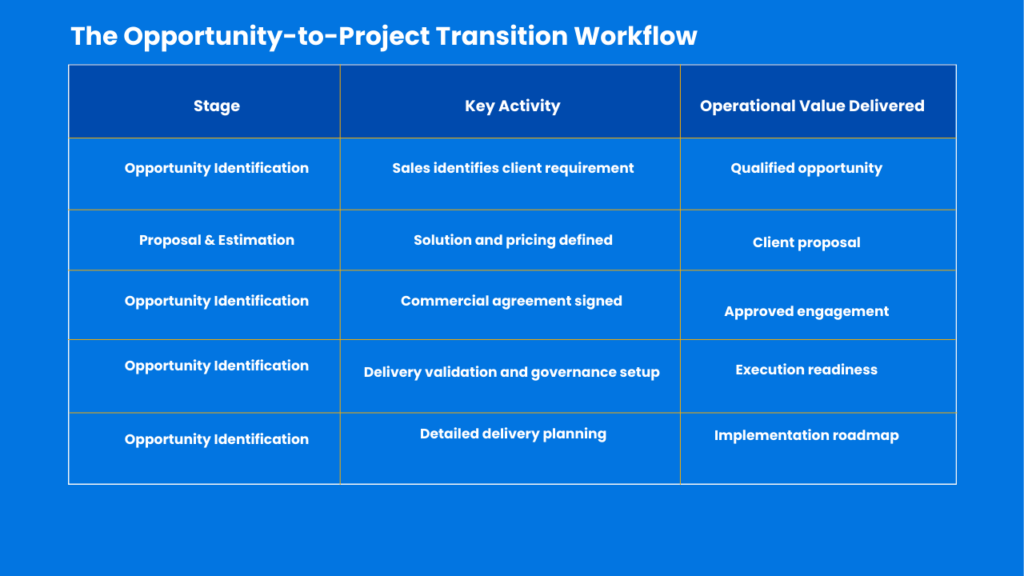
This structured transition ensures that commercial commitments translate into achievable delivery plans.
Operational Challenges in O2C Project Initiation
Despite its importance, many IT services companies face challenges when transitioning opportunities into projects.
Several operational gaps commonly appear.
Presales and Delivery Disconnect
Sales teams focus on securing deals. Delivery teams focus on execution feasibility.
Without structured collaboration during initiation, these perspectives may conflict.
Fragmented Information
Opportunity data, proposal documents, and estimation models often reside in separate systems.
Delivery teams struggle to obtain a complete engagement view.
Limited Resource Visibility
Resource allocation decisions often occur after project approval.
This creates delays when required expertise is unavailable.
Financial Assumption Gaps
Presales pricing sometimes lacks detailed delivery cost modeling.
Margins become uncertain once execution begins.
Organizations that strengthen the initiation stage significantly improve their O2C lifecycle performance.
Portfolio Visibility During Opportunity Conversion
IT services companies rarely manage a single client engagement at a time.
They manage portfolios containing dozens or hundreds of projects.
Project initiation must therefore consider the broader delivery landscape.
Leadership evaluates several factors before approving new projects.
- current resource utilization levels
- delivery commitments across active engagements
- financial impact on overall portfolio margins
- potential risks across concurrent projects
Without portfolio visibility, organizations may approve projects that exceed delivery capacity.
Structured initiation ensures that new engagements fit within the organization’s operational bandwidth.
Resource Planning During Project Initiation
Resource management is central to delivery success in IT services organizations.
Skilled professionals often contribute to multiple engagements simultaneously.
Project initiation therefore requires early resource planning.
Typical activities include:
- identifying required technical skills
- estimating effort requirements
- reviewing current team availability
- forecasting utilization impact
When these activities occur early, projects begin with realistic staffing plans.
This improves both delivery timelines and utilization management.
Key Deliverables of Project Initiation in IT Services
A well structured initiation phase produces several operational outputs.
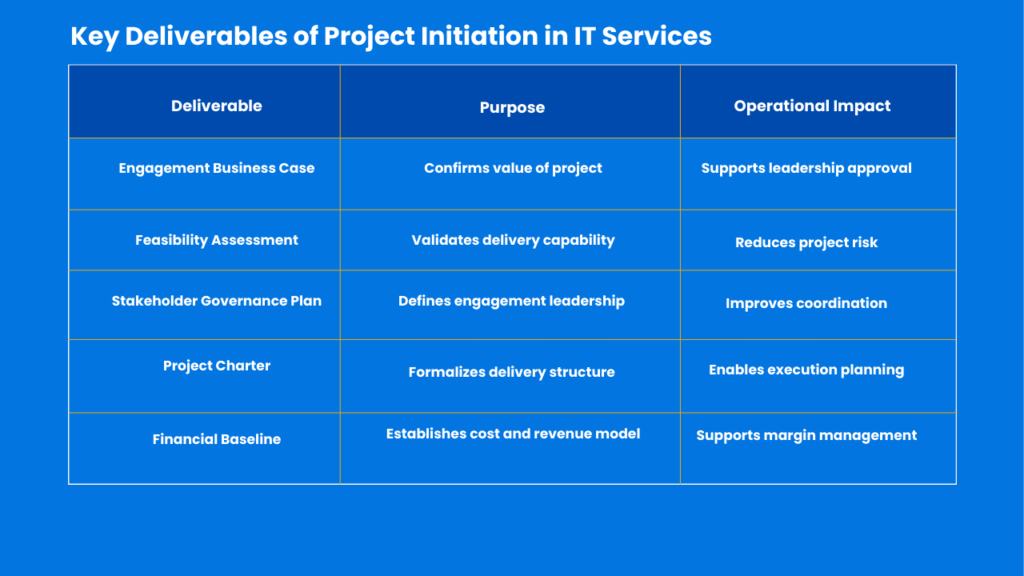
These deliverables ensure that delivery teams begin execution with clear operational guidance.
Best Practices for Managing Project Initiation in IT Services
Organizations that consistently deliver successful engagements adopt disciplined initiation practices.
Effective approaches typically include:
- integrating presales and delivery collaboration during opportunity conversion
- validating estimates before project approval
- establishing standardized engagement documentation
- aligning resource planning with project commitments
- maintaining portfolio visibility across active projects
These practices strengthen the transition between sales commitments and delivery execution.
How Kytes Strengthens Project Initiation in the O2C Lifecycle
Kytes is designed to support project driven organizations operating within complex O2C environments.
The platform integrates opportunity management, estimation workflows, delivery planning, and financial tracking into a unified system.
Within the initiation phase, Kytes enables organizations to manage critical activities in a structured manner.
- opportunity and proposal management
- estimation validation and financial modeling
- resource allocation forecasting
- governance and approval workflows
- automated project charter creation
- integration with enterprise financial and HR systems
This unified approach ensures that opportunities transition into projects with full operational visibility.
For IT and ITeS companies managing large delivery portfolios, Kytes strengthens the connection between sales commitments and successful project execution.
Also Watch: Kytes AI: Smarter Project Management in Action | Kytes
Conclusion
A disciplined initiation process validates estimates, aligns stakeholders, confirms resources, and establishes governance before delivery begins. This ensures projects move forward with clarity and predictable outcomes.
Kytes helps IT and ITeS organizations bring structure to this transition. By connecting opportunity management, estimation, resource planning, and financial oversight in one platform, Kytes ensures projects start with complete operational clarity.
Book a demo with Kytes to see how structured project initiation can strengthen your O2C delivery lifecycle.
Bring Structure to Your Opportunity-to-Cash Lifecycle
Explore how Kytes helps IT services companies convert opportunities into well-structured projects with better visibility, resource alignment, and financial clarity.
Book a Demo