Blog Highlights
- A clear, practical explanation of Strategic Portfolio Management (SPM) as an execution discipline—not just a planning or governance framework.
- How enterprises can bridge the persistent gap between strategy and delivery by structuring portfolios around outcomes, capacity, and real-world constraints.
- The role of portfolio analysis in strategic management in enabling intelligent prioritization, funding decisions, and resource allocation.
- Why traditional planning, budgeting, and governance models break down under modern business complexity—and what replaces them.
- How portfolio strategy in strategic management enables continuous realignment of investments as business priorities shift.
- The operational and leadership capabilities required to build execution clarity, strategic agility, and measurable business impact at scale.
- How AI-driven portfolio intelligence enhances forecasting, risk detection, and decision confidence without increasing management overhead.
Even the best strategies fail if execution breaks down. According to Harvard Business Review, up to 70% of strategic initiatives fail due to poor execution, not flawed strategy. The problem isn’t vision—it’s the operational gap between planning and delivery.
That gap shows up quietly. Portfolios fill with initiatives that once made sense but no longer reflect current priorities. Funding continues because stopping feels riskier than persisting. Capacity stretches thin, forcing teams to trade quality for speed and direction for momentum. Over time, execution becomes reactive, and strategy fades into a quarterly exercise instead of a daily guide.
This is where Strategic Portfolio Management becomes decisive. Not as a reporting layer, but as a leadership discipline that aligns intent, investment, capacity, and outcomes. When portfolio analysis in strategic management moves beyond budgeting, and portfolio strategy in strategic management becomes an active operating system, organizations regain the ability to direct execution with clarity and purpose.
What Strategic Portfolio Management Really Means
At its core, Strategic Portfolio Management is the disciplined practice of deciding where to invest, what to stop, how to allocate resources, and when to change course based on evolving strategic priorities.
It goes far beyond tracking project status or financial spend.
True Strategic Portfolio Management answers four fundamental questions:
- Are we investing in the right initiatives?
- Are we balancing risk, value, and capacity intelligently?
- Are we learning fast enough to adjust direction?
- Are we delivering outcomes that match strategic intent?
This requires a shift in mindset.
Instead of managing a collection of projects, organizations must manage a dynamic portfolio of strategic bets. Each initiative becomes an investment hypothesis, not just a delivery task. Every roadmap becomes a living expression of strategy, not a fixed commitment.
Strategic Portfolio Management integrates:
- Corporate strategy
- Financial planning
- Resource capacity management
- Delivery execution
- Outcome measurement
- Risk governance
When these elements operate in isolation, alignment collapses. When integrated through portfolio thinking, strategy becomes executable.
Why Strategy and Delivery Drift Apart
Most organizations do not struggle with defining strategy. They struggle with operationalizing it.
The drift happens because strategic planning and delivery execution are built on fundamentally different time horizons, incentives, and rhythms.
Structural Causes of Misalignment
- Strategy is annual, while delivery is continuous
- Budgeting is fixed, while priorities shift
- Governance is rigid, while markets move
- Resource planning is static, while demand fluctuates
This creates a predictable pattern:
- Strategy teams define objectives.
- Portfolio managers translate objectives into projects.
- Delivery teams focus on execution velocity.
- Finance teams control spend.
- Leadership reviews performance quarterly.
Each function optimizes locally, but no one optimizes for strategic coherence.
Over time, delivery begins serving momentum instead of intent. Projects continue because stopping them feels politically risky. New strategic priorities are layered on top of existing commitments, stretching capacity thin and diluting impact.
This is not a failure of execution. It is a failure of portfolio design.
The Invisible Cost of Poor Portfolio Alignment
Misalignment between strategy and delivery rarely shows up as a single catastrophic failure. Instead, it manifests as a slow erosion of organizational effectiveness.
The costs accumulate quietly across:
- Opportunity loss
- Resource burnout
- Capital inefficiency
- Strategic inertia
Hidden Operational Consequence
- Teams remain overloaded while high-value initiatives wait for capacity.
- Funding continues for low-impact programs due to legacy commitments.
- Leaders lose confidence in portfolio data and revert to intuition.
- Strategy becomes aspirational rather than operational.
Over time, organizations begin to experience a dangerous paradox: they appear busy, but feel stuck.
This is precisely where portfolio analysis in strategic management becomes critical.
Portfolio Analysis in Strategic Management: Moving Beyond Budgeting
In many enterprises, portfolio analysis still revolves around financial control. Budgets are approved, variances are tracked, and financial governance is enforced. While essential, this approach is insufficient.
Modern portfolio analysis must evaluate initiatives through a multi-dimensional lens.
Dimensions of Advanced Portfolio Analysis
- Strategic contribution
- Risk exposure
- Value realization timeline
- Resource intensity
- Dependency complexity
- Operational resilience
This enables leaders to make decisions that reflect strategic reality rather than accounting convenience.
Effective portfolio analysis in strategic management allows organizations to:
- Identify strategic misalignment early
- Quantify trade-offs between initiatives
- Prioritize based on impact, not urgency
- Continuously rebalance investments
This transforms portfolio reviews from compliance rituals into strategic conversations.
Portfolio Strategy in Strategic Management: From Planning to Continuous Direction
Traditional portfolio strategy assumes a predictable environment. Roadmaps are fixed annually. Funding is allocated once. Execution follows linear plans.
That model no longer holds.
Portfolio strategy in strategic management today must be adaptive, data-driven, and iterative.
What Modern Portfolio Strategy Demands
- Continuous reprioritization
- Dynamic funding models
- Scenario-based planning
- Real-time performance intelligence
- Rapid decision feedback loops
Rather than asking, “Did we deliver what we planned?”, leaders must ask, “Are we still delivering what matters?”
Portfolio strategy becomes less about governance and more about navigation.
The Leadership Operating Model: Where Strategic Portfolio Management Actually Lives
Most organizations treat Strategic Portfolio Management as a system problem. In reality, it is first a leadership problem.
No portfolio framework can compensate for leadership rhythms that reinforce short-termism, siloed accountability, and reactive decision-making. If strategy is reviewed quarterly, funding is locked annually, and delivery is measured monthly, misalignment becomes inevitable, regardless of tooling.
Strategic Portfolio Management demands a different operating model for leadership.
One where strategic intent is not revisited once a year, but continuously translated into portfolio decisions. Where capacity is reviewed alongside financial performance. Where risk, opportunity, and trade-offs are debated openly instead of being buried inside project plans.
This shifts leadership from episodic oversight to continuous direction-setting.
How High-Performing Leadership Teams Operate Differently
- Portfolio reviews replace traditional project status meetings
- Strategic outcomes become as visible as financial metrics
- Investment decisions are revisited dynamically, not annually
- Capacity constraints are treated as strategic inputs, not operational bottlenecks
- Trade-offs are made explicitly, not by default

The Role of Data, AI, and Predictive Intelligence
Strategic Portfolio Management cannot function effectively without deep operational visibility. Yet most organizations still rely on retrospective reporting.
By the time leadership receives insights, decisions have already been made.
This is where AI-driven portfolio intelligence changes the equation.
How AI Enhances Strategic Portfolio Management
- Predictive demand forecasting
- Early detection of delivery risk
- Scenario modeling for investment decisions
- Dynamic resource optimization
- Real-time outcome measurement
Instead of reacting to variance, leaders gain the ability to anticipate it.
AI enables organizations to move from governance-heavy portfolio models to intelligence-driven portfolio ecosystems.
Why Traditional PPM and PSA Systems Fail Alignment
Legacy PPM and PSA tools were built for operational control, not strategic agility. They excel at:
- Time tracking
- Budget control
- Project scheduling
- Resource assignment
But they struggle with:
- Strategic scenario modeling
- Outcome measurement
- Cross-portfolio dependency mapping
- Real-time portfolio rebalancing
This creates a fundamental gap.
Organizations end up running strategy on spreadsheets, finance in ERP, delivery in PSA, and portfolio reporting in BI tools. Each system operates independently, forcing leaders to stitch insights manually.
True Strategic Portfolio Management requires a unified intelligence layer that connects strategy, finance, capacity, and execution in one system.
What Operationally Mature Organizations Do Differently
High-performing enterprises treat portfolio management as a strategic discipline, not an administrative function.
Key Differentiators
- Strategy is operationalized through rolling portfolio cycles.
- Funding is dynamic and outcome-driven.
- Capacity is managed as a strategic asset.
- Delivery metrics focus on impact, not output.
- AI augments leadership decision-making.
These organizations understand that execution excellence is meaningless without strategic coherence.
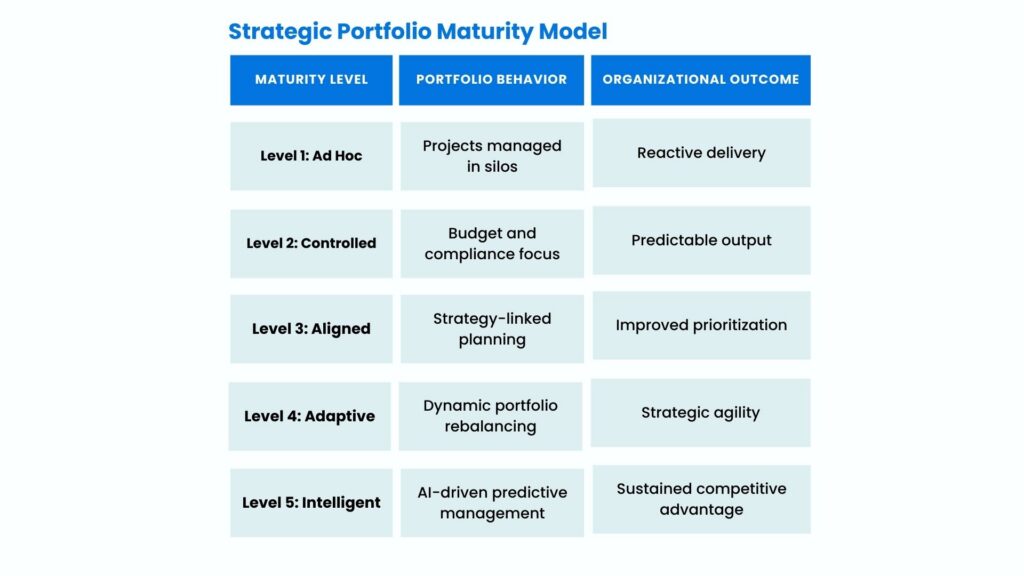
Most organizations operate between Level 2 and Level 3. Competitive leaders operate at Levels 4 and 5.
Does your strategy looks clear but delivery feels chaotic?
Explore how modern Kytes Strategic Portfolio Management can reconnect ambition with action.
Building Strategic Portfolio Management as a Core Capability
Achieving portfolio maturity requires both cultural and technological transformation.
Key Capability Pillars
- Strategic clarity
- Governance discipline
- Delivery transparency
- Financial agility
- AI-driven intelligence
These pillars must operate as a single ecosystem, not isolated functions.
Organizations that embed Strategic Portfolio Management into leadership rhythm create an environment where:
- Strategy adapts continuously
- Teams understand strategic relevance
- Investments evolve dynamically
- Execution delivers measurable outcomes
Governance Without Bureaucracy
Governance often becomes synonymous with friction. Yet strategic governance should enable speed, not restrict it.
Effective portfolio governance focuses on:
- Decision clarity
- Strategic thresholds
- Investment guardrails
- Rapid escalation paths
Rather than controlling activity, governance should control direction.
Delivery teams thrive when strategy provides clarity, not constraints.
Strategic Portfolio Management enables:
- Clear prioritization
- Realistic capacity planning
- Transparent trade-off decisions
- Reduced delivery friction
This allows execution to become purposeful rather than frantic.
Strategic Portfolio Management in Action: Real-World Scenarios
Scenario 1: Product-Led SaaS Enterprise
Without portfolio intelligence:
- Product teams compete for funding.
- Roadmaps overcommit.
- Technical debt accumulates.
With Strategic Portfolio Management:
- Investment is tied to product strategy.
- Capacity aligns with growth objectives.
- Innovation accelerates without destabilizing delivery.
Scenario 2: IT Services Organization
Without portfolio alignment:
- Resource utilization dominates decisions.
- Strategic differentiation erodes.
With Strategic Portfolio Management:
- Delivery prioritizes long-term client value.
- Capacity shifts dynamically across programs.
- Profitability and reputation rise together.
Takeaway
Strategy is not defined by vision statements. It is defined by the choices organizations make every day about where to invest time, money, and talent. Strategic Portfolio Management is the discipline that ensures those choices remain coherent.
In a world defined by uncertainty, volatility, and constant technological disruption, alignment between strategy and delivery is no longer optional. It is the difference between organizations that adapt and those that slowly fade.
When portfolio intelligence becomes central to leadership decision-making, strategy regains its power. Execution regains its purpose. And organizations regain their capacity to move deliberately, even in chaos.