
Blog Highlights
- Most IT firms struggle with visibility, not talent shortage
- Poor allocation quietly reduces margins
- Legacy tools create planning gaps
- Real-time visibility improves project delivery
- Better forecasting supports smarter hiring
- Kytes connects planning, delivery, and financial control
It’s often quite tempting and simple-seeming how growing an IT service looks on the surface. More work comes in, more sales targets need to be met, the sales pipeline looks full of potential.
However, the issue of growth often breeds strain before it breeds scale. One architect may end up handling more projects than they can manage and highly skilled resources may not be utilized enough. Leaders may recruit ahead of capacity, bench costs may be rising, delivery schedule might slip… And so on.
This is where Resource Planning software comes in handy. Resource planning software allows an IT service business to predict demand, manage employees, and align the capacity with delivery requirements to scale in a controlled rather than confused manner. It’s not shortage of talent but lack of visibility, inefficient forecast and bad allocation which often prove challenging to most of the IT and ITES firms.
What Is Resource Planning Software?
Resource planning software helps a business schedule, allocate and monitor staff, skills, budgets and time.
It allows leaders to clearly see team capacity, upcoming demand and the way resources are currently used, enabling them to make informed choices about how many people they need to hire and deliver against time.
Without the software, many companies operate on spreadsheets or separate systems, failing to identify future staffing shortages, failing to allocate overloaded individuals fairly or fail to utilize expensive resources.
As time progresses, these workforce planning deficiencies impact on delivery times and profitability.
The Real Problem: Most Companies Do Not Have a Talent Shortage
It’s common in many IT firms to attribute project delays to lack of resource (more people) to carry out the work.
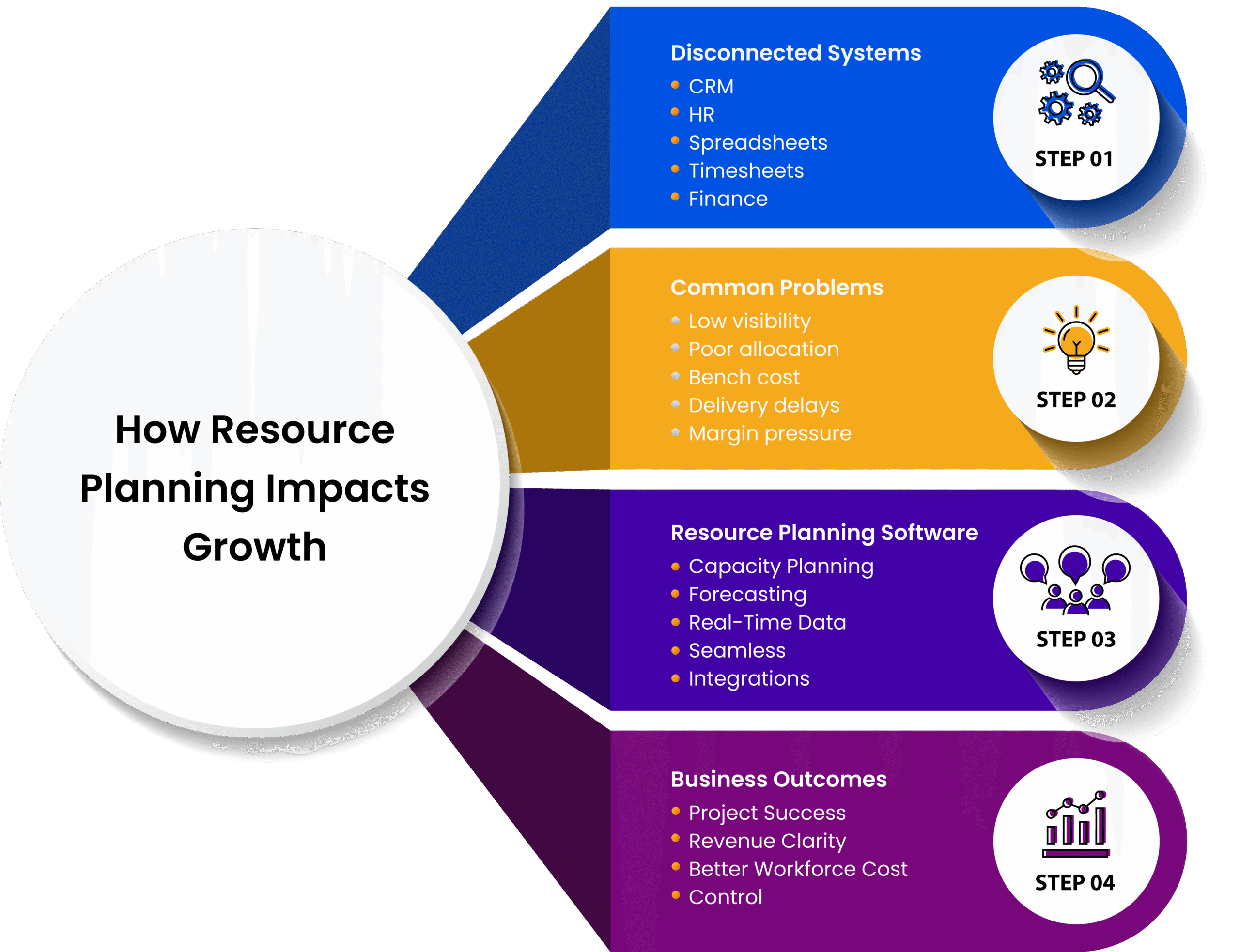
In reality most businesses already have capable resource. The actual issue is the lack of visibility; the sales team work on a different system from delivery, both work separately to HR and then there is finance, creating operational blind spots through the organization. This lead to leader hiring resources before necessary or over burdening specialists, while an alternative is often already there.
Common Resource Planning Challenges in IT Services
Poor Capacity Planning
Hiring is reactive, not strategic, in the absence of reliable forecasting. In some cases over-hiring leads to high bench costs, in others under-hiring results in delivery pressures. In both cases, business growth suffers.
Weak Resource Allocation
Manual planning leads to imbalanced workload distribution: some team members get burnt out while others have excess capacity. Lowers productivity and diminishes performance.
Bench Cost Leakage
Idle resources also lead to hidden expenses. For example, a lot of bench cost results from lack of planning, not from lack of need.
Delivery Delays
The main cause for project delays is a mis-alignment between the available workforce resources planned and actually used.
Why Traditional Tools Fail
Although delivery is becoming more complex, the majority of businesses still manage using spreadsheets, HR systems, or standalone project software packages.
These tools will track tasks but do not solve strategic resource planning.
They Focus on Tasks, Not Capacity
While standard tools can represent the currently allocated resources, they lack the ability to display future demand requirements, available capacity or planning shortcomings.
They Lack Real-Time Visibility
Late updates result in late responses from leaders, at which point delivery could already be off target.
They Ignore Financial Outcomes
Well done on your resource planning that will help make income easier to understand, defend margins and provide greater control of labor costs.
How Resource Planning Impacts Growth
What Modern Resource Planning Software Should Deliver
Modern IT services firms need more than scheduling.
They need strategic control.
1. Real-Time Visibility
This need for Leaders to have insight into the workload, skills and resources used and in the future needed.
2. Data Driven Decisions
A business plan needs to be about the linkage between sales, staffing and delivery, workforce capacity.
3. Seamless Integrations
It is better to keep sales, HR, delivery, and finance working as one.
4. Margin Protection
With better planning it will result in less waste, less expenditure and therefore a more healthy margin.
Why Kytes Works as an All-in-One Resource Planning Software
Kytes provides businesses with the ability to address more complex planning challenges, by integrating the three core areas of resources planning, delivery execution and financial insight into one common platform. Now instead of dealing with separate systems, managers have a single linked system of control.
Capacity Planning
It also enables to anticipate the future demand and resources early in the process.
Resource Allocation
Kytes assist to allocate correct person according to the skill sets available and the project requirements and resource availability.
Project Delivery
Kytes synchronises its projects with real labor conditions.
Financial Control
Kytes monitors resource consumption, profit margins, and staffing costs on a minute-by-minute basis.
This gives Kytes its edge beyond resource management software; it transforms Kytes into the control system that IT service providers are looking for to increase visibility, drive effective delivery, and scale their businesses.
Leadership Impact
Business leaders know that their resource planning directly affects their business outcome.
Well-planned resources provides revenue clarity, because delivery matches contractually agreed deadlines. It helps preserve margins by eliminating under-delivery due to poor allocation and “secret bench” costs. Workforce costs can be driven down, thanks to sound recruitment strategies and efficient resource utilization. Finally, it leads to successful projects, as efforts are matched to the available team.
Final Thought
Rarely will IT services firms fail because they don’t have talent. They will fail because they don’t fully see, predict and control resources. This is precisely why resource planning software is becoming a strategic growth system. For firms serious about project delivery, better resource control and margins Kytes might just be the solution for you. In contemporary IT services the reason demand is not a growth impediment is because of the fact that its lack of visibility is. Firms that grow the most are those that do it with clear planning, allocation and execution.
For IT services firms looking to improve delivery control, resource clarity, and scalable growth, exploring a connected platform like Kytes may be a practical next step.