

Blog Highlights
- All types of businesses with work or projects to staff can benefit from matching available skills, resources and rates to various project needs, to maximize margins.
- Sub-optimal resourcing, too much bench, lack of required skills and other issues all contribute to slippage on projects, higher staffing costs and lower margins.
- Effectively allocating available resources to suitable projects should result in higher levels of billable utilization and better control of total costs of the available resource pool.
- By relating expected requirements from sales opportunities to available resources, companies can make better predictions of their future resource needs and avoid resource deficits.
- There are a number of ways that AI can be beneficial, including skills matching, forecasts of future demand, warnings of issues, and overall better information on current resource status.
- Linkage to project costs and other systems, for example, ERP or HRMS, will allow detailed analysis of resources, their costs and utilization, typically company-wide.
As well as recording staff allocation and hours, good workforce management solutions will match available resources with project requirements on various criteria including skills, cost rates, time available and the resulting project margins. All key commercial considerations therefore enter into allocating resources to work. With most organizations dependent on generating billable hours, it will be a major determinant of conversion of hours worked to fees billable and ultimately received.
The head of one business unit of an approximately 300 staff IT and engineering company based in Chennai would review overall staff utilization each Monday morning, showing around 71% on average. A number of projects were subsequently under-margin in the quarter. On investigation this was largely due to inappropriate allocation of resources, in particular too many highly skilled and -costed engineers allocated to work readily within the capability of others at about 50% cost rate. Also available were 2 very specially-skilled resources who were idle, while an external supplier was being approached to provide similar skills at approximately 300% cost rate for another project.
On average, firms in the SPI Research 2026 study achieved 66.4% billable utilization, the lowest in the 19 years of the survey, and EBITDA margins of 9.9%. These results are hardly surprising, given the continuing reliance by many on intuition, spreadsheets and ad hoc enquiries as to who may be available, instead of appropriate software to optimize available skills and capacity against total requirements.
What Does Workforce Management Software Do for Project-Driven Firms?
Most companies in the IT, engineering, professional services, pharma CRO or EPC sectors will find that rostering and recording hours and absence are insufficient. All of these can be argued to fall squarely within HR’s remit. They all want to know who of what skill, and therefore cost to the business, to allocate to what opportunities, for how long and from when, and the impact on profitability.
Appropriate software will therefore seek to combine information about available resources and their relevant skills, day rates, planned absence, nationality and so on; relevant information about all current projects; and information about opportunities being pursued, anticipated timing and skills required. All of this will be valuable to a head of delivery to assess availability, suitability and the commercial implications. It has been estimated that 5-10% of total income per annum is forfeited as a result of inadequate matching of resources to projects. On revenues of $25m, this represents $1.25-$2.5m lost each year due to resource shortfalls and mismatches.
Where Do the 5 Biggest Staffing Failures Hide?
Most failures in project business margins can be classified into 5 broad categories, all relating to mismatches of resources against some aspect of the estimated price of the work.
Failure 1: Staffing by Availability Instead of Fit
There are various resources with appropriate skills available to be allocated to meet a requirement on a project. It’s convenient to allocate the first one shown as available on RMS (or spreadsheet) to the project. However, he may charge $110 hr-1 versus an estimate of $80, whereas someone with suitable skills may be available in about a week at $72. There is clearly a significant risk to margins from haphazard allocation of resources with no guide to their skills or cost.
Failure 2: Bench Time Hides in Plain Sight
Someone with a particular skill set, for example validation, may be idle for a number of weeks. At the same time the company may be paying an outside party, at $180 hr-1, to supply this skill set for a pharmaceutical project. Clearly there is a significant cost of keeping the resource idle. For example, at $95 hr-1, 3 weeks would cost around $11,400. Unless there is software to assist with allocating resources to all known requirements, there is little chance that either the PMs or Resource Manager will know of the requirement.
Failure 3: Pipeline Demand Hits Without Warning
A number, for example 3, of bids may be successful in any one month requiring a similar skill set, for example, various embedded systems. If there are only 4 appropriate staff available for all these new projects, this problem will become apparent around the start dates, in the absence of software to indicate likely requirements based on the bid pipeline against existing committed requirements. Again outside contractors at high rates, and or project delays, will be necessary.
Failure 4: Cross-Border Staffing Ignores Cost Arbitrage
With employees in several locations such as India and the US, an important consideration is whether work can be done as economically as possible in one of the cheaper locations. For example, equally good development work may be available in India (Pune) at $45 versus $125 in Dallas. Subject to sufficient common time zones and terms of contract with the customer, there could be a large saving. Unless all relevant information on location and rates and restrictions is readily available to the person making the resource decision, this benefit will generally be lost.
Failure 5: Utilization Looks Healthy but Margin Does Not
It is common to achieve apparently healthy overall staff utilization levels, for example 72%, and be content with this. Of course this only reflects total time spent working. Many factors may apply, such as over-qualified staff working at much higher rates than justified, to give a very different result when considering billable utilization, that is time worked at appropriate rates on appropriate jobs. Thus highly qualified staff at $95 working on activities suitable for much less skilled people at $55 will give 100% utilization but poor contribution. It is therefore important to distinguish between these 2 measures of utilization and have suitable software to report the latter.
What Should You Look for in Resource Management Software?
There are 7 key features to look for in resource management solutions aimed at professional services businesses.
Skill-based matching with depth-It should be able to distinguish between various levels and types of skill and search on these criteria. There are many more distinctions to be made than just between, say, validation and process engineers, or programmers proficient in Python versus Java. If resources are allocated broadly by job description alone, there will be many inappropriate assignments. A recent McKinsey Global Survey found that 87% of senior managers believed there were skills shortfalls across their overall employee base (McKinsey 2022). Much of this for a services business would be due to inappropriate assignment of available skills. That is, suitable skills are available within the business, but not readily identifiable.
Cost rate and margin impact at the point of assignment-Once a resource has been identified, it would be very useful to know their rate, the available budget for that area of the project, and the resulting projected margin, compared with other options. Assigning resources to projects with no regard to the financial implications is hardly sensible.
Portfolio-wide demand and supply view-Ideally all requirements from current projects, proposals and future planned projects would be displayed, against available resource capacity by appropriate skills, geography, and time available. All of this information would allow effective overall resourcing of the business as a whole, rather than a series of individual searches to staff each project.
Bench tracking with proactive alerts-It should also be possible to identify individuals likely to fall to bench in the near future and identify requirements that they could be allocated to. Obviously, it is better to avoid the bench by identifying work to keep people fully utilized, rather than accepting 100% cost with nil income.
Billable and non-billable time separation-A proportion of total hours worked will be on non-billable internal tasks. It is therefore desirable to record this as distinct from hours on billable projects when timesheets are entered, in order to obtain an accurate figure for utilisation on billable projects only.
Pipeline-to-capacity forecasting-It would also be valuable if requirements could be generated based on the current sales pipeline and assumed win ratios. This would enable appropriate advance action by the Head of Delivery to ensure sufficient skills available to deliver the work, whether through recruitment, training or purchase of third party resources.
Multi-location, multi-currency workforce view-Appropriate functionality would enable application of different costs by location, time zones, visa considerations and proportions of billing in various currencies, all relevant where there may be a mix, for example, of Indian and US based staff delivering each project. Obvious suitability for a particular piece of work may be less attractive once associated rates and other considerations are applied.
How Does Resource Allocation Software Change Staffing Decisions?
When resource allocation software connects to project financials, three shifts happen that spreadsheets cannot replicate.
Staffing becomes a margin decision-As well as available resources, the PM has visibility of the relative costs of individuals and the overall budgets available. SPI Research 2026 shows best-in-class companies achieving an average utilization of 79.5%, compared to only 66.4% overall. This difference will largely be down to appropriate allocation based on cost and other attributes.
Conflicts surface before they cause damage-Current requirements across all projects, as well as proposed work, will be considered. So, for example, if resources to tender on 2 projects are required over the same period, this would be highlighted well in advance of any SOW issue, allowing appropriate forward planning.
Bench time converts to billable hours-Suitable available resources can also be identified for future requirements and allocated in advance. Assuming 50 available resources at an average cost of $6,000 per month, a reduction of just 2 weeks overall would be worth approximately $150,000 per quarter with no requirement for additional business.
Generic HR Tool vs Project-Connected Workforce Platform: What Changes?
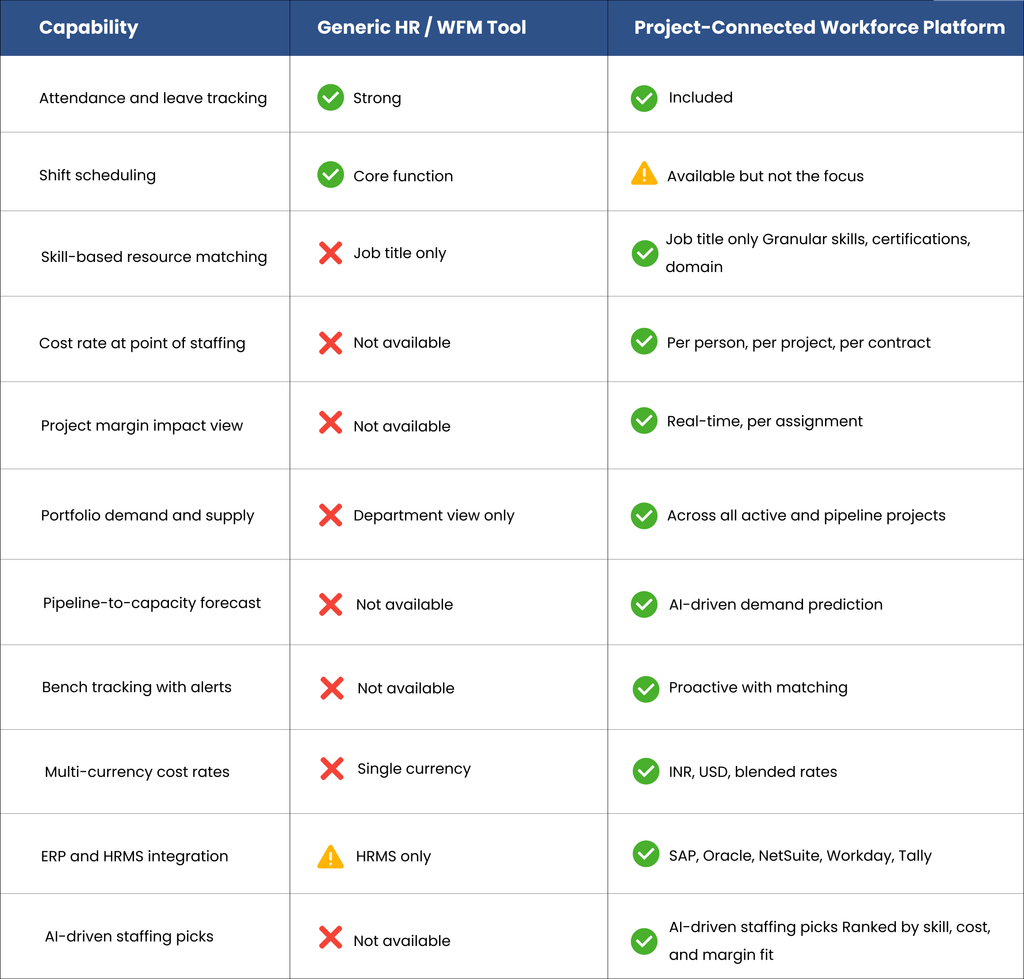
Margo Visitacion, VP and Principal Analyst at Forrester, defines capacity management as making sure resources can be applied to the best available opportunities (Forrester, 2025). This would essentially cover all functions of a PMO for many service businesses. All resources will have an associated cost, and all opportunities will have desired margins. So ideally, on assignment, the system being used would relate these together, failing which the PMO will be left guessing.
There will be many situations where resources need to be scheduled generally over time, such as most in-house support functions, and there are good systems available to support this level of reporting. However, for a business delivering 30-200+ projects to customers, being able to relate the resources to specific projects is vital, in order to understand profitability.
How Should You Evaluate Workforce Planning Platforms?
Complete the following 5 checks, each about an hour long, against any candidate software. At the end you should know to what extent each product links resources and their costs to delivery.
- On allocating resources to projects, would the PM know the rate of those resources and the resulting margin on the project? If not, he will be guessing the margin implications of each allocation.
- Would the Resource Manager be able to view requirements for all current and proposed work? If not, there will inevitably be resource clashes between projects and idle capacity that will come to light only at a later date.
- Would requirements be generated based on opportunities in the sales pipeline? Most products purporting to be workforce planning tools will do this and allow the Head of Delivery to begin allocating well in advance. Otherwise, all projects will, to a greater or lesser extent, involve frantic efforts to find suitable resources.
- If delivering from more than one location, can various rates be applied according to location, as well as other parameters such as time zone and billing arrangement? All these would need to be available when making allocations to a project if there is, say, both Indian and domestic delivery capacity.
- Is there an interface with other key systems, in particular the ERP (for example, SAP, Oracle, Tally) and HRMS (for example, Workday)? Ideally key information would be fed to and from these automatically.
Where Does Kytes Fit in This Picture?
Kytes is a PSA and PPM system with various AI functionalities, targeting companies predominantly delivering projects. These include IT services, engineering services, pharmaceutical, EPC and other GCC type businesses, all managed off a single common dataset.
Skill-based staffing with margin context-It compares resources available versus required for all projects, on various parameters including skills, rates and geography. Its algorithms determine preferred resources based on suitability for the project, margins and other relevant factors. Typical results after the first few months for an engineering services business include improvements in resource utilization of around 14% and project completion times of 21%.
Pipeline-to-capacity forecasting-Based on current opportunities, it can estimate future resource requirements, enabling the delivery head to plan appropriately about 8 weeks out rather than reacting to receipt of a SOW.
Project financials at the point of staffing.All resources have associated costs, rates and hence margin implications. So any decision to allocate a resource has an immediate indication of the impact on overall project margin.
AI-driven intelligence-Other examples of the application of AI include prediction of slippages, identification of projects at risk, auto-generation of a range of documents, and free text search over all information. It will also highlight declining utilization levels, increasing numbers on the bench, and other such information to relevant management.
Enterprise integration-It will interface to most major ERP systems including SAP, Oracle, NetSuite, Tally and Workday. A major Japanese E&E company has implemented this to provide all key workforce and project information, instead of multiple stand-alone Excel files. The Head of Delivery of an IoT and embedded systems company commented: “Kytes is an excellent indicator of health and progress of all our various projects”.
Frequently Asked Questions