
Blog Highlights
- Cash flow forecasting fails in most software organizations because delivery updates do not reach finance in time.
- Even a single delayed milestone can trigger immediate cash leakage and disrupt planned inflows.
- Fragmented tools across delivery, finance, and billing create blind spots that make forecasts unreliable.
- Integrated project financials restore accuracy by linking WBS progress, milestones, billing events, and cash models in one system.
- AI strengthens forecasting by predicting milestone slippage, surfacing unbilled work, and adjusting cash projections in real time.
- Cash visibility is a strategic advantage, influencing hiring decisions, risk management, and growth planning.
- PSA platforms outperform ERPs for forecasting because they connect financial outcomes directly with project execution.
- Kytes AI-enabled [PSA+PPM] Software delivers real-time cash clarity, faster billing cycles, and stronger accountability across all projects.
Cash flow forecasting is often viewed as a finance function, but in software project organizations, it is ultimately a project execution function. The timing of cash inflows depends not on accounting models but on how accurately projects progress, how reliably milestones are achieved, and how quickly billing can be triggered. Yet most companies still rely on fragmented tools—finance works inside ERP systems, delivery operates in isolated project tools, and milestone updates travel slowly or inconsistently. The result is chronic forecasting inaccuracy, repeated cash surprises, unplanned borrowing, and financial stress that could otherwise be prevented.
In software and IT services, cash does not arrive in a steady monthly rhythm. It arrives in lumps, tied to contractual billing milestones or time-based cycles. A single slipped milestone can disrupt an entire cash plan, pushing organizations into reactive problem-solving mode. This blog explores why forecasting breaks, how milestone behavior drives financial volatility, and how integrated PSA platforms and AI-driven insights restore reliability. Finally, it examines how Kytes AI-enabled [PSA+PPM] Software brings real-time accuracy and accountability into cash planning for CXOs.
Why Cash Flow Forecasting Goes Wrong in Software Project Organizations
Forecasting challenges arise from structural gaps between delivery and finance. The moment a project begins, both teams start working on different timelines, with different data and different levels of visibility.
1. Project Plans Change, but Forecasts Don’t
Finance departments prepare cash flow forecasts based on initial milestone plans. But once execution begins, real-world timelines shift due to resource fluctuations, requirement changes, unexpected complexity, or client-side delays. Although delivery teams update schedules internally, finance rarely receives timely updates. Forecasting becomes detached from reality.
2. Delayed Milestones Create Direct Cash Leakage
In milestone-billing projects, cash flow is tied to delivery progress. Even a short delay disrupts inflows, often triggering working capital shortages. Outflows continue—salaries, software subscriptions, cloud costs, subcontractor payments—while inflows freeze. This mismatch silently erodes liquidity and increases financial risk.
3. Unbilled DSOs Build Up Quietly
Work is completed, but invoices are not raised because:
- PMs fail to inform finance
- deliverables are pending documentation
- acceptance criteria are not clarified
- billing workflows are manual
Each day of unbilled work increases DSOs, affecting cash health even when revenue is technically earned.
4. Fragmented Systems Multiply Forecast Errors
Most companies use:
- Project tools for tasks
- ERPs for finances
- Excel for tracking
- Email/Slack for communication
With no single source of truth, project forecasting becomes guesswork. Forecasts prepared monthly or quarterly become outdated after a few days.
5. Cumulative Cash Risk Across Projects
Delays, when multiplied across portfolios, become multi-crore cash gaps. CFOs often discover this only when treasury cycles expose the shortfall.
These breakdowns highlight the necessity for integrated systems capable of linking project progress directly with billing and cash flow models.
See how Kytes AI-enabled [PSA+PPM] Software provides real-time cash flow visibility across all projects.
Book a Demo
The Critical Need for Integrated Project Financials
Software companies can no longer afford forecasting processes that operate independently of delivery execution. Integrated project financials change the entire dynamic by aligning WBS progress, resource usage, milestones, deliverables, and billing triggers into a unified financial model.
1. WBS Tasks Mapped Directly to Billing Milestones
Traditional models treat milestones as static dates. Integrated PSA platforms treat milestones as task-dependent events. When WBS items slip or accelerate, milestone dates automatically adjust—creating dynamically updated forecasts.
2. Real-Time Delivery and Finance Synchronization
Both teams get simultaneous access to:
- planned vs actual progress
- realistic billing dates
- upcoming inflow windows
- risks to cash projections
This eliminates communication lag and brings forecasting accuracy closer to real-time precision.
3. Early Alerts for Cash Flow Disruptions
Integrated systems detect early signals:
- delayed tasks
- incomplete deliverables
- approvals pending
- client-side dependencies
- resource shortages
They flag risks before they translate to cash delays, giving CXOs time to intervene.
4. Immediate Billing Once Work is Completed
As soon as all milestone-linked tasks are finished, automated notifications reach both PMs and finance—triggering faster billing and reducing unbilled DSOs. This directly improves cash cycles.

The Cost of Delayed Cash Flows
Software project companies operate with high people costs and predictable outflows. Even a minor delay in cash inflow forces organizations to take loans, delay vendor payments, rely on credit, or postpone investments. Across multiple fixed-price projects, these delays accumulate into staggering financial losses.
Delayed payments eventually come, but the opportunity cost of delayed cash is irreversible. Companies pay interest, lose flexibility, and weaken their balance sheet merely because milestones were not properly tracked or communicated.
When billing delays occur across dozens of projects, this becomes not just a project risk—but an organizational liquidity risk.
See Kytes in action to know how AI-powered project forecasting prevents slippage of billing milestones and strengthens cash discipline.
Why Portfolio-Level Cash Flow Management Is More Critical Than Project-Level Accuracy
Most software organizations try to optimize cash flow one project at a time. However, real cash stability is determined not by individual project performance, but by how delays, accelerations, or billing gaps accumulate across the entire portfolio. CXOs often discover cash shortfalls only when treasury cycles reveal discrepancies—long after the warning signals were present inside individual projects.
Portfolio-level forecasting is difficult because each project carries its own billing logic, milestone structure, approval workflows, and client-side dependencies. A 10-day delay may be manageable at a project level, but when 20–30 projects slip simultaneously, the organization faces multi-crore liquidity disruption. Outflows—salary cycles, cloud contracts, vendor payments—remain fixed, while inflows fluctuate unpredictably based on delivery behaviour. This creates a structural mismatch that cannot be solved by project-level monitoring alone.
Hidden Risk is Portfolio Billing Concentration
Many software companies have peak billing periods tied to quarter-end deliverables or specific milestone clusters. When these clusters slip, the entire financial plan collapses at once. Without portfolio visibility, finance teams cannot anticipate when inflows will bunch or dry up—leading to emergency borrowing, delayed investments, or inability to commit to new projects.
Portfolio-level forecasting also provides strategic opportunities. It highlights high-risk clients who consistently delay documentation, projects that repeatedly miss acceptance deadlines, and teams whose velocity trends impact billing reliability. It gives CXOs clarity to reallocate resources, re-sequence milestones, or negotiate better commercial terms.
When project-level data is aggregated across portfolios in real time, leaders can finally move from reactive troubleshooting to proactive cash planning. This shift is essential for building financial resilience—especially in people-intensive businesses where cash determines execution capacity.
Why CXOs Must Elevate Cash Flow Forecasting to a Strategic Priority
Cash isn’t just an accounting metric—it determines the organization’s ability to:
- Scale delivery
- Hire confidently
- Handle downturns
- Accelerate growth
- Invest in new capabilities
- Acquire clients
- Build innovation pipelines
Most software businesses fail not due to poor margins but due to poor cash visibility.
This visibility can only be restored through integrated forecasting, not disconnected spreadsheets.
The Role of AI in Project Forecasting and Cash Visibility
AI brings predictive intelligence to forecasting by analyzing patterns across historical performance, resource behavior, project velocity, and milestone variability.
1. Predicting Milestone Slippage in Advance
AI models evaluate:
- Velocity trends
- Team productivity
- Number of open blockers
- Pending dependencies
- Schedule variance
It identifies milestones likely to slip and quantifies the potential cash impact early.
2. Identifying Unbilled Opportunities
AI continuously evaluates deliverable readiness, task completion, and blockers. If a milestone is billable, the system alerts finance immediately.
3. Dynamic Project Forecasting
AI adjusts forecasts as:
- Scope changes
- Shifts in resource capacity occur
- Team allocations change
- Holidays or leave impacts arise
- Project risks escalate or resolve
This makes cash flow forecasting in project management software adaptive and accurate.
4. AI Dashboards for CXOs
Leaders gain access to:
- Rolling cash inflow predictions
- Variance analysis
- BU-wise exposure
- Customer-specific cash trends
- Scenario-based projections
These insights replace static forecasts with actionable intelligence.
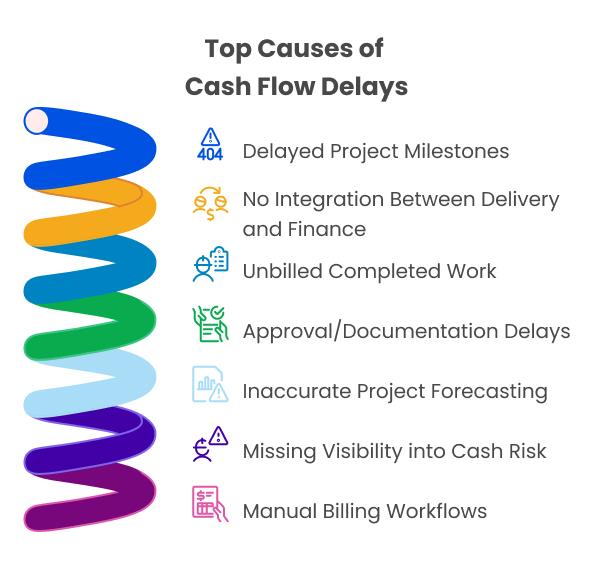
This visualization highlights the structural root causes that must be solved.
Why PSA Platforms Are Becoming CFO Essentials
CFOs increasingly rely on PSA over ERP for forecasting because:
- ERPs don’t track milestone behavior
- PM tools don’t understand billing logic
- Spreadsheets cannot process dynamic project environments
- Manual communication creates leaks
- Finance needs real-time project visibility
- Delivery needs structured billing alignment
A PSA platform closes all these gaps, especially when built as a unified Opportunity-to-Cash system.
How Kytes AI-Enabled [PSA+PPM] Software Helps CXOs Master Cash Flow Forecasting
Kytes provides a single system where every task, milestone, deliverable, billing event, and inflow prediction stays synchronized.
Kytes delivers:
1. Realistic, Dynamic Cash Flow Projections
Because milestones are tied to actual WBS tasks—not static dates—forecasts reflect the truth of project execution.
2. Predictive Cash Risk Alerts
AI evaluates project behavior and alerts leadership before cash disruptions occur.
3. Lower DSOs and Faster Billing
Automated milestone achievement notifications drive quicker invoicing.
4. CXO-Level Drilldowns
Across customers, portfolios, BUs, teams, and even individual tasks.
5. True Accountability Across the Value Chain
Delays can be traced back to root causes, helping leaders build a culture of financial discipline.
Conclusion
Cash flow forecasting in software project management must evolve from a static spreadsheet exercise into a dynamic operational discipline. In a business model where cash depends on execution, forecasting must reflect project reality—not outdated assumptions. Traditional tools fail because they fragment delivery and finance. Integrated PSA platforms unify them, while AI elevates forecasting from reactive updates to predictive intelligence.
Organizations that master task-to-milestone synchronization, billing accuracy, and real-time cash visibility gain a competitive advantage: stability, predictability, and strategic freedom.
Kytes AI-enabled [PSA+PPM] Software empowers CXOs with precisely this capability—delivering real-time cash forecasts, actionable insights, and a unified financial view of project execution.