
Blog Highlights
- Project visibility has become a strategic leadership capability, directly shaping revenue predictability, margin protection, and execution confidence.
- Executives need decision-grade visibility across financials, delivery performance, resources, and forecasts—not fragmented operational reports.
- CXO dashboards serve as the primary interface between enterprise execution and leadership decision-making by unifying cross-functional data.
- Unified data foundations and AI-enabled PSA + PPM platforms make real-time, trustworthy visibility possible at scale.
- Organizations that operationalize executive project visibility gain faster decision-making, higher forecast accuracy, and stronger portfolio control.
As portfolios grow larger and delivery models become more distributed, PMOs are expected to make faster, higher-stakes decisions—often with incomplete or delayed information.
This is where project visibility becomes a leadership issue rather than an operational one.
Executives do not lack data. They lack decision-grade visibility. Status reports arrive late. Dashboards contradict each other. Financials and delivery metrics live in separate systems. The result is an environment where leadership decision-making is reactive instead of proactive.
Project visibility for executives is about ensuring that CXOs have a clear, real-time, and trustworthy view of portfolio health, financial performance, resource capacity, and delivery risk—without depending on manual consolidation or subjective interpretation.
Organizations that solve this challenge create a structural advantage. They intervene earlier, allocate capital more effectively, and steer delivery with confidence.
The Visibility Gap in Enterprise Project Environments
Most enterprise IT professional services organizations operate across multiple systems:
- Project and portfolio management tools
- Professional services automation platforms
- ERP and financial systems
- Time and expense tools
- Spreadsheets maintained by teams
Each system may be accurate within its own boundaries. The problem arises when executives try to view performance across them.
Common symptoms of the visibility gap include:
- Portfolio-level revenue forecasts that differ from finance projections
- Delivery status that does not reflect financial risk
- Utilization numbers that cannot be tied to margin impact
- Lag between execution issues and executive awareness
Because data is fragmented, leadership views are constructed through manual aggregation and periodic reporting cycles. By the time insights reach executives, they are already outdated.
This gap becomes more severe as organizations scale. What worked for a few dozen projects breaks down when portfolios reach hundreds or thousands of concurrent engagements.
How Poor Project Visibility Impacts Leadership Decision-Making
Visibility is not an abstract reporting problem. It directly shapes the quality and speed of leadership decisions.
When executives lack real-time insight:
- Investment decisions are made using stale forecasts
- At-risk projects are discovered late in the lifecycle
- Resource shortages become emergencies instead of planned shifts
- Margin erosion is identified after it has already occurred
Leadership teams end up managing by exception—reacting to escalations rather than steering performance.
In contrast, strong project visibility enables:
- Early detection of delivery and financial risk
- Continuous prioritization of high-value initiatives
- Faster reallocation of budget and resources
- Greater confidence in revenue and margin projections
In practical terms, better visibility shortens the distance between what is happening and what leaders do about it.
What Executives Actually Need to See (Not More Data, But Better Signal)
Executives do not need task-level detail. They need synthesized views that translate operational activity into business impact.
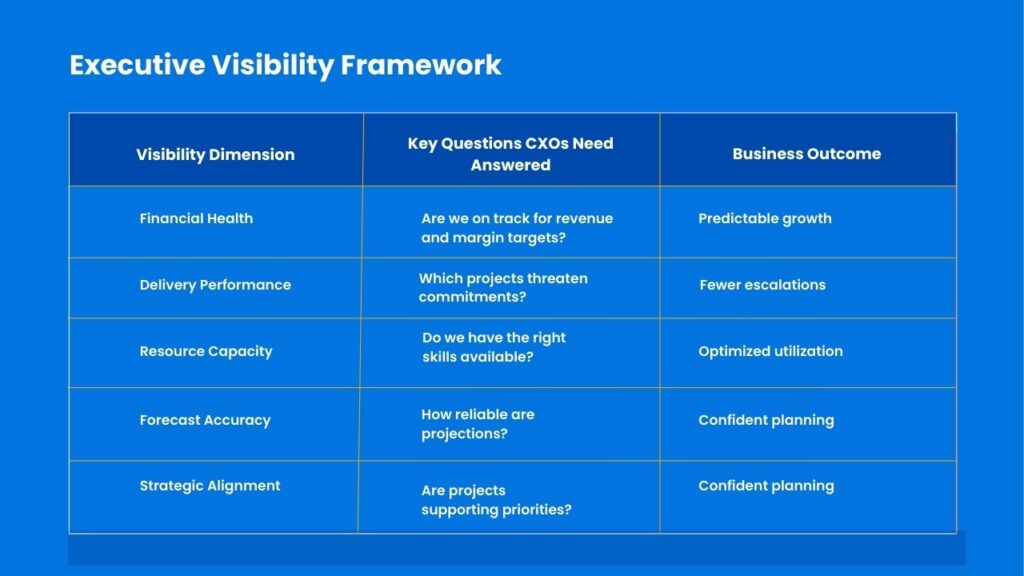
Executive-grade project visibility focuses on five core dimensions:
- Portfolio financial health
- Delivery performance
- Resource capacity and utilization
- Forecast accuracy
- Strategic alignment
These dimensions ensure leaders see both current performance and forward-looking risk.
The Role of CXO Dashboards in Driving Executive Alignment
CXO dashboards act as the primary interface between enterprise execution and leadership decision-making.
Well-designed CXO dashboards:
- Consolidate data across delivery, resources, and financials
- Present standardized definitions and metrics
- Refresh in real time or near real time
- Support drill-down from portfolio to project level
This creates a shared source of truth for executives, PMOs, finance leaders, and delivery heads.
Effective CXO dashboards typically include:
- Portfolio revenue and margin outlook
- Top at-risk projects by financial and delivery impact
- Capacity constraints and utilization trends
- Forecast vs actual performance
- Geographic and practice-level performance
When all leaders operate from the same dashboards, alignment improves. Conversations shift from debating numbers to deciding actions.
From Project-Level Visibility to Portfolio-Level Intelligence
Project-level reporting answers the question: Is this project on track?
Portfolio-level intelligence answers: Is the business on track?
Executives need visibility that rolls up across:
- Programs
- Accounts
- Regions
- Practices
- Strategic initiatives
This aggregation allows leadership to:
- Compare performance across portfolios
- Identify systemic execution issues
- Prioritize investments based on return potential
- Balance growth and profitability
Without portfolio-level intelligence, executives are forced to extrapolate from individual project snapshots. This approach does not scale.
Why Unified Data Foundations Are Essential for Executive Visibility
Executive visibility collapses when delivery data and financial data originate from different systems.
A unified data foundation ensures that:
- Time and expense actuals feed financial projections automatically
- Delivery progress updates refresh forecasts
- Resource allocations reflect in cost and margin models
- Billing and revenue data align with execution milestones
This eliminates manual reconciliation and conflicting reports.
A strong foundation also requires:
- Integrated ELT pipelines
- Data standardization and cleansing
- Role-based access control
- Governed reporting views
Without this infrastructure, even the best dashboards become unreliable.
How AI-Enabled [PSA + PPM] Software Enable Executive-Grade Visibility
Modern AI-enabled PSA + PPM platforms are designed to unify execution, resources, and financials within a single operational environment.
Software like Kytes provide a unified analytics layer across project delivery, resources, financials, and portfolios—giving executives a single, trusted view of performance.
Key capabilities that support executive visibility include:
Multi-Level Graphical Dashboards
Interactive dashboards with role-, region-, and function-based views allow executives to track revenue, utilization, margins, schedules, and costs—and drill down from portfolio to individual project in real time.
Embedded Analytics
Contextual metrics are embedded directly into workflows. Leaders and managers see live indicators such as effort variance, billing leakage, or WBS delays without switching tools.
Analytics-Ready Data Foundation
Integrated ELT engines clean, standardize, and synchronize data across systems, ensuring consistency and performance even at scale.
External BI Compatibility
Secure data access for tools like Microsoft Power BI, Tableau, and Zoho Analytics enables organizations to extend analytics into their broader BI ecosystem.
Role-Based Analytics Portals
Leadership, PMOs, finance, and delivery teams each receive personalized views aligned to their decision needs.
See how Kytes delivers real-time CXO dashboards and unified project intelligence across delivery, resources, and financials.
Book a Demo
Making Visibility Actionable: Turning Insight Into Execution Control
Visibility alone does not create value. Action does.
When executives have continuous, reliable visibility, they can:
- Reprioritize portfolios based on margin outlook
- Shift capacity toward high-growth accounts
- Intervene early on at-risk projects
- Adjust pricing or scope based on delivery economics
This closes the loop between insight and control.
Organizations move from periodic reviews to continuous steering.
Conclusion: Visibility as a Strategic Asset for Leadership Teams
Project visibility for executives is no longer a reporting convenience. It is a strategic capability.
Enterprises that rely on fragmented reports operate with delay and uncertainty. Those that invest in unified data foundations, CXO dashboards, and AI-enabled analytics operate with clarity and confidence.
Strong executive project visibility enables:
- Faster leadership decision-making
- Higher forecast accuracy
- Better margin protection
- Scalable execution
In an environment where execution defines competitiveness, visibility becomes one of the most powerful advantages leadership teams can possess.