Blog Highlights
- Find out how shared, tamper-proof records can enhance transparency and accountability and make disputing easier.
- Learn how blockchain-powered project tracking can be used to verify deliverables, trace approvals, and avoid the chaos among stakeholders.
- EPC, IT services, consulting, pharma – applicable real-world examples for The Use of Blockchain in the business world – for your industry.
- Blockchain vs. traditional PSA/PPM software: Discover the difference blockchain makes, why it won’t replace project management software, and how Kytes can help you realize the benefits of connected project delivery and financial transparency.
- Blockchain ROI, Risks, and Adoption Decisions: Evaluate potential cost savings, implementation challenges, and the factors enterprises should consider before investing in blockchain technology.
A milestone is marked as complete. The supplier claims the work was delivered. Your customer claims it was never approved. Finance is unable to authorise the invoice and the project manager is scouring email chains for evidence.
Not just the amount you argued over. The real cost is the hours lost chasing paperwork, the strain on your client relationships and the lack of visibility of your project cash flow.
Blockchain project management relies on digital records that are open and difficult to tamper with, which allow organizations to corroborate selected milestones, approvals, and transactions. Blockchain can facilitate the investigation of disputes but can’t eliminate all disagreements – or substitute the systems that govern project execution.
However, where does it truly add value for businesses in 2026?
What Does Blockchain Technology in Project Management Actually Mean?
Blockchain is a distributed ledger that can record transactions between two parties efficiently and in a verifiable and permanent way, in a cryptographically secure manner. It is, according to the US National Institute of Standards and Technology (NIST), tamper-evident and tamper-resistant-not automatically accurate.
Within an enterprise environment the permissioned network will be able to allow trusted clients, suppliers and delivery partners to record and/or verify approved events. Confidential documents are maintained within the familiar secure environments, whilst the ledger tracks timestamp and crypto.
Just think about it: a ledger can verify what was posted to it, who entered it and when. It cannot verify the physical receipt, inspection, or approval of the item without evidence and controls to support it.
Why Do Costly Project Disputes Happen?
And disputes happen when the records aren’t aligned. The contractor thinks the milestone is accepted. The customer thinks its a pending change request. And the project plan, contract and invoice tell different stories.
A shared ledger could also put an end to disagreements about whether something was ever put in there in the first place, especially if multiple bodies need to track it. But the ledger would need rules for adoption, amendments, exceptions and access.
The benefit is not the absence of fights, but the reduction of ambiguity during a fight.
How Would Blockchain-Based Project Tracking Work in Practice?
Imagine that a US engineering firm has an Indian delivery partner and an outside vendor of equipment. Equipment delay threatens to derail an installation deadline.
Illustrative scenario—not an actual customer deployment:
- The supplier submits dispatch evidence to a secure document system.
- An authorized system records its reference and timestamp on a permissioned ledger.
- The delivery team confirms receipt; an engineer reviews the evidence.
- The customer approves, rejects, or requests clarification. Each decision creates a traceable record.
- Connected financial workflows can use verified acceptance information to prepare the next billing step, subject to contractual and human approval rules.
No. If an incorrect delivery date is entered the network cannot change it. Valid correction should be added and the history kept.
And still, even if the construction gets delayed, the management software needs to be able to monitor the changes in dependencies, resource assignments, cost forecast, and commitments by customers.
Where Could Blockchain Deliver the Most Value?
Milestone approvals and smart contracts. Rules can be coded to auto-advance a review or invoice process once they have been approved by the right people. Any contract disputes or exceptions to work that fall outside the scope of the rule.
Contractor procurement/ supplier engagement. Be assured to your contractors, engineers, and vendors that all major purchase orders, inspections, shipments, or handover events occurred before trying to reconcile the files.
IT services and consulting. Greater clarity around scope change documentation, acceptance of deliverables, and scope sign-off by US customers and India delivery teams.
Pharma and CDMO. Simultaneously, the sponsors with their manufacturing partners might also be interested in examining common records of authorized standards or document occurrence, in case records safety, validation, and compliance measures are properly in place.
Blockchain vs. PSA/PPM Software: Which One Does Your Business Need?
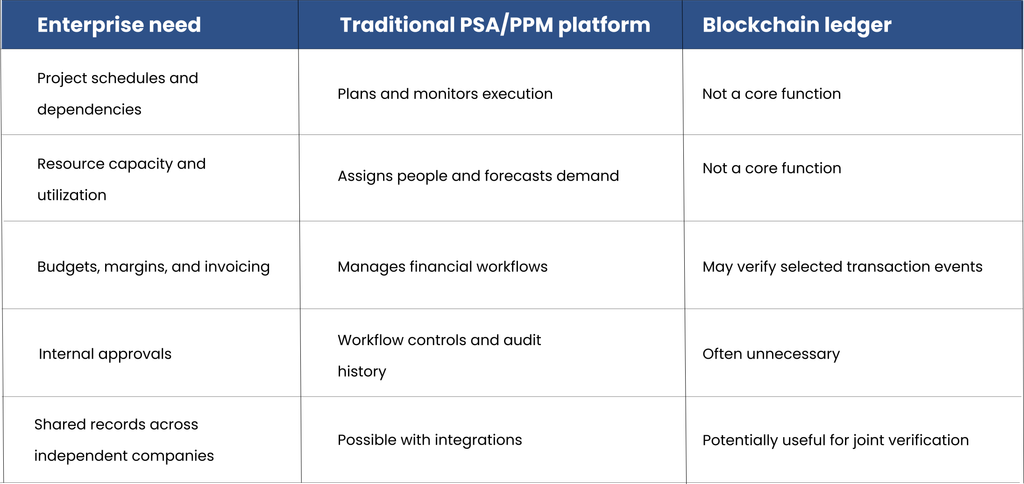
The practical answer: Use PSA/PPM for operational control. Explore a blockchain only when multiple independent organizations need shared verification that ordinary audit logs, electronic signatures, and system integrations cannot provide economically.
Is Blockchain Mature Enough for Enterprise Projects in 2026?
The technology is mature, but the uptake in project management is uneven. Noteboom and colleagues’ systematic review of 29 peer reviewed papers in 2026 highlighted promising uses of digital twins in procurement, coordination, stakeholder management and quality. They noted the use of the technology was mostly conceptually/experimentally, with limited use in practice, outside construction related fields.
That’s important. A working prototype is not an enterprise-scale, governed product.
What about integration with enterprise resource planning, project systems, privacy, identification, transaction costs, accountability for bad information, and dispute-resolution process? Blockchain-based project management must be driven by a business problem-not a trending prediction.
Can Blockchain Reduce Dispute-Related Costs? A Simple ROI Example
Let’s say a company reviews 40 challenged approvals each month, and spends two hours on each one at a fully loaded rate of $60 an hour. That’s $4,800 in investigation effort each month.
A proposed Shared-Record system would have reduced the effort by 50%. In the model it reduces the effort by $2,400/month, and when combined with recurring operating costs, results in a net saving of $1,400/month. Over $24,000 of one-time implementation costs would be recovered in about 17 months.
Note: these are hypothetical assumptions and do not represent any real measured blockchain outcomes. Actual results will vary based on levels of adoption, data integrity, usability and governance and what a cost reduction from an inferior traditional solution might look like. Similar calculations can be performed using costs in INR.
Where Does Kytes Fit into Better Project Governance?
It’s helpful to verify an approval. But what leaders really need to know is-what does that approval mean? Was a deadline pushed back? Is someone now overallocated? Will billing or project margin be affected?
Kytes is an AI-enabled Professional Services Automation (PSA) and Project Portfolio Management (PPM) application that links project execution, resources, and financials.
Its published features are project planning and tracking of milestones, risks and governance; resource demand planning; budgets, billing, revenue recognition, and margins.
Kytes isn’t the native blockchain platform of choice for this display. Instead it’s the operational layer enabling the teams to act on that trusted information and see what it means in delivery and finance.
Try the complementary project management guide on financial automation to understand why financial visibility at project level is so important.
How Should Decision-Makers Choose the Right Approach?
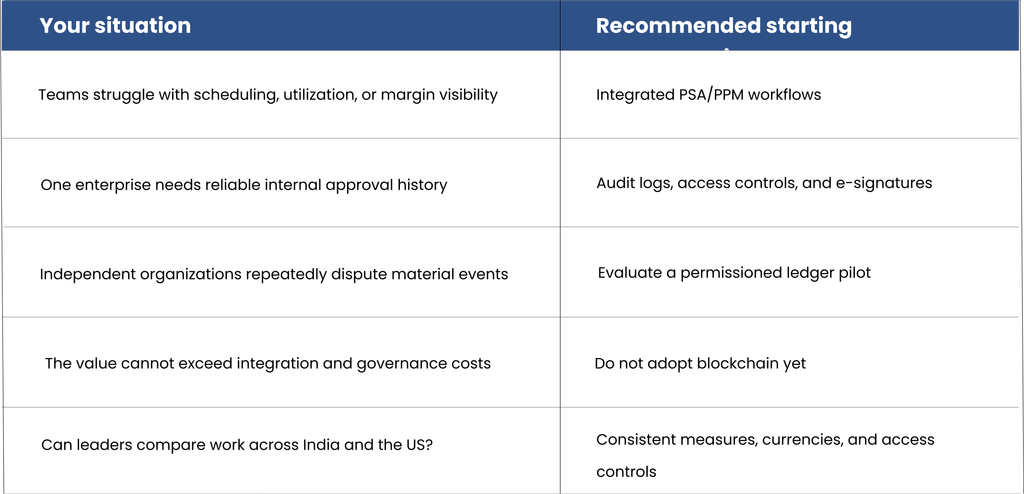
Start with one measurable workflow. Compare approval cycle times, disputes, reconciliation hours, invoice delays, and total cost of ownership before and after a pilot.
Frequently Asked Questions