
Key Takeaways:
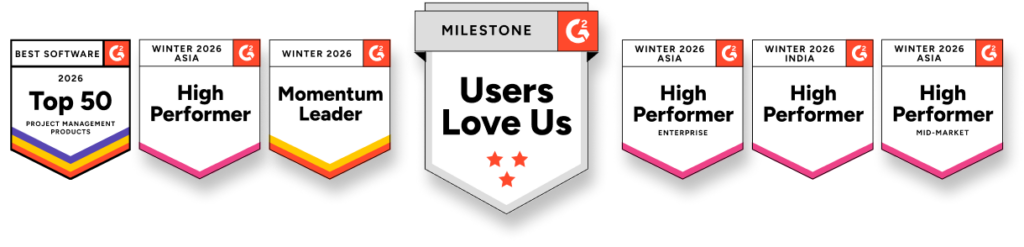
- What awards has Kytes received on G2? High Performer (India & APAC), Momentum Leader, High Performer – PPM, Easiest to Do Business With.
- How does Kytes support enterprise project management tools? Unifies delivery, resources, project financials, and project governance in one system.
- What benefits does Kytes provide to organizations? Improves visibility, resource utilization, revenue, and margins.
- How does Kytes enhance AI capabilities? Delivers predictive insights, automated planning, and smart optimization.
- Why is a work management layer essential alongside Project Portfolio Management? Aligns tasks with strategy for seamless execution.
Why is a work management layer important if you already have an enterprise project management system?
From the outside, most enterprises are well prepared. There are PM tools to set project timetables and portfolio management tools to manage the overall strategic initiative. They have dashboards to see how each project and portfolio is progressing. However, the execution is always misaligned.
This is because of a disconnect between different levels of organization.
The strategy is on the portfolio level, project planning on the project level, but the execution-the work itself-is on the task level where team members work, update their progress and make tactical decisions every day. If the task level is detached from the organization system, the alignment fails.
Tasks become scattered throughout email boxes and spread sheets. Progress is always delayed or not timely reported, dependencies are handled manually, thus execution is missing crucial part. Gradually leadership views and ground work are not same any more.
Kytes fixes this by embedding the work management directly into the enterprise project management tool. It makes sure that all tasks not only monitored.
But also contextualized – linked to project deliverables,aligned to portfolio goals and connected to financial impact.
The work management at the task level evolves from a chaotic task to an orderly activity that all work contributed to the great cause.
How does Kytes connect enterprise project management systems across delivery, resources, and financials?
Businesses today are running on multiple systems. The CRM system manages opportunities. The project management tools manage execution. Finance systems manage the revenue and communication tools manage working together.
When it comes to a single system, all are effective. Working in conjunction with each other, they bring disunity.
Kytes will eliminate this disunity and build an integrated execution system.
When an opportunity is made, it will be directly channeled into the project plan where task breakdowns can be completed. The project plans will directly link to resources, making sure that the required expertise is at the right place at the right time.
As the delivery continues, the financial parameters will automatically be updated. Expenses are tied to resource consumptions, revenues tied to milestones completed, while the margins are changing on the run.
This flow brings the whole life cycle together.
Traditional integration takes into account connectors between tools, while Kytes takes an integrated approach. Kytes integrates processes, rather than just linking tools together. This is why it is an enterprise project management tool where the execution, resources and financials flow together.
What makes Kytes a true enterprise project management system for modern organizations?
Execution isn’t a straight line in an enterprise. It’s complex, layered, and ever changing.
Projects collide. Resources are moved. Market conditions fluctuate. Dependencies unexpectedly spring up.
Most tools aren’t designed to manage complexity. They are single-point solutions for certain aspects of project execution, like task management, scheduling, or reporting, not the entire system.
Kytes takes a system-level view.
It integrates portfolio governance, project execution, resource management and financial tracking within one platform. All decisions taken at one layer are carried over to the other layers.
When you make a change to a project schedule, resources reallocate instantly and financial forecasts are revised automatically. When a new project opportunity arises, the impact on capacity and profit margins are visible immediately.
This interconnectedness allows companies to maintain clear, controlled execution through a complex landscape, making project management responsive rather than reactive-this is the system that should be capable of delivering modern enterprise project management.
How does Kytes deliver measurable outcomes across enterprise execution?
The real value of any enterprise platform lies in its outcomes.
Kytes yields tangible gains in a range of execution parameters.
Financial visibility is one of the highest returns. In traditional, fragmented organizations, businesses only learn about profitability through scheduled reports; with Kytes, business leaders see their profit margin at a glance and act on margin risks proactively.
Resources are better utilized; with Kytes they’re assigned smartly according to skill, availability and task demands. This way, businesses can reduce downtime for resources and avoid over-loading the team.
Revenue leakage, an inevitable problem in fragmented organizations, is eliminated as the billing directly follows the execution. All billable work is automatically accounted for, guaranteeing a perfect correlation between delivered work and billed revenue.
Business decisions are made much more quickly and on a fact-based foundation; decision-makers are not operating on old data in reports but instead on a constantly updated live data feed. The benefits are both accelerated decision-making speed and increased decision-maker confidence.
All together, the gains made result in the execution being more efficient, predictable and scalable.
How does Kytes create a strong foundation for AI across enterprise systems?
Automation is often discussed in terms of efficiency. In project financial management, its real value lies in accuracy and AI is quickly becoming the biggest differentiator in the enterprise software, but the ability to leverage AI is dictated by the core system architecture.
Fragmented data makes AI useless. Inefficient workflow will not enable automation.
Kytes creates the AI solution directly on top of a connected execution layer to support the AI with relevant, real time data.
As a result, the solution provides predictive risk intelligence: an organization can detect delays, overspending, resource conflicts before they actually happen.
Automated work breakdown structures: create well-structured project plans based on initial project inputs. Kytes will use AI to create these structures to limit manual data entry.
Dynamic financial planning: a constantly updating set of predicted revenue and costs based on real time execution data.
AI-supported resource allocation: identifies the right talent to utilize without burning out.
Why do enterprises need Kytes to unify their project, portfolio, and work management systems?
One of the most critical enterprise execution struggles is fragmentation.
It does not appear all at once, but slowly results in inefficiency, delay, and financial error. In an effort to fix this organizations often add more tools. This, of course, just adds more complexity.
Kytes provides another solution – unification.
Kytes centralizes project management, portfolio governance and work management on one platform. By integrating these three layers of execution, Kytes aligns an organization’s execution.
Execution follows planning. Execution accounts for financials in real-time. Strategic decisions leverage financials.
No reconciliation and multiple system dependencies fall away.
Organizations simply become environments of simplicity, alignment, and efficient execution.
How does Kytes enable a single source of truth across enterprise operations?
One of the biggest roadblocks to sound decision-making is data inconsistency.
Multiple systems produce varied answers to the same question. This results in confusion and delays in action.
Kytes offers a single source of truth solution.
Data is synchronized in real-time across projects, resources, and financials; so, everyone sees and trusts the same information.
From the project manager checking status to the CXO viewing the portfolio; all users have the same view. This helps both with reporting, and trusting that a given view or report is accurate and current and decisions can be made more quickly and with greater confidence.
How does Kytes support industry-specific enterprise project management needs?
There is substantial industry specific difference in enterprise execution.
IT and ITES deals with complex delivery models involving distributed teams. Pharmaceuticals deals with a compliance & regulatory layer on top of their complexity. EPCs has complexities in engineering & procurement.
Kytes is built to handle these varying needs:
It addresses Agile & hybrid delivery in IT, compliance driven work flows in Pharmaceuticals, engineering & procurement in EPC and centralized governance in GCC.
The depth in industries means Kytes isn’t just adaptable but directly usable.
Why is Kytes recognized on G2 across multiple enterprise categories?
G2 recognition is based on actual users and, therefore, has significant impact as an indicator of product effectiveness.
Kytes’ positioning across each category: High Performer, Momentum Leader, and Easiest to Do Business With demonstrates the delivery of sustained value.
These categories can only be achieved through ease of use, successful deployment across an organization, and a tangible benefit.
Perhaps most importantly, these honors stand as testament to the way that Kytes’ executes: Alignment, visibility, and control.
Why is Kytes shaping the future of enterprise project management systems?
As enterprises grow in complexity, so does the complexity of execution.
Increased projects, more dependencies and increased variables in the financial world demand tools that traditional systems cannot effectively accommodate.
Kytes has been developed as the next generation of connected intelligence to execution.
With real-time visibility, prediction capability, and integration seamlessly united, it gives you command and visibility.
This positions Kytes ahead of the future of the enterprise project management system.
Final Thoughts: Why Kytes Moves Enterprises from Management to Mastery
The way enterprises approach project management is changing.
It is no longer about managing tasks or tracking timelines. It is about orchestrating execution across the entire organization.
Kytes enables this transformation.
With its G2 recognition, embedded AI capabilities, and integrated work management layer, it provides a system where planning, execution, and financials work together seamlessly.
Because in today’s enterprise environment, success is not defined by how many tools you use.
It is defined by how well everything works together—
intelligently simple.