
Blog Highlights
- An enterprise project management system helps organizations manage multiple projects while maintaining visibility into resources, timelines, and financial performance.
- As delivery operations scale, fragmented tools and disconnected workflows create challenges in resource planning, governance, and financial tracking.
- Connected delivery systems improve coordination by linking project execution with planning, resource management, and revenue realization.
- Professional services organizations often require capabilities beyond standard tools, which is why many evaluate PSA vs project management tools when scaling operations.
- Kytes AI-enabled PSA + PPM platform simplifies enterprise project management by digitizing and automating workflows end-to-end while providing a single version of truth across delivery operations.
Organizations delivering multiple projects simultaneously operate in a complex environment. Each engagement has its own scope, timeline, team structure, and financial model, yet all projects must contribute to shared business objectives such as revenue growth, margin stability, and client satisfaction.
As delivery operations expand, maintaining clear visibility across projects becomes increasingly challenging. Multiple teams work across overlapping engagements, resource planning becomes harder to coordinate, and financial tracking often spreads across several systems. Leadership teams may struggle to understand how individual project outcomes affect overall delivery performance.
An enterprise project management system helps organizations manage this complexity by bringing project execution, resource planning, and financial oversight into a single operational framework.
Instead of managing projects in isolation, enterprises gain the ability to coordinate delivery across the entire organization.
Also Watch:
What Is an Enterprise Project Management System?
An enterprise project management system is designed to help organizations manage multiple projects while maintaining alignment with operational and financial goals.
Traditional project management tools typically focus on tracking tasks, timelines, and team collaboration within individual projects. While useful at the project level, they often lack the visibility required to manage delivery operations across the organization.
Enterprise systems extend beyond task management by providing portfolio-level insights that allow organizations to oversee project performance, coordinate shared resources, and track financial outcomes.
For organizations delivering services to multiple clients, this level of coordination is essential for maintaining operational clarity and consistency.
Why Enterprises Need an Enterprise Project Management System
As organizations scale their delivery operations, project activities become increasingly interconnected. Teams collaborate across functions, resources move between engagements, and project outcomes directly influence revenue and profitability.
Without a structured system in place, several challenges begin to emerge.
Project information can become fragmented across different tools used by delivery, finance, and account management teams. This fragmentation slows decision-making and makes it difficult to maintain a unified view of performance.
Resource planning also becomes harder to manage. Skilled professionals often contribute to multiple projects, and without centralized oversight, workloads can become uneven or difficult to coordinate.
Financial visibility is another concern. Budget tracking, project costs, and revenue forecasts may not always reflect the actual progress of delivery work.
Delivery governance may also vary across teams, creating inconsistencies in how projects are planned and executed.
An enterprise project management system addresses these challenges by creating a unified operational environment where delivery activities remain connected and visible.
Core Elements of Enterprise Project Management
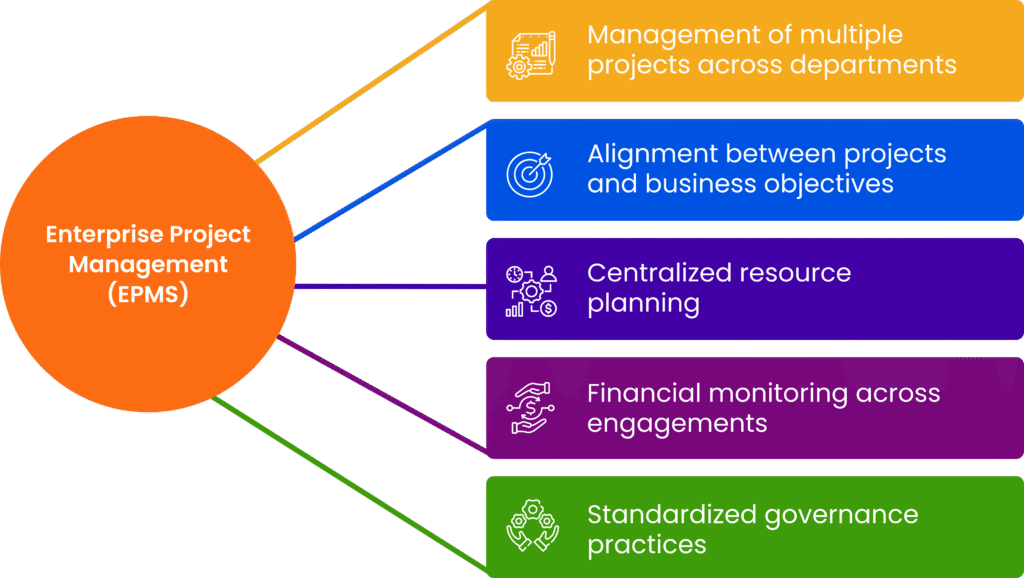
Enterprise project management systems support delivery operations through several core capabilities that help organizations maintain alignment across projects.
Portfolio Visibility
Delivery leaders require a consolidated view of all active engagements. Portfolio-level insights help organizations monitor progress, evaluate project health, and identify risks early.
Resource Management
Centralized resource planning ensures that talent is assigned based on availability, skill requirements, and project priorities. This reduces scheduling conflicts and improves utilization.
Financial Oversight
Budgets, costs, and revenue forecasts remain connected to project progress, enabling organizations to monitor financial performance throughout the delivery lifecycle.
Governance and Standardization
Enterprise systems establish consistent delivery practices across teams, ensuring that projects follow structured processes and reporting standards.
Together, these elements enable organizations to manage complex project environments with greater clarity and control.
Connected Delivery Systems
Enterprise project management systems are evolving into connected delivery systems that integrate multiple stages of the delivery lifecycle.
Instead of operating as isolated tools, modern systems connect operational workflows that surround project execution.
These workflows typically include:
- opportunity evaluation and planning
- project execution and monitoring
- resource capacity management
- financial tracking and forecasting
- invoicing and revenue realization
When these stages are connected within a single system, information moves more smoothly across teams and departments. Organizations gain clearer visibility into how projects progress from planning to revenue generation.
Connected delivery systems strengthen enterprise project management by reducing operational silos and improving coordination across functions.
PSA vs Project Management Tools in Enterprise Context
Organizations evaluating enterprise solutions often come across comparisons such as PSA vs project management tools. The distinction mainly relates to the operational depth required by delivery-driven organizations.
Project management tools are designed to help teams coordinate tasks, timelines, and collaboration within a project. They support execution but typically offer limited visibility into financial performance or resource capacity across the organization.
Professional services organizations require broader operational capabilities. This is where Professional Services Automation (PSA) platforms become relevant.
PSA platforms extend project management by connecting delivery execution with resource planning, utilization tracking, financial oversight, and billing processes. This integration helps organizations manage delivery operations more effectively across multiple client engagements.
Also Watch:
Kytes AI-Enabled PSA + PPM Software
Managing enterprise delivery operations requires more than centralized data. Organizations need systems that simplify complexity while improving visibility across projects, resources, and financial performance.
Kytes AI-enabled PSA + PPM platform makes project management intelligently simple for enterprises. It digitizes and automates project management end-to-end, creating a single version of truth across delivery operations.
Purpose-built for enterprises managing large project portfolios, Kytes connects project execution, resource planning, financial oversight, and delivery governance within one unified system.
This approach eliminates fragmented tools and disconnected workflows. Delivery teams, finance leaders, and account managers operate using the same operational data, improving coordination across the organization.
Artificial intelligence strengthens this system by analyzing delivery patterns and operational data across projects.
AI-driven capabilities help organizations:
- forecast resource demand with greater accuracy
- identify delivery risks earlier in the lifecycle
- improve estimation reliability across projects
- monitor utilization trends across teams
- track project financial performance more effectively
By combining PSA and PPM with AI intelligence, Kytes supports a shift from reactive project management to predictive and prescriptive delivery operations.
This allows enterprises to manage complex delivery environments with clarity, control, and confidence.
Benefits of an Enterprise Project Management System
Organizations implementing enterprise project management systems gain several operational advantages.
Projects remain aligned with broader business priorities, improving coordination across teams and departments.
Resource utilization becomes more balanced because teams can be allocated based on real-time availability and project needs.
Financial oversight improves as project budgets, costs, and revenue forecasts remain connected to delivery progress.
Delivery risks become easier to identify when leadership teams can monitor the entire project portfolio from a single system.
Standardized practices across projects also improve consistency in how delivery teams operate.
These improvements help organizations scale project operations without losing control over performance and outcomes.
Conclusion
Project-driven organizations operate in environments where multiple engagements, teams, and financial structures must remain aligned. Managing this complexity requires more than isolated project tracking tools.
An enterprise project management system provides the structure needed to coordinate delivery operations at scale.
By connecting projects, resources, and financial data within a unified framework, organizations gain the visibility required to manage growth while maintaining operational stability.
Book a Demo with Kytes
Kytes helps enterprises manage complex project portfolios through a connected delivery platform that combines AI-enabled PSA and PPM capabilities.
Book a demo with Kytes to see how an enterprise project management system can strengthen delivery visibility and operational efficiency.
Book a Demo