Blog Highlights
- Generative AI Is Transforming Project Management: Discover how AI automates project reporting, risk identification, scheduling, and decision support.
- Smarter Resource Planning and Scheduling: Learn how AI improves resource allocation, balances workloads, and helps prevent project delays.
- Improving Project Profitability with AI: Explore how AI-driven insights can improve utilization, protect margins, and strengthen financial visibility.
- Choosing the Right AI Project Management Tools: Understand what to look for in AI-enabled platforms, from integrated financial intelligence to actionable recommendations.
- Measuring the ROI of Generative AI: Learn which metrics matter most, including time saved, forecast accuracy, resource utilization, and project profitability.
India and US project leads have the same pressure point. Making for thinner margins, impatient customers and even more diverse project teams with India, US and everyone else in the middle. Imagine generative AI in project management, you’ve heard the demo. It’s drafting of status reports, identifying slippages, suggesting forward steps, raising risk logs – even before the project manager has logged in.
What the shift is, how to identify where you are in the shift, and how to select a platform that’s right for your services business.
What Does Generative AI Mean for Project Teams?
Generate artifacts with LLMs, reasoning agents, gisting, decision points. Not a dashboard, an operations assistant that reads your project data, prepares the first draft, and is ready to be edited.
How this is different than the automation we had in 2022: Context-aware at the project level. The previous automation was at the record level. Now that I have context, it writes in my voice from past project reports. I don’t have to tell it what to do, it reasons between financials, schedules and resourcing.
Why Does 2026 Feel Different from Last Year?
Two shifts add up. Enterprise AI governance is a sure thing. For example, in Mumbai, Bengaluru, New York and Austin your executives can authorize AI enabled service delivery workflow directly in the system in Bengaluru, New York and Austin, without having to wait for a 6-month annual security review. And you can get project support with AI, in less than 1 hour of a senior PMs weekly time.
And here’s the result. By the time we started, AI was always already in the delivery stack.
How Does It Change a Project Manager’s Day?
A PM still owns the plan, the client relationship, and the call on trade-offs. What changes is the work around those decisions.
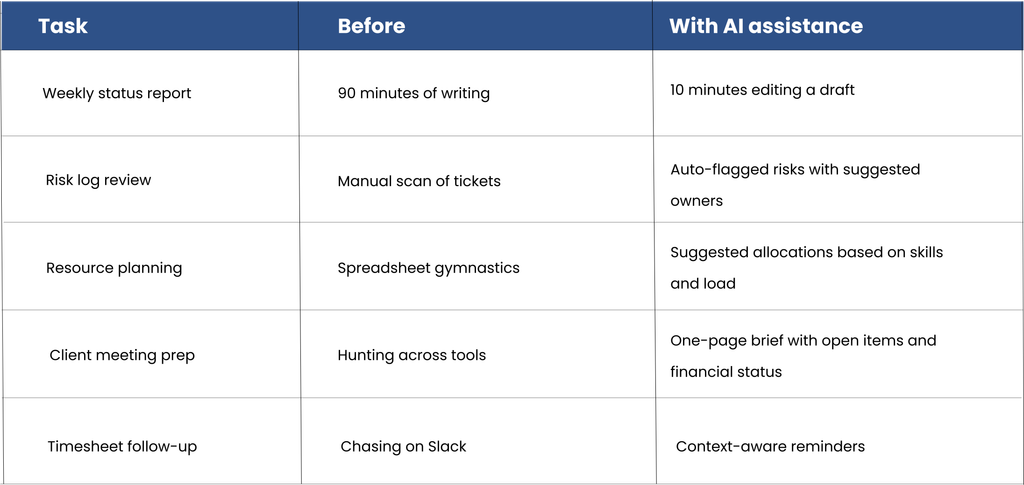
Hours saved per PM per week sit between six and twelve, based on services firms running 40 or more concurrent projects.
Which AI Project Management Tools Actually Deliver?
Market consists of three buckets: Add-on helpers: insert a bot into existing platform Point solution: autocite a specific output – meeting notes or scheduling Embedding: embed AI into the whole project lifecycle, from bid to close
Professional services companies benefit. If your chatbot doesn’t have clarity of your margin, your utilization, or your scope of work (SOW), it will confidently respond with surface-level information.
Are there target and task data, available to the model? Will it act or only advise? When the model is wrong, who owns the consequence?
Yes, last question is slightly more important in 2026 than a year ago. Selling things to regulated industries will require your vendors to generate an audit trail of AI decision making.
How Does AI-Powered Project Scheduling Work in Practice?
Market consists of three buckets: Add-on helpers: insert a bot into existing platform Point solution: autocite a specific output – meeting notes or scheduling Embedding: embed AI into the whole project lifecycle, from bid to close
Professional services companies benefit. If your chatbot doesn’t have clarity of your margin, your utilization, or your scope of work (SOW), it will confidently respond with surface-level information.
Are there target and task data, available to the model? Will it act or only advise? When the model is wrong, who owns the consequence?
Yes, last question is slightly more important in 2026 than a year ago. Selling things to regulated industries will require your vendors to generate an audit trail of AI decision making.
Where Does Kytes Fit In This Picture?
Kytes is a PSA & project portfolio management platform designed for services companies that measure all their projects as revenue. It combines bid management, project delivery, resource planning, timesheets, billing & the financials – front-to-back – to work with AI.
Three capabilities deserve a closer look.
Intelligent project planning– Similarly SOWs to scope project Kytes give project milestones and also suggest the amount of resources needed against the available skill set (existing data in the system). The white sheet that was a blank canvas for the project manager, is no longer white.
Smart resource allocation-By leveraging live utilization, skill tags, and project pipeline it identifies the right resource to close the sale. Margin impact forecasted before a decision is made clarifies the tradeoffs between speed and margin.
Financial intelligence built in-All three, Revenue Recognition, Invoicing Drafts and Margin Alerts run on the same Data Layer. When AI suggestion is displayed it has a cost context, so it does not require a finance query of how schedule change affects P&L.
Designs are not gone beyond to the item. Thought we give an idea free; continue humanized in control; send off all design advising within the monetary considerations of the engagement.
What Should Decision Makers in India and the US Do Next?
The choice isn’t whether or not to have generative AI in your project delivery toolkit. It’s where you draw the line so that you’re comfortable with an AI’s first draft and confident to provide executive sign-off. And those organizations that draw that line well in 2026 will have lighter delivery organizations, delivering more projects to completion faster and giving their top project managers more face time with clients, and less with the status meetings.
Select one workflow (i.e.: status reporting, resource planning) is the highest ROI. Quantify the time saved; forecast accuracy; margin improvement for the next quarter. Continue this process to measure all workflows.
Key KPI’s for a services CFO. Gross margin, utilization, DSO and win rate. Research from SPI Research and Gartner (2025/26) shows that those firms most advanced with AI are delivering ahead of the pack on all the major KPI’s. Here’s how generative AI is shaping your P&L.
The Hidden P&L Shift Services Firms Are Seeing in 2026
The numbers that matter to a services CFO are not AI metrics. They are gross margin, utilization, DSO, and win rate. Research from SPI Research and Gartner across 2025 and 2026 shows services firms with mature AI adoption outperforming peers on each of these measures. Here is where generative AI shows up on your P&L.
Gross margin lift of 3 to 7 points– “Plugging AI into resourcing and planning returns billable hours to the sales people and senior consultants have less time building status decks and more time working on clients – a time shuffle that is felt straight away on the bottom line.”
Utilization climbs by 8 to 15 percent-Not because we do more work, but because we get the right person to the right job faster. The AI scans skill tags, demand and project priorities, to recommend assignments that would otherwise take a human planner an afternoon to work out.
Win rate on bids improves by double digits-It’s only days-not weeks-for your team to respond to RFPs. Your AI will generate your technical approach, mine for relevant case studies, and cost the estimate based on the close matches to wins like this. Your sales executives in Indian IT services and US consulting firms will see tangible lift.
DSO shortens by one to two weeks-Draft invoice work is booked into your systems the day it is booked. Dispute free once the data is booked. Month can be closed the same day once data is booked, finance has fewer sign off’s.
PMs and consultants who are no longer buried in admin last longer. In a market where senior project staffing is in short supply in Bengaluru & Boston, that metric alone will more than pay for your investment.
Access more information on these top use cases by leveraging AI planning: See our resources on bid-to-cash automation and resource planning for services firms.
Frequently Asked Questions