Blog Highlights
- In IT/ITES enterprises, project execution defines business success. Risk management must move beyond compliance and become part of everyday delivery, resourcing, and financial operations.
- Fragmented ownership, delayed metrics, poor visibility, talent dependence, and system silos allow risks to escalate before they affect revenue or margins.
- Modern methods—predictive analytics, anomaly detection, correlation analysis, and scenario simulation—shift risk analysis from reactive reporting to proactive intelligence.
- AI unifies delivery, finance, and people data into one analytical framework, predicting risks, scoring exposure, and recommending mitigations in real time.
- By digitising risk identification and linking governance with execution, the platform enables enterprises to safeguard margins, anticipate disruptions, and build long-term resilience.
In IT and ITES organisations, project execution is not a support function — it is the business itself.
Every delivery, deviation, and delay directly affects revenue, profitability, and client satisfaction. Yet, enterprise risk management often operates in isolation from project delivery. Risk discussions typically appear during audits, quarterly reviews, or CXO meetings but rarely influence day-to-day execution. By the time a risk surfaces, its impact is already visible — missed SLAs, budget overruns, or stressed teams.
In this blog, we explore how risk analysis in project management can evolve from a disconnected governance activity into an operational discipline. One that continuously identifies issues, quantifies exposure, and empowers teams to act before risks turn into losses. In a volatile, technology-driven environment, building such real-time risk intelligence is not optional — it’s essential.
Defining Risk Analysis in Project Management
Risk analysis in project management is the process of identifying potential threats, estimating their impact, and prioritising mitigation efforts to protect project objectives. In enterprise contexts, these risks extend far beyond delivery schedules.
A resource leaving mid-cycle can cause delivery slippage. Poor requirement clarity can inflate effort hours. A client’s delayed payment can affect overall revenue recognition. Each instance represents a project-level event with enterprise-level implications.
Traditional definitions view risk analysis as linear: identify → assess → respond.
Today, that sequence is circular. Risks must be monitored, recalculated, and re-scored continuously as variables change.
Three Pillars of Enterprise Risk Intelligence
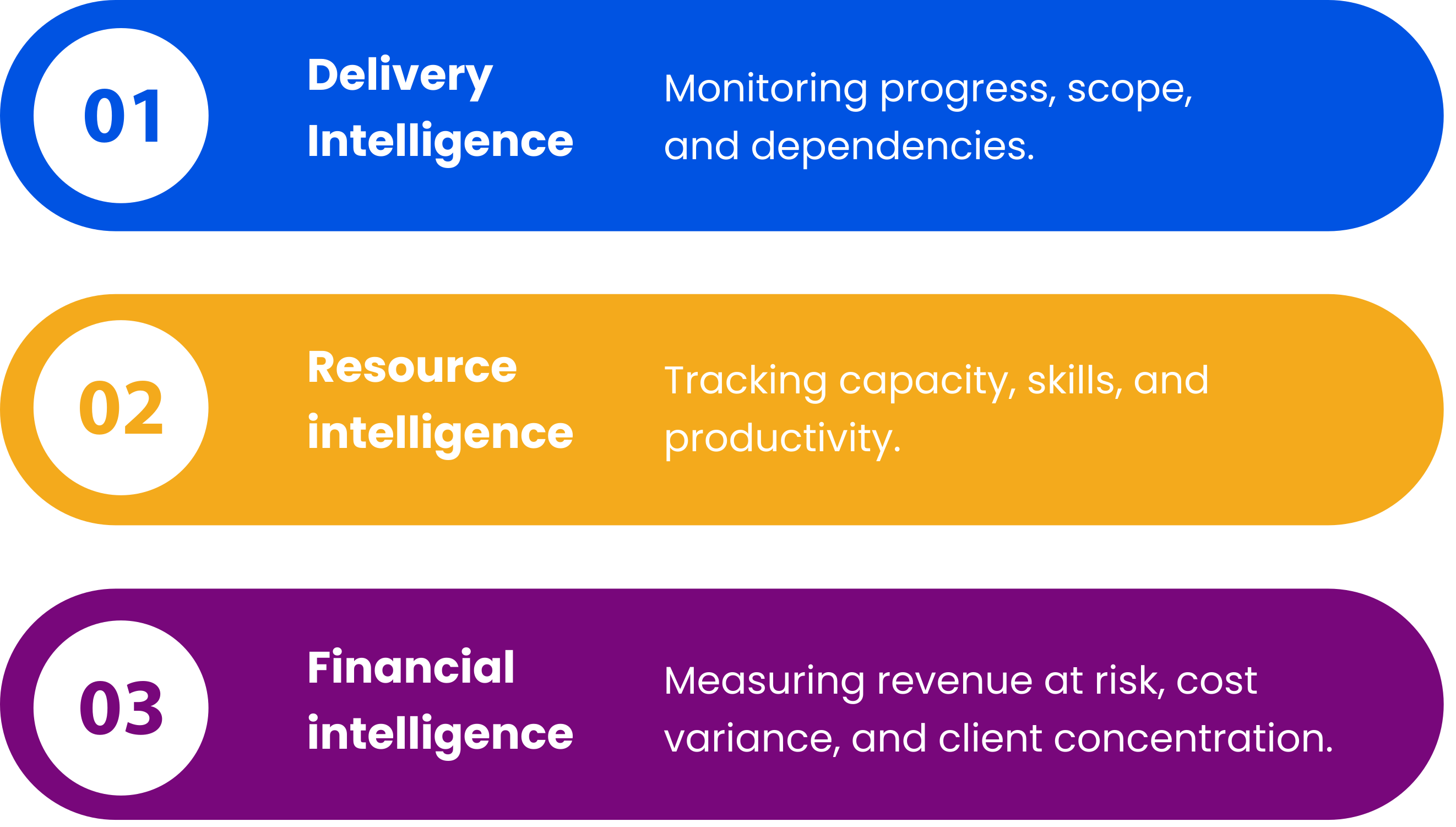
When these layers converge within a unified analytical system, project managers gain foresight — not just visibility.
The Hidden Gaps in Traditional Risk Management
Most organisations acknowledge the importance of risk management but rarely institutionalise it. Several recurring gaps persist:
- Fragmented ownership: In many enterprises, risk ownership is decentralised. Governance or audit teams maintain risk registers, while project managers focus primarily on delivery execution.
This disconnect prevents real-time collaboration and delays escalation. When risk accountability isn’t shared, early signals often get ignored until they become operational crises. - Delayed metrics: KPIs related to cost, schedule, or utilisation are often updated manually. By the time they reach decision-makers, the information reflects what has happened, not what is happening.
This lag creates a reactive environment where leaders are constantly responding to past problems rather than preventing future ones. - Limited visibility:
Critical risk indicators — such as attrition trends, client concentration, or utilisation variance — often remain hidden in spreadsheets or departmental silos.
Without integrated visibility, enterprises miss the interdependencies that connect delivery health with financial and resource stability. - Overreliance on talent:
Dependence on a few high-performing or niche-skilled individuals poses a continuity risk. When these key people leave, take time off, or shift roles, project momentum drops sharply.
This overreliance also restricts scalability, making it difficult to redistribute workloads or build redundancy in delivery teams. - Lack of integration:
Financial data, delivery milestones, and workforce analytics often exist in separate systems. Without unified dashboards or connected data streams, correlating delivery delays with cost overruns or resource constraints becomes nearly impossible.
The absence of integration leads to fragmented insights and slower, less confident decisions.
These blind spots create enterprise-level exposure. Missed delivery milestones lead to revenue delays. Attrition triggers re-planning costs. Client dependency increases volatility when a major account slows spending.
When analysis of project risk in project management is disconnected from operations, leaders end up firefighting symptoms rather than addressing root causes. A dynamic, system-driven approach is the only way to close these gaps.
Risk Management With Kytes
Delivery risks influence financial performance, resource gaps affect profitability, and client dependencies can destabilise entire portfolios. Kytes AI-enabled [PSA + PPM] software brings all these aspects together, offering a connected, data-driven approach to enterprise risk management.
- Unified Risk Visibility
Kytes connects project-level and enterprise-level risks on a single platform. Delivery health, utilisation, billing progress, and people analytics are synchronised in real time, creating one source of truth for risk monitoring. Leadership teams gain immediate visibility into margin exposure, delivery bottlenecks, and resource vulnerabilities.
- AI-Driven Detection and Prediction
The platform’s machine-learning engine continuously analyses historical and live project data to identify early warning signs. It predicts schedule variance, cost overruns, and utilisation dips long before they appear in reports. Automated alerts ensure risks are not just recorded — they are anticipated.
- KPI Intelligence and Dynamic Dashboards
Kytes intelligent dashboards automatically update key metrics such as:
- Revenue at risk from delayed milestones or change requests
- Person-wise profitability to track individual or team performance
- Attrition and skill coverage trends for proactive workforce planning
- Customer concentration ratios that highlight dependency on select clients
These metrics evolve dynamically, giving decision-makers a real-time assessment of both operational and financial exposure.
- Integrated Mitigation and Simulation
Beyond detection, Kytes enables managers to test “what-if” scenarios. They can simulate how resource churn, rate fluctuations, or project delays impact cash flow or utilisation. The system quantifies outcomes instantly, helping teams choose the most effective mitigation plan before the risk materialises.
- Embedded Governance and Accountability
Every project plan, milestone, and approval cycle within Kytes is linked to a defined risk owner and response strategy. This eliminates fragmented accountability and ensures governance processes are built into the workflow, not added after the fact.
Outcome:
Kytes transforms risk from a compliance exercise into a strategic management capability. By digitising, automating, and predicting risks across delivery, resourcing, and financials, it strengthens enterprise foresight and protects profitability. The result is a culture of informed, data-driven decisions — where risks are visible, actionable, and continuously reduced.
See how AI-powered risk management can strengthen your project delivery and profitability.
Business Impact of Poor Risk Visibility
Unmonitored risks don’t just derail projects — they erode profitability and reputation. The absence of connected visibility leads to:
- Margin leakage: Lost productivity, delayed billing, and inefficient utilisation quietly reduce profitability.
- Reactive governance: Without predictive signals, management intervenes only after escalation.
- Revenue unpredictability: Projects with uncontrolled variances distort cash-flow forecasts.
- Reduced competitiveness: Frequent project overruns weaken client trust and renewal potential.
Enterprises that treat risk as a reporting function often find themselves managing outcomes they could have prevented. The solution lies in shifting from visibility to predictability — using technology to anticipate operational, financial, and talent-related risks before they materialise.
Modern Risk Analysis Methods in Project Management
Traditional risk analysis methods in project management provide structure but not speed. Qualitative techniques such as probability-impact grids or risk matrices depend on subjective scoring.
In high-velocity project environments, these models alone fall short. Modern enterprises now combine them with AI-driven and data-integrated approaches:
- Predictive analytics:
Machine-learning algorithms scan historical project data to identify early warning signs.
Example: If a software development program consistently shows utilisation dipping below 70% two sprints before a delay, the system flags the upcoming schedule risk. It predicts the probability of slippage and recommends corrective action, such as reassigning capacity or reducing non-core work.
- Anomaly detection:
AI systems automatically identify deviations in project KPIs such as effort variance, quality defects, or resource churn.
Example: A delivery dashboard detects that one module’s effort hours have doubled compared to baseline despite no scope change. The system alerts the project manager to investigate scope creep or inefficiency before costs escalate.
- Correlation analysis:
AI links operational data with financial performance to uncover relationships invisible in manual reviews.
Example: The platform finds that projects with over 25% new hires on the team experience a 10% margin drop. It connects workforce readiness, project complexity, and profitability — giving management a measurable risk indicator to address through targeted training.
- Scenario simulation:
Risk models allow managers to test “what-if” cases before decisions are made.
Example: Before accepting a large change request, a project manager simulates the impact of extending timelines by three weeks or losing two key developers. The tool shows potential effects on utilisation, billing, and client satisfaction, helping leadership choose the least disruptive response.
- Automated risk scoring:
Dynamic scoring engines update each project’s risk index in real time as metrics shift.
Example: When a project’s defect density rises and two senior engineers resign, the risk score increases automatically. The dashboard reprioritises that project for leadership review and mitigation planning — without waiting for manual escalation.
Together, these methods transform risk analysis in project management into a continuous intelligence process. Data doesn’t just report what happened; it explains why it happened and what to do next.
Embedding Risk Analysis into the Project Lifecycle
To make risk analysis effective, it must be embedded in every delivery stage:
- Initiation: Identify scope, contract, and dependency risks before approval.
- Planning: Map potential resource shortages, technology gaps, and schedule bottlenecks.
- Execution: Continuously monitor utilisation, quality metrics, and change requests for deviations.
- Closure: Capture lessons learned and feed them back into future predictive models.
This integration ensures that risks are not treated as end-of-cycle surprises but as operational signals visible from day one.
For example, if resource utilisation drops below a defined threshold, the system can automatically flag potential margin loss and prompt reallocation. Similarly, if a milestone delay overlaps with a key billing event, financial risk is calculated and surfaced instantly.
Embedding project risk analytics in project management this way allows leaders to connect micro-level decisions with macro-level outcomes — strengthening both governance and agility.
The Role of AI and Automation in Risk Intelligence
AI extends risk analysis from observation to orchestration. Its contribution spans five core areas:
- Data unification: AI integrates delivery, HR, and finance systems, providing a 360-degree risk view.
- Predictive monitoring: Algorithms learn from past projects to forecast cost or schedule variance.
- Dynamic dashboards: KPIs such as person-wise profitability, attrition trends, and customer dependency update automatically.
- Causal insight: Machine learning doesn’t just show correlations; it uncovers relationships between performance factors.
- Action simulation: Managers can model the outcome of interventions before execution.
This transition marks a move from risk management to risk intelligence. AI identifies hidden dependencies — how a niche skill gap affects delivery timelines or how delayed billing impacts liquidity.
In advanced ecosystems, automation enables two-way integration: risk triggers can update project plans, resource allocations, and budget forecasts in real time.
The result is faster response cycles and more stable project performance.
In practice, AI makes risk analysis methods in project management adaptive and responsive. Risks are detected, assessed, and mitigated as the project evolves — not after it concludes.
Building a Culture of Risk Sensitivity
Technology alone cannot sustain resilience; mindset must evolve with it. A mature enterprise culture treats risk awareness as shared responsibility.
Leaders should:
- Provide transparency around enterprise-level risks and how they affect daily delivery.
- Encourage open reporting of early warning signs without blame.
- Link risk ownership to performance KPIs.
- Reward proactive identification rather than reactive fixes.
Teams that see risk visibility as empowerment, not criticism, create an early-response environment. Periodic retrospectives can turn into learning loops that refine predictive accuracy.
When data and accountability converge, risk analysis in project management becomes a collaborative process — one that strengthens trust internally and with clients.
The Future of Risk Analysis in Project Management
The next generation of risk analysis will move from dashboards to autonomy.
- Agentic AI will continuously evaluate live data, recommend mitigation steps, and learn from outcomes.
- Self-healing workflows will automatically reassign tasks or adjust baselines when deviations appear.
- Integrated benchmarking will compare risk maturity across portfolios and regions.
- Cross-domain intelligence will connect operational, cyber, and compliance risks within one command layer.
These innovations will redefine how enterprises view risk — not as an operational overhead but as a measurable performance driver.
The analysis of project risk in project management will become an integral part of strategic planning, revenue forecasting, and customer engagement.
Conclusion: From Control to Confidence
Risk cannot be eliminated, but it can be understood, quantified, and managed intelligently.
For IT and ITES enterprises, predictive risk intelligence turns uncertainty into opportunity. When delivery, resource, and financial data operate in one framework, decision-makers gain continuous foresight.
Enterprises that institutionalise risk analysis in project management move from reactive governance to resilient performance.
They protect margins, maintain customer confidence, and achieve operational stability in dynamic markets.
The future of risk management lies in connected systems, data-driven decisions, and cultures that treat risk awareness as a strategic advantage.
Ultimately, the organisations that master risk don’t just prevent failure — they accelerate growth.