
Blog Highlights
- EPC projects slip not because of poor planning, but due to disconnected execution.
- Fragmented tools create a gap between project progress and financial visibility.
- Lack of real-time data leads to delayed decisions, cost overruns, and loss of control.
- Cost overruns occur because execution is not linked to financial outcomes in real time.
- Traditional systems like ERP and scheduling tools operate in silos and miss execution context.
- Unified EPC Project Management Software enables real-time visibility, control, and predictable project outcomes.
When Everything Looks Right—But the Project Still Slips
Late evening. Project review call. The plan looked great on paper: schedules in sync, resources assigned, budgets greenlighted. The reality being discussed in the call seems completely different. Procurement issues are being identified, site teams claim being on track but the execution is not lining up, and finance is already signaling cost overrun.
Work is being done. Progress is being made. Yet, the project is lagging.
EPC Project Management Software provides a single integrated platform linking planning to execution, linking resources to project schedule, and linking project finance to execution – keeping the project aligned, on schedule and within budget. In most EPC organizations, this linkage is absent. And execution failure begins – right from the best laid out plans.
What Is EPC Project Management Software?
EPC project management software is an integrated solution created for the unique needs of Engineering, Procurement, and Construction (EPC) projects. This single platform allows users to combine project planning, tracking the project execution, the procurement processes and resource planning and managing cost performance.
Instead of fragmented systems, it presents a unified source of truth where each change (either from engineering, procurement or field execution) becomes instantly available through all project stages. The real-time update facilitates to shift from lagging reporting to ongoing control.
The Reality of EPC Execution Today
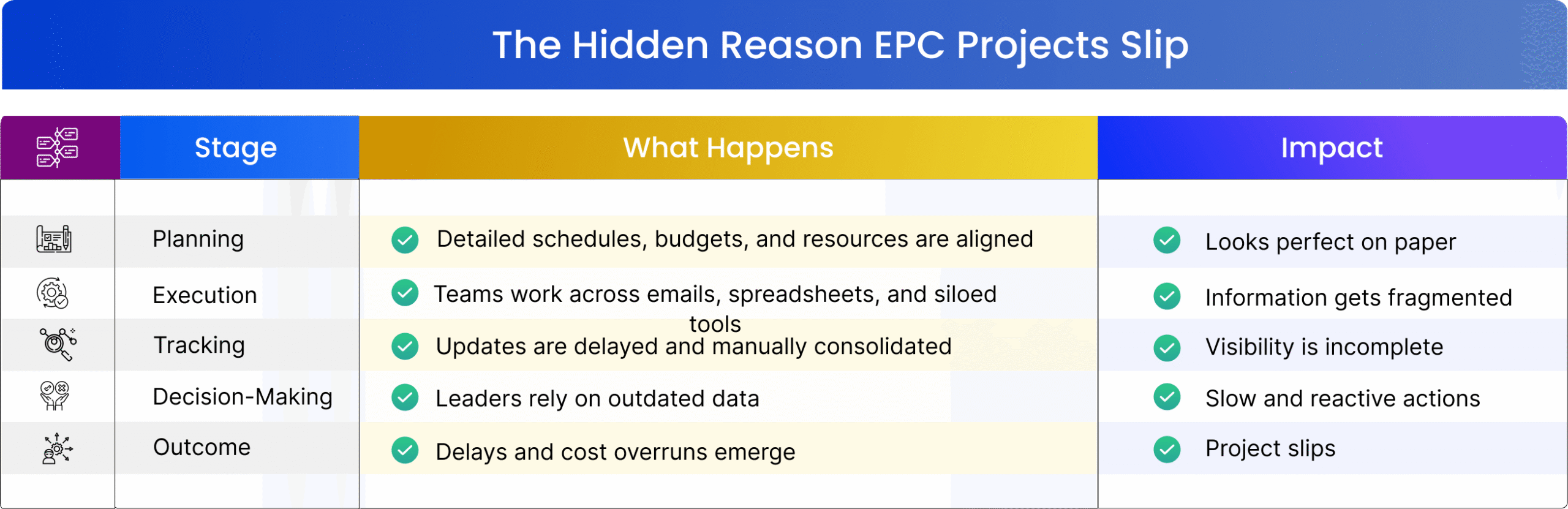
EPC projects are exceptionally complex, as activities are conducted concurrently; design occurs while purchasing is taking place, while construction occurs depending on design and purchasing. Vendors, stake holders and project teams all operate remotely which can be complex to coordinate.
Complexity itself does not mean that projects are not successful.
It is the segmentation that means the projects often fall behind schedule. Planning is carried out on one system, whereas updates about project execution are completed on a different system, and financial tracking is done on a separate system. There is a delay between what is actually happening on site and what management is receiving updates on.
By the time any problem is noticed the project costs and/or schedules have been affected making decision making a reaction rather than a proactive decision.

The Everyday Challenges EPC Leaders Face
These gaps, on the other hand, are manifested in everyday practices for CXO’s, delivery heads and site execution leaders in a less evident, but very crucial way.
The visibility to a project gets delayed, as information has to be collected and consolidated from various sources. Work on the site may be proceeding at pace, but the financials on its progress only become visible much later. Engineering, procurement and construction teams work in their own respective siloes with emails and status call as the medium of communication.
Consequently, the pace of decision making decelerates, as leaders make their decisions with limited, dispersed information and lack the confidence. This drift slowly catches up with projects, how well so ever planned, margins dwindle, project schedules slip and it becomes difficult to track down the owner for any specific delay/issue.
Why Existing Systems Are Not Enough
Existing EPC organizations are already using tools like ERPs for financials, scheduling tools for timelining, and spreadsheets for collaboration, but the problems themselves are largely unaddressed.
The reason these systems do not serve as an execution layer is obvious: they were not built as such.
ERPs log finances but do not offer real-time visibility into execution, scheduling tools manage timelines but not the cost and resource implications, and spreadsheets are prone to a time-lagged reality.
The result is that there is a fractured execution cycle wherein planning, execution, and financial tracking exist independently.
What Changes with EPC Project Management Software
The above fragmentation is addressed by modern EPC Project Management Software, which unites all functions within one connected system.
Planning, execution updates, procurement monitoring, resource management and budget are centralized. Information uploaded from the construction site instantly reflects in the system and provides stakeholders with a consistent, real-time project picture.
The approach to project management shifts from manual tracking across multiple disparate tools, to one integrated real-time operation system. This enables better decision making, with teams no longer having to chase information.
Fixing the Execution-to-Financial Disconnect
One of the key discrepancies that exist in EPC projects, and one that is solved with an integrated approach is the lack of linkage between execution and financial results.
In a traditional framework work proceeds at the site, but is financially blind until the costs arise, when often it’s too late to identify and rectify cost overruns, or until the billing cycle can catch up with the actual execution.
An integrated system bridges this gap intrinsically. The moment the task status is updated, it gets reflected immediately on the project finances, providing leaders with instant visibility into cost impact and allowing timely intervention. This creates a seamless linkage between what’s happening at the site and the financial performance.
Where Kytes Fits In
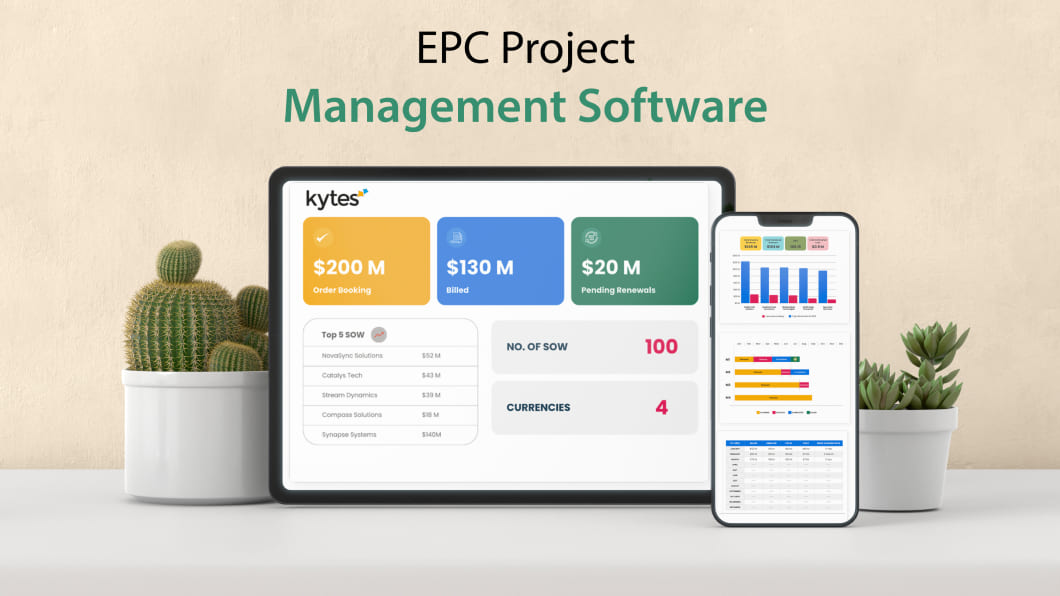
Kytes is structured on this single execution philosophy – connecting projects, resources, and financials in a single operational view.
Real-time visibility is gained throughout the engineering, procurement, and construction processes, tying execution movements to financial results. Teams are unified on a single system, minimizing the reliance on informal communication and manual coordination. The key objective is not only project control, but integrated execution and financial/resource movement.
What This Means for Leadership
To CXOs and project leads this means concrete business results:
Better decisions due to data not outdated reports. Reduced over-spend due to proactive risk identification. Shorter time to market because the team can stay aligned through execution. More accurate margins because finances are linked directly to project delivery. Projects will become integrated business outcomes – not isolated tasks – driven by clarity and control.
Final Thought
Failure in EPC projects is extremely rare during planning stages. Failure occurs when planning begins to stray from actual execution.
With increased complexity and tightened margins it’s no longer viable to continue operating with scattered systems. Integrating planning, execution, resources and financial reporting into one system has become an operational necessity rather than just a technical upgrade.
If organizations wish to scale delivery without losing command and control,EPC Project Management Software is a concept to investigate.
See how EPC leaders are bringing execution, resources, and financials into one system—without disrupting existing workflows