Blog Highlights
- Just one in three manufacturing companies deliver projects on time (Wellingtone 2026).
- Almost half of manufacturers report planning and scheduling positions as the most difficult to fill (Deloitte 2025). Since that’s where the challenge is, it isn’t really a people problem.
- Forward capacity planning among projects is the biggest contributor to delivering multi-project plants on time.
- Linking the ERP information back to the project plan will bridge the divide of difference between what the ledger will record and what the program schedule requires.
- India’s manufacturing sector will expand from $459 billion to $1.66 trillion by FY34 (DSP/IBEF 2024). But that growth is not a given.
A year ago, an auto parts company in Pune went live with a new line. The engineering was perfect. The equipment arrived on time. The line went live 11 weeks late. Not for lack of technical precision. The tooling group, it turned out, had been booked on two jobs at once, and no one realised until the install date had come and gone.
Manufacturing project management software connects project scheduling, resource planning, procurement, quality, and financials for each plant’s every project. It replaces the spreadsheets, email conversations, and ERP hacks that many plants still rely on. All teams get the same plan, and the same risks.
Why Manufacturing Projects Fail More Than They Should
Technical issues aren’t the main culprit of manufacturing project failures – visibility gaps are. Only one out of three groups mostly or always delivers projects on time, according to the Wellingtone Report (2026). Three out of four groups experienced at least one major project failure over the course of a year, according to McKinsey data.
Indeed, as Balaji Viswanathan, CEO of Invento Robotics and an Indian manufacturing veteran observes: “The factory floor has never been short of talent. What it has been short of is one single source of truth that links the plan to the people to the parts.”
Manufacturing is not immune, and the failures accumulate. A late tooling installation delays the qualification. A delayed qualification delays the customer sample. Missed sample dates jeopardize the contract. It’s not only time that’s lost, it’s revenue, reputation, and in some cases, the customer’s relationship.
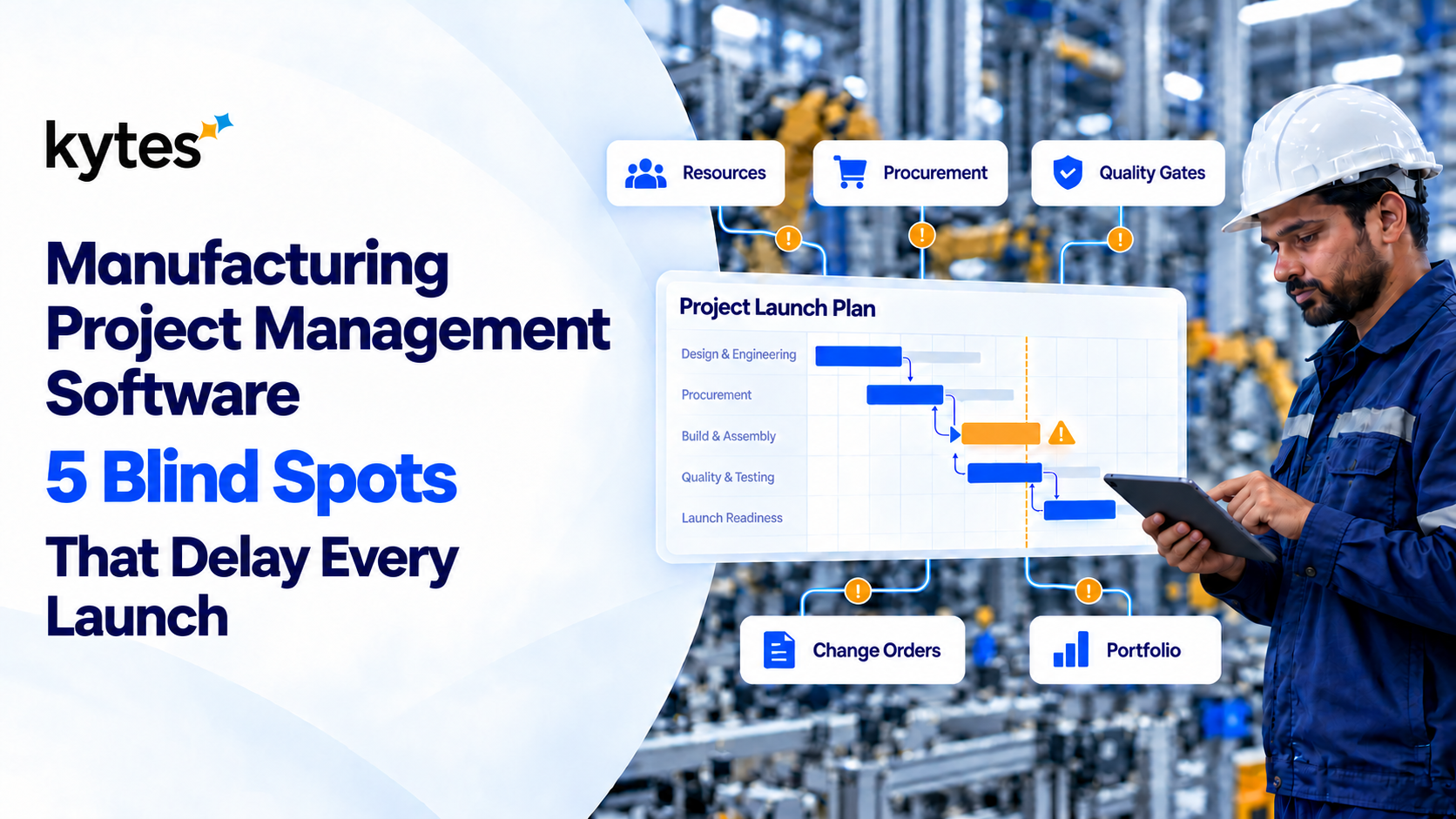
The project plan is stored in one system. The resource schedule is saved elsewhere. Procurement happens in another. Quality records are stored on a shared drive. Nobody has the whole picture. Decisions are made using incomplete information. Conflicts become apparent only when the damage has been done.
Five Gaps That Cost Manufacturing Plants Their Deadlines
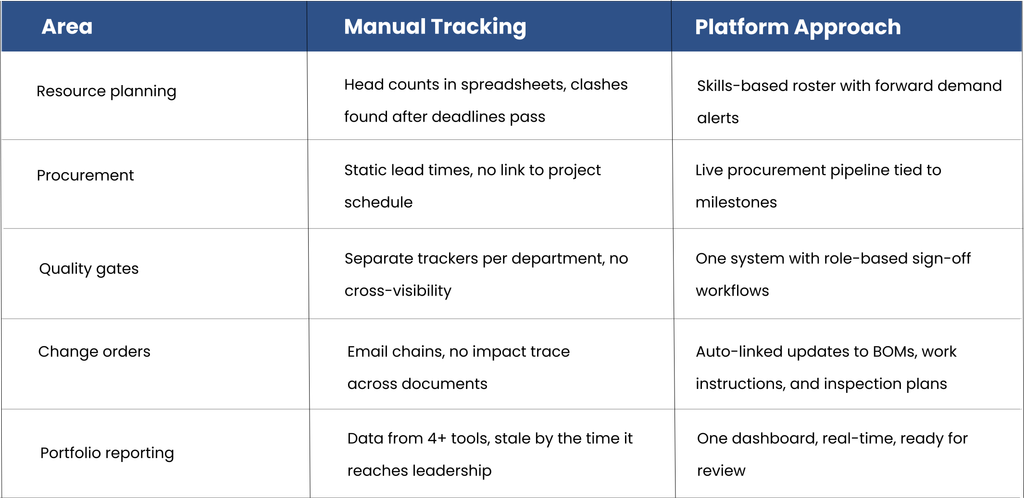
These five patterns appear across discrete, process, and hybrid manufacturers. Each one is fixable. Each one hides in a spreadsheet.
One: resource clashes across projects– A plant running six projects needs the same fixture on three of them in the same week. No one asked. The delay ripples downstream to all other jobs.
Two: procurement blind spots– A raw material lead time has increased from six weeks to fourteen. The project plan still shows the old value. When purchasing gets around to identifying the delay, the production date will already be in the past.
Three: quality gates tracked in silos– A batch also requires three sign-offs to ship: engineering, quality, and regulation. However, every sign-off is filed in its own system in its own gate. When one group finishes early and the other finishes late, the week slippage doesn’t exist to anyone until the ship date.
Four: change orders that stop short– A design revision changes the BOM. But the work instruction, the fixture drawing, the incoming inspection plan have all changed to the new revision. These mismatches cause rework, scrap, and compliance risk.
Five: no single view of the portfolio– The plant manager inquires about the ranking of the top five projects. The PMO extracts data from the ERP, a spreadsheet, two email string continuities, and a shared drive. Once compiled, the figures are almost out of date.
These are not technology gaps. They are wiring gaps. The work gets done. The systems around it do not talk to each other.
Resource Capacity Planning: The Lever Most Plants Overlook
For multi-project manufacturers, resource capacity planning is the ultimate arbiter of whether a deadline stays or goes. Book a single technician or test rig with multiple launches and you create a bottleneck. That bottleneck then affects every milestone after it.
The true measurement is forward visibility. The majority of plants have good confidence in what is going on right now. Less have any real idea what they will be strained three weeks from now. Very few can answer this: if I sign up for a new business, what active program will it delay?

A skills-centric set of team views: not just names and titles, but certifications, machine skills, and shift times. Forward demand maps that connect the project plan to hours. Clash alerts that fire before a due date is missed, not after.
With them in sync, the plant is able to sequence projects correctly, bring on employees at the right time, and cross-train when it matters.
ERP Integration for Project Management: Closing the Financial Blind Spot
An ERP is the common denominator of most manufacturers. SAP or Oracle, a mid-market system. But an ERP is not really where the project is managed. It just records transactions. The schedule, the resource plan, the milestone list, it’s stored somewhere else. Or nowhere.
Here’s where the margin leaks are hiding. A production run uses raw material. The ERP records the cost. But unless the project layer communicates with the ERP no one knows if that run was over budget. The slack shows up on the P&L three months later.
ERP project management integration addresses three issues:
1. Billing is pushed to project date, so invoices track completed work
2. Buying is based on the project schedule, so inventory shortages are identified before delay
3. Finance gets a real-time view of project margin instead of a quarterly approximation.
This layer helps transition the ERP from a ledger to decision making mechanism.
How Leading Manufacturers Close These Gaps
Through our work with manufacturers in India and the US, one pattern emerges. The plants that got deliveries in and built margins are those that gained from loose tools to one project layer.
Kytes comes in. It links the project plan to the resource register, the procurement pipeline, the quality process, and the ERP. All functions operate from the same data.
Resource guides align personnel and equipment to jobs by skill, cert and shift time. Clash notifications identify delays before they happen. Milestone billing charge clients once work is verified. AI-powered forecast overcomes forward demand scanning. It alerts the jobs most likely to be impacted by a staffing or material shortage.
A Tier 1 auto parts manufacturer in Maharashtra had 14 projects running simultaneously at two plants. At Kytes, the team reduced project delays by 30% in the first year. “We’re no longer discovering clashes on the install date, but three weeks in advance – and fixing them before they blow up the schedule,” the operations head explained.
Manufacturing in automotive, pharma and industrial gear use Kytes to run their programs. For those plants, the platform has optimized launch timing and reduced firefighting across project teams.
India and the US: A Dual Opportunity
India’s manufacturing reached $459 billion in FY24, and is expected to hit $1.66 trillion in FY34, as per a report by DSP Mutual Fund, citing IBEF data (2024). Rs 2.58 lakh crore ($27.27 billion) has been invested under the PLI scheme till June 2026, as per IBEF citing CII data.
But growth without disciplined execution creates a whole other issue. More projects, more products, more customer demand. All clogging the same few people and the same few machines. Without a capacity planning process, growth is nothing but chaos.
For US manufacturers, the squeeze comes from the other end. In Deloitte’s 2025 study, 92% of large US manufacturers surveyed believe smart manufacturing will give them an edge in the coming three years. But the most difficult functions to recruit for are planning (46%) and production management (48%). The talent shortfall means the system needs to do more of the heavy lifting.
Timing is tight for all equipment manufacturers. The ones that make the investment to develop project execution services now will only have a widening advantage. The ones that hold back will only have to add one more reason to the list of why the last launch was late.
The Bottom Line
Manufacturing in India is growing very quickly. US manufacturers are committing significantly to smart factories. But the plants that succeed are not those with the highest capacity. They are the plants with the best execution. Proper manufacturing project management software combines resource capacity planning and ERP integration for project management along with a single view of every open project into one layer. That is the difference making growing plants successful and struggling plants failing.
Frequently Asked Questions