
Blog Highlights
- Capacity planning in operations management ensures organizations can deliver multiple IT projects without overloading teams.
- Resource capacity planning software helps leaders see skill availability, workload, and demand with real-time accuracy.
- Multi-project delivery becomes more predictable when prioritization is driven by capacity instead of stakeholder pressure.
- Skill-level forecasting prevents bottlenecks and uncovers capability gaps before they impact delivery.
- Resource allocation and capacity planning improves throughput, utilization, morale, stakeholder trust, and delivery confidence.
- Enterprise-grade PSA software like Kytes enable continuous planning, scenario modeling, and controlled execution across all IT initiatives.
Most IT teams begin their day with the same tension. Too many projects, not enough people, and everyone convinced their work is the top priority. Leadership wants faster delivery, managers want accurate timelines, and developers want workloads that won’t burn them out.
Then comes the question:
“Can we take on one more project?”
Silence. Not due to lack of competence, but because most organizations still can’t see real-time resource capacity versus project demand.
The issue is that capacity planning is often treated as a spreadsheet task or a quarterly headcount review. In reality, for IT organizations juggling multiple initiatives, it’s the backbone of predictable delivery.
This blog breaks down what capacity planning really means, why many companies struggle to achieve it, and how modern software helps improve throughput, decision-making, and stakeholder confidence. For dependable multi-project delivery, capacity planning has to be more than a report — it must be a way of operating.
Why Capacity Planning Matters in IT More Than Most Leaders Realize
In operations management, capacity planning is the structured process of ensuring that an organization has the right resources to meet demand without overloading teams or underutilizing talent. In physical manufacturing, this is straightforward. Machines produce units at predictable rates. Variability is limited. A production manager knows exactly how many units twenty machines can make per hour.
IT delivery is different. One senior developer working in Node.js cannot be instantly replaced with five junior developers. Testing isn’t a machine that runs at the same speed every day. Requirements change. Dependencies shift. Client priorities evolve overnight. Forecasting delivery in a dynamic environment demands more than knowing how many people are on payroll. It requires visibility into:
- What teams are working on today
- What work is coming soon
- What work is truly strategic
- What skills exist in the organization
- How much of each skill is available at any given time
- Where constraints and bottlenecks are forming
This also means that effective capacity planning is not just a PMO responsibility. Operations management, finance, CTOs, delivery heads, program managers, and even team leads play a role. Organizations that treat capacity planning as a shared operating mechanism deliver faster and scale more predictably. Those that don’t typically rely on urgency, redesigns, overtime, or firefighting to stay afloat.
The Hard Truth: Why Most IT Organizations Struggle With Capacity Planning
Most organizations think they are already capacity planning. In reality, many are doing one of the following:
- Counting headcount and calling it capacity
- Updating static spreadsheets once in a quarter
- Estimating work effort without actual skill-based availability
- Reviewing utilization retrospectively instead of forecasting proactively
- Making decisions based on intuition rather than data confidence
The issue is rarely lack of intelligence or effort. The underlying flaws run deeper:
1. Capacity is measured at project level, not skill level
IT resources are not interchangeable.
Two Java developers are not identical.
A strong UI architect cannot fill a backend gap.
When organizations plan projects without skill mapping, forecasting breaks down before delivery even begins.
2. No unified view across all projects
Project A is planned in one tool, staffing in another, timesheets elsewhere, and reporting in slides. When data lives in different systems, decisions take too long and depend on human interpretation instead of real-time reality.
3. Workload is assumed linear
IT work is not linear. Bottlenecks form around:
- One senior reviewer
- One system architect
- One QA environment
- One integration milestone
Ignoring such constraints leads to delayed timelines even when “capacity looks available.”
4. Prioritization is subjective
In many organizations:
- The loudest stakeholder wins
- Sales commitments outrank operational availability
- PMO plans without final delivery alignment
- Urgent projects displace strategic programs
Without capacity-based prioritization, even the best resource planning software will fail.
5. Work is planned, but reallocation is not
Requirements shift. Deadlines move. People take leave. Teams change. Many businesses have no mechanism to reassign work quickly without derailing delivery commitments.
This is why spreadsheets, decks, isolated dashboards, and manual coordination eventually collapse under real-world complexity. Proper capacity planning in operations management needs system-level thinking and software built specifically for multi-project planning.
Defining Capacity Planning in Operations Management (The Real Way)
Capacity planning in operations management is the process of analyzing current and future resource demand, comparing it to actual capacity, and ensuring projects can be delivered without overloading teams or underutilizing talent. It includes four interconnected disciplines:
- Resource forecasting
- Skill-based allocation
- Capacity vs. demand scenario modeling
- Decision control and prioritization
The aim is not perfect prediction. Prediction in IT is never perfect. The aim is decision confidence — knowing that when leaders make a commitment, the organization can execute it consistently.
Types of Capacity Planning Relevant to IT Delivery
Although textbooks define several types, only three directly influence multi-project delivery in IT.
1. Workforce Capacity Planning
Ensuring the right number of engineers, testers, designers, and specialists are available to meet ongoing and upcoming project needs.
2. Skill Capacity Planning
Understanding not just how many people exist, but:
- Which skills they have
- At what proficiency
- How much availability remains in each skill area
This level of granularity prevents overloaded experts and idle generalists.
3. Technology and Systems Capacity
Performance and throughput of environments, tools, CI/CD pipelines, testing systems, release frameworks, etc.
Even if people are available, a constrained delivery pipeline slows everything down.
Organizations that plan only headcount usually miss the other two dimensions — which is why timelines slip even when teams look fully staffed on paper.
A Realistic Definition of Demand in IT Project Environments
One of the reasons resource allocation and capacity planning fails is that organizations define demand incorrectly. Most treat demand as project headcount. In practice, demand is shaped by:
- Active projects
- Pipeline projects
- Change requests
- Operational support
- Innovation or PoC work
- Technical debt backlog
- Training, knowledge transfer, and onboarding time
Failing to account for hidden demand usually leads to overcommitment. This is where structured resource capacity planning software dramatically changes the planning landscape.
The Core Framework for Capacity Planning in Multi-Project IT Delivery
Most capable IT organizations who succeed in multi-project execution use a framework that looks like this:
Operating Model for Capacity Planning
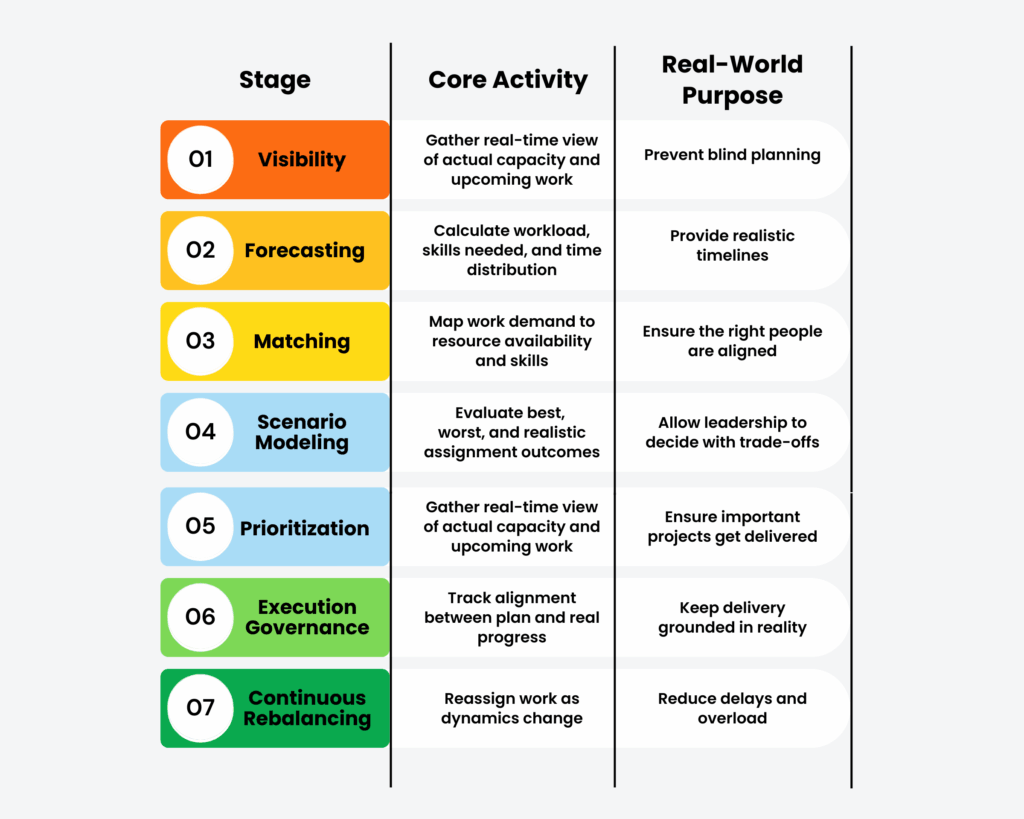
This is the level of operational maturity that helps IT organizations deliver multiple projects in parallel without burning teams out or dragging timelines endlessly.
The issue is that few organizations manage all seven steps — not because they are unwilling, but because manual systems simply cannot support this level of operational discipline.
The Moment Capacity Planning Changes The Game: When It Becomes Continuous Instead of Occasional
Most enterprises still engage in capacity planning during:
- Quarterly reviews
- Annual operating plans
- Large project onboarding
- Resource shortfalls
This schedule is too slow.
IT delivery is a living, breathing system.
New work arrives every week, priorities change every month, and delays can emerge any day.
Mature organizations treat capacity planning as an ongoing operating function — the same way sales tracks pipeline continuously and finance tracks budgets continuously.
Continuous capacity planning allows teams to answer the most important questions instantly:
- What work can we safely commit to?
- What skill gaps will appear in three months?
- Which projects will slow down because of upcoming constraints?
- Where do we need hiring, or cross-skilling, or contractor support?
- If we increase or decrease project volume, how does delivery timing shift?
This is where enterprise-grade PSA software with forecasting intelligence help organizations move from hindsight reporting to controlled execution.
The First Breakthrough: Skill-Level Capacity Visibility
Many organizations have no consolidated visibility of:
- Who is free
- Who is overbooked
- What skill is stretched
- Where delivery bottlenecks are likely to form
Resource capacity planning software changes this because it allows:
- Centralized resource profiles
- Skill tagging
- Current and future allocation visibility
- Partial allocation support (e.g., 30% on one project, 70% on another)
- Automated utilization tracking
This is when capacity planning moves from guesswork to operational control.
The Second Breakthrough: Confidence in Estimation and Forecasting
Even mature organizations sometimes undermine themselves by building detailed Gantt charts while the rest of the business lacks skill capacity to support those timelines. A forecasting engine changes that by:
- Converting workload into skill demand
- Matching demand with realistic resource availability
- Allowing schedule simulation before commitments are made
Decision-makers gain a powerful advantage: they know the consequences of a commitment before they make it.
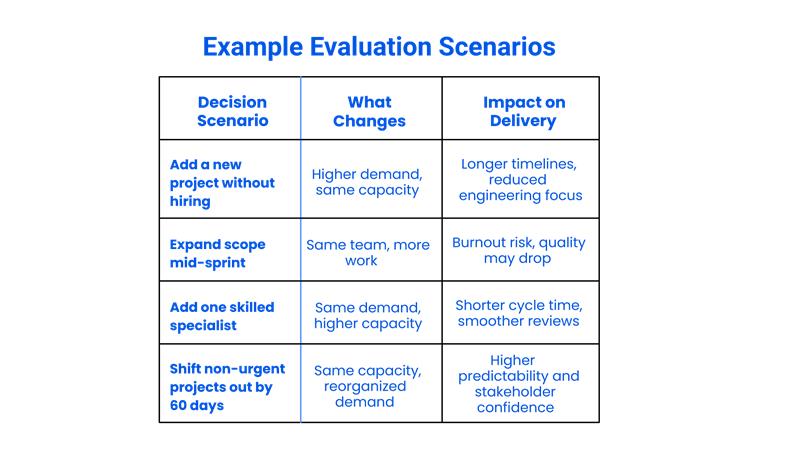
The Third Breakthrough: Scenario-Based “What If” Analysis
When organizations can simulate scenarios such as:
- “What happens if this specialist goes on leave?”
- “If we add one more initiative without additional hiring, which existing project will slow down?”
- “If the client wants a 40 percent scope increase, what timeline becomes realistic?”
Then planning is no longer reactive. Leadership can make informed trade-offs.
This transforms capacity planning from a planning exercise to strategic governance.
How Capacity Planning Improves Multi-Project Delivery in IT
A strong capacity planning approach has measurable impact across several dimensions.
1. Faster and More Reliable Project Commitments
When leaders know the relationship between:
- Current load
- Upcoming pipeline
- Skill availability
- Constraint points
They can make commitments that are realistic rather than optimistic. Sales promises become achievable. PMO dates become credible. Teams work with focus instead of constant recovery mode.
2. Higher Throughput Without Hiring More People
Most organizations assume that faster delivery requires more hiring. In reality, hiring often hides operational inefficiencies. When capacity planning highlights:
- Enterprisewide idle pockets
- Resource fragmentation
- Duplicate work
- Misallocated roles
- Underloaded specialists
Organizations can deliver more with the same headcount.
3. Better Prioritization and Leadership Alignment
Leadership alignment suffers when stakeholders argue based on personal priorities. A capacity-driven planning model changes the conversation:
Instead of: “Project X is important — we must do it now.”
It becomes: “We have 800 hours of available full-stack capacity in the next 60 days, but this initiative alone requires 900 hours. Something needs to be moved.”
Data ends opinion debates. Prioritization becomes objective.
4. More Predictable Hiring and Training
With forecasting in place, IT heads can see skill shortages forming months in advance:
- DevOps capacity dropping in Q2
- Senior frontend review load peaking next quarter
- Mobile engineering bandwidth too thin for fiscal roadmap
- Architectural reviews accumulating as backlog grows
This enables:
- Hiring ahead of need
- Cross-skilling talent
- Securing contractors proactively
Instead of reacting when delivery has already slowed down.
5. Higher Employee Morale and Lower Burnout
Burnout is not caused by workload.
It is caused by uncontrolled workload, where individuals:
- Don’t know how long the pressure will last
- Cannot defend their availability
- Don’t see the prioritization logic
When planning is transparent, teams feel in control. When allocation is realistic, quality improves.
6. Stakeholder Trust and Organizational Credibility
Most delivery problems are not caused by technical failures. They are caused by timeline surprises. When multiple projects deliver within realistic and controlled timelines:
- The organization looks well-run
- Executives feel confident
- Clients trust delivery maturity
- Teams gain pride in output
Capacity planning makes delivery expectations predictable.
Where Traditional Tools Fail — and Why PSA Software Works
Spreadsheets, PM tools, and shared dashboards are not built for multi-project capacity planning. They fail because they lack:
- Real-time updates
- Forecasting intelligence
- Skill-based mapping
- Automated rebalancing
- Multi-project alignment
- Decision simulation
- Historical utilization analysis
A PSA software that understands resource allocation and capacity planning gives organizations:
- Unified delivery visibility
- Continuous forecasting
- Shared understanding of workload
- Scenario-based decision control
- Delivery execution that stays connected to reality
This is how planning moves from theoretical to operational.
Turn Capacity Planning into a Living Operating System
Future of Capacity Planning: AI Will Elevate Decision-Making
The next evolution is not automation of scheduling.
It is automated intelligence in decision support.
AI will enable:
- Automatic detection of future bottlenecks
- Skill gap pattern recognition
- Automatic suggestion of optimal allocations
- Effort predictions based on project history
- Workload balance without human guesswork
- Real-time alerts before delivery risk materializes
Leaders will move from “What is happening?” to “What is likely next, and what should we do now?”
In other words: The future of resource capacity planning software is not dashboards. It is an operational brain that helps enterprises scale delivery without chaos.
Conclusion
Capacity planning in operations management is not a reporting function. It is the basis of predictable IT delivery. When organizations adopt structured capacity planning supported by PSA software:
- Teams stop firefighting
- Leadership stops gambling on commitment
- Budgets are spent more intelligently
- Deadlines become reliable
- Employee morale improves
- The business becomes capable of growth without breakdown
Most organizations have the talent to deliver reliably at scale.
What they often lack is the operating discipline and tooling to connect planning with execution continuously.
The organizations that fix this run multiple projects without the usual chaos. Teams deliver faster. Stakeholders gain trust. Decisions become data-driven instead of emotional. And the business becomes capable of scaling strategically, not reactively.
About Kytes
Kytes AI-enabled [PSA + PPM] software is designed for real-world delivery complexity. It combines professional services automation and project portfolio management with intelligent capacity planning, forecasting, allocation, utilization analytics, and scenario modeling. IT organizations use Kytes to build an execution system where projects are committed based on capacity truth, not assumption, and where leaders always know the real impact of their decisions before they make them.
If you want to move from reactive project management to predictable multi-project delivery driven by capacity intelligence, book a deep-dive session with Kytes and see how leading IT organizations plan with clarity, confidence, and control.