
Blog Highlights
- Why resource planning is important becomes evident as IT teams handle multiple projects, where informal tracking fails and delivery risks remain hidden until it’s too late.
- Resource planning in project management goes beyond allocations, requiring visibility into skills, dependencies, and workload strain.
- Most project and resource management issues arise when timelines are set before capacity is planned, leading to burnout and missed commitments.
- High-performing teams treat resource planning as a continuous process, using real-time data and scenario planning instead of static plans.
- Weak resource planning impacts margins and forecasts, not just delivery timelines.
- Strong resource planning gives IT leaders control, enabling predictable delivery without overloading teams.
Ask most delivery leaders where projects slip and they will point to scope changes or client pressure. Dig deeper and a different pattern emerges. Teams are stretched across parallel commitments. Senior engineers become bottlenecks. Dependencies pile up silently. By the time delivery risk becomes visible, the schedule is already compromised.
This is where the real answer to why resource planning is important begins. Not as an administrative exercise, but as a control system for complex delivery environments.
Why resource planning is important once teams manage more than one project
Resource planning feels optional when teams run one or two projects. Spreadsheets seem sufficient. Managers rely on tribal knowledge. Problems are solved through heroics. The moment an IT team manages five, ten, or twenty concurrent initiatives, that model collapses.
Resource planning is important because project complexity does not increase linearly. Each new project adds competing priorities, shared skill dependencies, and schedule coupling across teams. Without structured resource planning in project management, delivery leaders lose the ability to answer basic questions with confidence.
- Who is actually available next month?
- Which projects depend on the same critical expertise?
- What happens if one project slips by two weeks?
If those answers come from instinct rather than data, the organization is already operating in risk mode.
The real complexity behind resource planning in project management
Many organizations reduce resource planning to allocation percentages. Forty percent here. Sixty percent there. On paper, everything balances.
In reality, project and resource management is constrained by factors allocation charts do not capture.
Skills are not interchangeable. A senior backend architect cannot be swapped with a mid-level developer without consequences. Context switching erodes productivity faster than most delivery models assume. A resource at eighty percent utilization across four projects rarely delivers eighty percent value.
Effective resource planning in project management accounts for skill depth, task sequencing, ramp-up time, and dependency pressure. It treats availability as a dynamic variable, not a static number.
This is why simplistic tools and manual tracking fail as delivery environments mature.
Where most IT teams get project and resource management wrong
The most common failure is planning resources after committing to project timelines. Sales closes deals. Delivery promises dates. Resource planning is expected to catch up.
This inversion creates systemic stress. Teams are forced to absorb unrealistic schedules. Burnout increases. Quality drops. Attrition follows.
Another frequent mistake is managing capacity at the team level rather than the skill level. Teams look staffed, but critical roles are overloaded. Projects stall while dashboards remain green.
Finally, many organizations treat resource planning as a monthly or quarterly exercise. In multi-project IT environments, capacity shifts weekly. Static plans age quickly.

How mature resource planning actually works in IT teams
High-performing IT organizations treat resource planning as a continuous decision system. They start with demand clarity. Projects are broken into skill-specific work, not generic effort. Capacity is modeled at the role and skill level. Dependencies across projects are mapped explicitly.
Instead of committing to rigid schedules, leaders run scenarios. What happens if a project pulls demand forward? What if a critical engineer becomes unavailable? Decisions are made with visibility, not hope. This approach transforms project and resource management from coordination to control.
Struggling to see capacity conflicts before they hurt delivery?
Explore how Kytes resource planning gives IT leaders real visibility into skills, demand, and delivery risk.
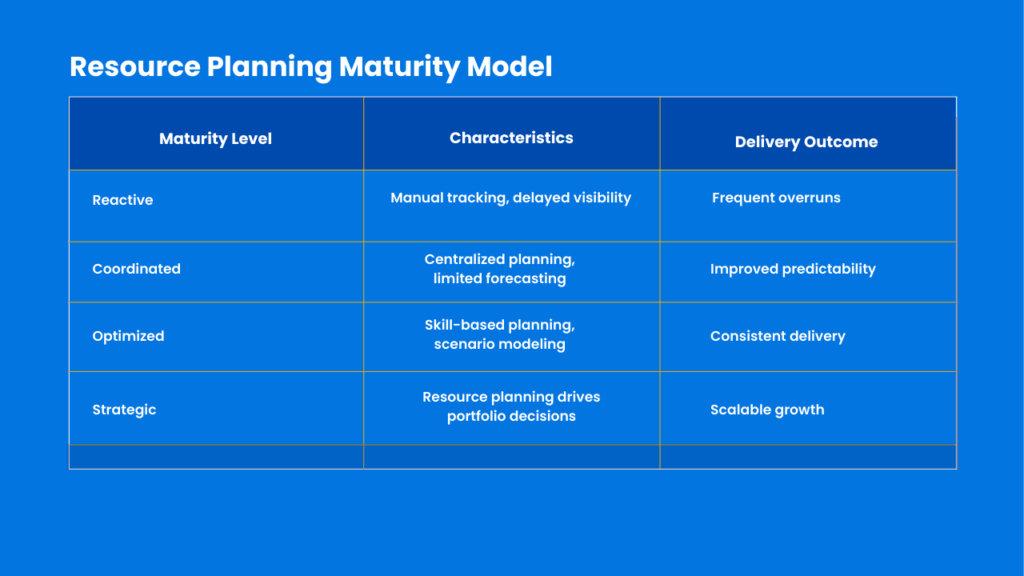
Most IT teams believe they operate at level three. In practice, many remain stuck between reactive and coordinated because their tools were not built for multi-project complexity.
The business impact leaders underestimate
Poor resource planning does not only affect delivery timelines. It distorts financial performance.
Underutilization hides inside overworked teams. Margin erosion occurs when senior talent is misallocated to low-value work. Forecast accuracy drops, affecting revenue confidence. Hiring decisions are made too late or too early.
When resource planning is strong, leadership gains leverage. Decisions about hiring, prioritization, and investment become evidence-based. Delivery becomes predictable without squeezing teams.
This is the operational truth many IT leaders discover too late.
Takeaway
Understanding why resource planning is important requires stepping beyond task allocation. It is about protecting delivery integrity in environments where complexity is unavoidable.
For IT teams managing multiple projects, resource planning is the difference between scaling responsibly and surviving through constant recovery. It turns visibility into control and planning into a competitive advantage.
How Kytes supports advanced resource planning
Kytes is an AI-enabled [PSA + PPM] platform designed for IT teams operating in complex, multi-project environments. It connects project demand, resource capacity, financials, and delivery execution in one system.
With Kytes, resource planning moves beyond static allocation. Leaders gain skill-based visibility, real-time capacity insights, and predictive signals that surface delivery risk before it becomes operational damage. Book a demo and experience connected project and resource management built for scale.