

Blog Highlights
- Project resource management determines whether delivery plans survive real execution, especially in multi-project IT environments
- Resource planning in project management often breaks down when assumptions are not continuously adjusted to reflect actual capacity and demand
- Project management resources extend beyond people to include time, skills, financial constraints, and organizational attention
- Poor resource allocation in project management leads to hidden costs such as burnout, attrition, margin erosion, and delayed outcomes
- Manual handling of a project management resource ecosystem fails at scale due to delayed visibility and static decision-making
- AI-enabled PSA and PPM systems provide continuous insight into capacity and utilization, enabling more reliable and scalable resource decisions
Every large IT organization has seen this play out. A portfolio review is in progress. Dashboards look clean. Most projects are marked green. Leaders speak confidently about milestones, burn rates, and delivery plans. On paper, execution appears controlled. Then a different question cuts through the room. Why are the same senior engineers critical to multiple initiatives at once? Why do timelines slip even when plans look sound? Why does attrition spike in teams that appear fully utilized?
This is where conversations slow down. Not because the answers are unclear, but because they expose an uncomfortable truth. The problem is rarely a lack of planning. Most organizations plan in detail. The weakness lies in how resources are understood, allocated, and adjusted once work is underway.
Resource management in project management is often treated as secondary to scope, schedules, and budgets. In practice, it is the layer that determines whether those plans survive real execution. When resource decisions rely on static tools and periodic reviews, risk does not disappear. It accumulates quietly. By the time delays or burnout become visible, the underlying imbalance has already taken hold.
This blog explores why manual resource management breaks under scale, where resource planning is commonly misread, and what it takes to manage capacity, skills, and utilization in complex delivery environments.
What are resources in project management, really?
Ask ten project managers what resources are, and most will start with people. Developers, analysts, testers, designers, architects. That answer is not wrong, but it is incomplete in ways that matter.
In project management, resources include anything that constrains or enables execution. People are central, but they are not the only limiting factor. Time is a resource, not just a dimension of a plan. Budget is a resource that competes across initiatives. Tools, platforms, environments, and licenses often gate progress more than staffing does. Even organizational attention, the ability of leaders and stakeholders to make timely decisions, functions as a finite resource.
What complicates matters further is that human resources are not interchangeable units. A “developer” is not a generic input. Skill depth, domain familiarity, context knowledge, and cognitive load all influence actual capacity. Two individuals with the same title can deliver very different outcomes under the same conditions.
When organizations collapse this complexity into simple availability percentages or role-based headcounts, they lose fidelity at precisely the point where accuracy matters most. Decisions become easier to document, but harder to defend when delivery pressure increases.
Understanding what resources are in project management is less about definitions and more about acknowledging constraints honestly. The more complex the work, the more damaging it becomes to oversimplify the inputs that make delivery possible.
Resource planning in project management versus resource management
Resource planning and resource management are often used interchangeably, but they solve different problems.
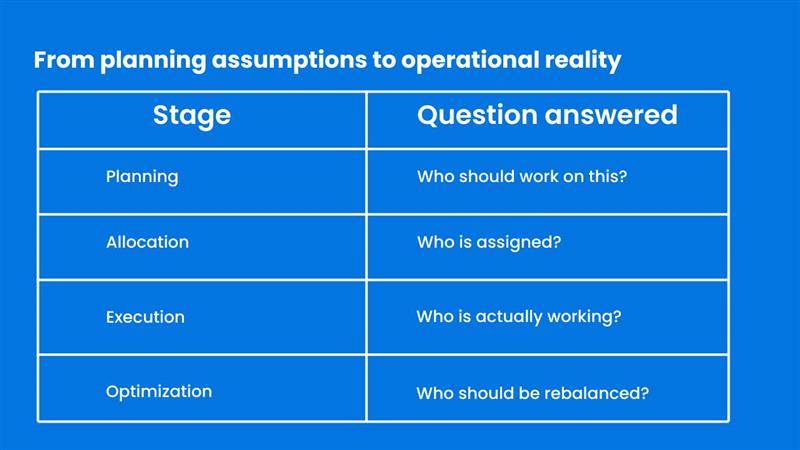
Resource planning in project management focuses on intent. It answers questions such as who should be assigned, when work is expected to start, and how capacity is expected to align with project timelines. Planning happens before execution. It relies on assumptions, estimates, and historical patterns.
Resource management operates during execution. It deals with what is actually happening, not what was expected to happen. It tracks how much effort is being consumed, where bottlenecks are forming, and which trade-offs are emerging across parallel initiatives.
The gap between planning and management is where most delivery friction lives.
Plans are static by design. They are snapshots created at a point in time. Delivery environments are not static. Priorities shift. Dependencies surface. People fall sick, leave, or get pulled into escalations. Clients change requirements. Internal stakeholders introduce new demands.
When organizations invest heavily in planning but lightly in active resource management, they operate with outdated information. Decisions continue to reference the plan long after reality has diverged from it.
This is not a failure of discipline. It is a structural mismatch between how work behaves and how it is tracked.
The modern project management resource problem
In small teams or single-project environments, informal coordination often works. People talk. Adjustments are made on the fly. Visibility is shared naturally.
As organizations scale, that informal layer breaks down.
Most IT and ITES organizations today run dozens, sometimes hundreds, of concurrent projects. Resources are shared across programs. Specialists are pulled into critical moments across teams. Delivery timelines overlap. Financial accountability spans multiple dimensions.
In this environment, three problems consistently emerge.
First, resource contention becomes invisible. A person can appear available in a system while being cognitively overloaded across initiatives.
Second, context switching becomes normalized. Skilled individuals are spread thin, reducing throughput even when utilization appears high.
Third, feedback lags increase. By the time utilization data is updated, the conditions it describes have already changed.
These issues are not caused by poor intent or lack of effort. They are symptoms of managing complex systems with tools designed for simpler ones.
Resource conflicts are portfolio problems, not project problems
Most organizations attempt to resolve resource conflicts inside individual projects. A delivery manager reshuffles assignments. A project manager negotiates for partial availability. A senior engineer is asked to “support just this one critical phase.”
These actions feel practical because they are close to the work. They are also where the problem gets misdiagnosed.
Resource contention is rarely created by a single project. It emerges at the portfolio level, where competing priorities draw from the same limited pool of skills, time, and attention. When each project optimizes locally, the organization optimizes poorly as a whole.
A project can be perfectly planned in isolation and still fail because of decisions made elsewhere. Another initiative pulls a key specialist for a week. A leadership escalation diverts senior capacity. A strategic program quietly absorbs the best people across teams. None of these shifts appear clearly in project-level plans, yet they reshape delivery reality.
Treating resource conflicts as project problems leads to endless negotiation and short-term fixes. Treating them as portfolio problems forces a different conversation. It requires leaders to weigh trade-offs explicitly, sequence initiatives realistically, and acknowledge that not all commitments can be optimized simultaneously.
Until resource decisions are owned and resolved at the portfolio level, project-level adjustments will remain reactive and fragile.
Why manual resource allocation in project management fails at scale
Manual approaches to resource allocation typically rely on spreadsheets, periodic updates, and manager judgment. Each of these elements works reasonably well in isolation. Together, they create a fragile system under scale.
Spreadsheets assume linear time. They struggle to represent overlapping work, partial availability, or fluctuating demand. Updating them accurately requires constant attention, which is rarely feasible in active delivery environments.
Periodic reviews create blind spots. Weekly or monthly updates are outpaced by daily changes in execution. Decisions are made based on what was true, not what is true.
Human judgment remains essential, but it does not scale when it must continuously reconcile competing priorities across a portfolio. Even experienced leaders cannot manually compute the downstream impact of reallocating a key resource across multiple projects.
The failure is not that manual systems are inaccurate. It is that they are slow. In complex environments, speed of feedback matters as much as precision. When signals arrive late, corrective action becomes reactive rather than preventive.
At scale, resource management becomes a dynamic problem. Manual tools are static by nature. That mismatch is where breakdowns occur.
The cost of delayed reallocation: why timing matters more than accuracy
In complex delivery environments, the timing of a decision often matters more than its precision.
Manual resource management systems struggle not because they produce incorrect answers, but because they produce answers too late. By the time over-allocation is visible, dependencies have formed around it. By the time a reallocation is approved, downstream plans have already adjusted. By the time relief arrives, the damage has compounded.
Delayed reallocation carries hidden costs. Work queues grow unevenly. Bottlenecks harden. Teams compensate by working longer hours or cutting corners. Small inefficiencies cascade into missed milestones and quality issues.
An early, imperfect adjustment can often prevent these effects. A late, perfectly reasoned one rarely does.
This is why static reviews and periodic updates fail under scale. They lock decision-making into a rhythm that does not match the pace of execution. In dynamic systems, speed of feedback is not a convenience. It is a requirement.
Resource management succeeds when organizations can sense imbalance early and respond while options still exist.

This contrast is not about sophistication for its own sake. It reflects the difference between managing what is planned and managing what is unfolding.
The hidden costs of poor project management resource decisions
When resource management fails, the consequences rarely appear as a single dramatic event. They accumulate quietly.
Underutilization erodes margins in services organizations. Overutilization drives burnout and attrition, increasing replacement costs and delivery risk. Delayed projects miss market windows or contractual milestones. Teams lose trust in plans that do not reflect their lived experience.
Perhaps most damaging is decision paralysis. When leaders cannot rely on resource data, they delay commitments or make conservative choices that limit growth. Opportunity cost becomes the silent tax paid for poor visibility.
These are business outcomes, not project-level inconveniences. Treating resource management as an operational detail understates its strategic impact.
Utilization is a lagging indicator, not a control mechanism
Utilization is one of the most widely tracked resource metrics, and one of the most misunderstood.
On the surface, it appears precise. Percentages suggest control. Targets imply discipline. In practice, utilization describes what has already happened, not what should happen next.
High utilization often looks healthy until it isn’t. Teams operating at sustained peak utilization have little room to absorb change, resolve unexpected issues, or improve quality. Context switching increases. Cognitive load rises. Throughput declines even as effort increases.
By the time utilization data signals a problem, the underlying strain has usually been present for weeks. Burnout does not begin when utilization crosses a threshold. It builds gradually, hidden behind full calendars and optimistic reporting.
Used correctly, utilization helps explain outcomes after the fact. Used incorrectly, it becomes a blunt instrument for planning future work. Organizations that attempt to control delivery by pushing utilization higher often achieve the opposite of what they intend.
Effective resource management treats utilization as a diagnostic signal, not a steering wheel.
If everything is “on track,” why does delivery still feel strained?
Kytes AI-enabled [PSA+PPM] software streamlines how resources are actually allocated and utilized across projects.
Explore Kytes
What scalable resource management actually requires
Managing resources effectively at scale requires a shift in capability, not just tooling.
First, visibility must be continuous. Capacity, allocation, and utilization need to reflect current conditions, not last week’s assumptions.
Second, allocation must be skill-aware. Assigning based on availability alone ignores whether the right expertise is applied at the right moment.
Third, leaders need scenario awareness. What happens if a key resource becomes unavailable? Which projects absorb the impact? Which commitments need adjustment?
Fourth, resource data must connect across systems. Project timelines, financial forecasts, and delivery metrics cannot live in isolation.
Scalable resource management does not remove complexity. It makes complexity legible.
Why resource transparency changes behavior, not just plans
Resource visibility is often framed as a reporting benefit. Better dashboards. Clearer forecasts. More confidence in numbers.
Its real impact runs deeper.
When capacity constraints and trade-offs are visible, behavior changes. Teams stop overcommitting because the cost is clear. Leaders negotiate priorities more deliberately because conflicts are explicit. Decisions shift from persuasion to evidence.
Transparency removes plausible deniability. It becomes harder to assume availability that does not exist or to defer difficult trade-offs. This does not reduce tension, but it makes tension productive rather than destructive.
AI has a role in modern resource management, but not the one often advertised.
Its value lies in pattern recognition. AI can surface utilization trends, predict overload risk, and highlight emerging bottlenecks earlier than manual analysis allows. It can model scenarios quickly and consistently.
What it does not do is make decisions in isolation. Human judgment remains essential for interpreting trade-offs, managing stakeholder expectations, and balancing competing priorities.
The most effective systems use AI to improve signal quality, not to automate leadership responsibility.
Resource management as a leadership discipline
Delegating resource decisions entirely to project managers or tools is tempting, but incomplete.
Resource allocation reflects organizational values. It determines which work is prioritized, which teams are protected from overload, and how trade-offs are communicated. Leaders who engage actively with resource data make better strategic decisions because they understand the true cost of commitments.
This is not about micromanagement. It is about informed stewardship of limited capacity.
Conclusion: the question that matters
The question leaders need to ask is not whether their teams are busy. It is whether their resource decisions are grounded in reality.
Scale does not create resource problems. It exposes them. Manual systems that once worked begin to fracture under complexity, not because people stop trying, but because the environment outgrows the tools.
Organizations that treat resource management in project management as a strategic capability gain resilience. They adapt faster. They protect their teams. They deliver with credibility.
Clarity, not control, is what sustains execution at scale.
About Kytes
Kytes is an AI-enabled [PSA+PPM] software purpose-built to manage complex project portfolios and shared resource pools. By unifying project delivery, resource visibility, and financial insight, Kytes helps leaders see how work actually flows across their organization.
Rather than relying on static plans or fragmented tools, teams using Kytes gain continuous insight into capacity, utilization, and risk. This enables better decisions, healthier teams, and more predictable outcomes across the delivery lifecycle.
Kytes is built for organizations that understand that execution quality depends on visibility, not guesswork. See how Kytes brings clarity to resource management.