
Blog Highlights
- Number one reason for project failures is too many projects at the same time.
- 72% of teams are spending half a day or more every month manually gathering status reports
- Forward capacity planning for resources and workload across multiple projects is the single biggest factor in on-time project delivery for multi-project teams.
- The worldwide project management talent gap by 2035 will be 30 million people
One CDMO just outside Hyderabad received a contract to produce a generic API for a European client. The CDMO project teams drafted the spreadsheet project plan. Milestones were all negotiable. And eight months down the line, the filing lagged by 14 weeks. The chemistry was perfect. The lab team was diverted onto a second project and nobody noticed until the dates were overdue.
Project scheduling software links every task, resource, milestone, and dependency into one live plan across all active projects. Whether new product introductions, plant additions, regulatory submissions, or capital projects: it covers them all. It takes the place of the spreadsheets, email threads, and ERP workarounds that most project-based teams are still using. All team members view the project schedule the same way, they see the same risks, and they see the same target finish date. When a schedule doesn’t exist, the missing puzzle pieces that destroy deadlines are out of sight until it’s too late.
Why Project Timelines Break Faster Than Teams Expect
The majority of schedule failures happen early on. The schedule is created. Tasks are added. Dates are allocated. And then the schedule is torn apart by reality.
According to the Wellingtone Report (2026), barely a third of teams nearly always or predominantly deliver projects on time. But even more concerning is the fact that approximately a third of projects are never baselined, which means a baseline point to measure slippage to is never established.
The cause is rarely a single mistake. It’s a series of planning schedules created without considering how they fit together. The work breakdown structure is stored in one file. The resource plan is stored in another. Purchase orders are managed in the ERP. The quality gates are stored in a shared directory. Nothing connects it all together. Decisions are made on incomplete information. The issues are visible in hindsight.
This is the pattern for CDMOs, EPC contractors, and engineering services companies on every project type. A clinical program gets delayed because a common lab resource was scheduled twice; a plant construction got delayed because the procurement schedule was not integrated with the installation schedule. They complete the work; the systems do not communicate with one another.
Six Timeline Killers Hiding in Your Project Plan
These six patterns appear across pharma, construction, and engineering firms. Each one is fixable. Each one hides in a spreadsheet.
One: task dependencies that cascade without warning- Lab tests are required on the clinical batch prior to the initiation of the stability studies. Any delay of three days in testing will cascade the issue to every downstream milestone. Static project plans don’t typically reflect that cascade. It adds up silently.
Two: resource constraints nobody checked-A CDMO has four programs running, and they need a single QC analyst for three of those in the same sprint. Nobody checked forward demand. The program evaluation and review technique (PERT) predicted duration correctly. But the schedule assumed the person would be there. They were not.
Three: a work breakdown structure (WBS) that stops at the output level– WBS states on one line method validation. When you look at the implementation, that line contains twelve tasks, three handoffs and two outside links. And the details are often missing, so it’s a guess.
Four: project milestones without owners– The plan has a filing due week 26. But who owns the checklist? Who owns the review? Who owns the follow up? Objectives without owners float. No one cares until the deadlines are missed.
Five: planning schedules built in silos– This plan shows a filing in week twenty-six. But no one owns the checklist, the review, the follow-up. Milestones without owners float by. No one notices the finish dates until they’re late.
Six: no single place to track progress– A project plan is built by the project manager. A purchasing plan is built by the buying team. The quality plan tracks gates in a third system. If the supplier lead time changes, only the purchasing plan is updated. The project plan remains unchanged. The gap remains hidden.
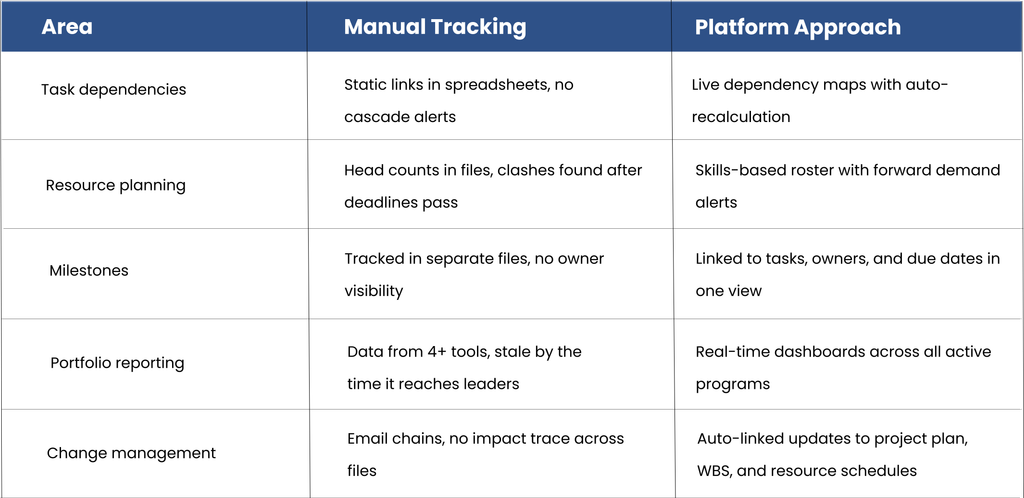
Manual Tracking vs. Platform Approach
Resource Allocation Software: The People Problem Behind Every Missed Deadline
When things go awry, the knee-jerk reaction is to hold the plan responsible. But the evidence shows that it’s people, not projects, that cause most slippage. The right work is not always the right work. The right person to do it is busy, overwhelmed or working on the wrong project.
This is where resource allocation software comes in to solve this challenge. It assigns the right people with the right skills to the right projects based on availability and priority. It doesn’t randomly assign it to anyone that’s available.
The Wellingtone Report (2026) identified an over-commitment of work across too many projects as one of the leading reasons why projects fail. It’s a resource issue. Everything is in competition with everything else, and no-one has visibility of the whole.
When CDMOs have parallel development programs, high stakes arise. An authorized lab scientist for a method might be the sole individual capable of executing a key assay. If they already work on another sponsor’s program, the project has to wait. Appropriate software identifies this conflict days, not weeks, before submission.
Resource Capacity Planning: Seeing Three Weeks Ahead
Resource scheduling tells you who is available today. Capacity planning tells you who will be available three weeks from now. The difference between the two means whether a team responds to an overdue deadline or avoids one altogether.
Most teams have some idea of who’s busy today. And even fewer will be able to identify who’ll be under pressure next month. But extremely few can give this answer: which current program will be delayed if we take on this new project?

There are three things needed to get project scheduling right. Skills-based view of the team, including not just names, titles and locations but skill tags, shift patterns and clearances. Forward demand maps – linking projects’ task plans to demand for work hours. Clash alerts – warning you, before an item is late, that workloads are busy.
When you leverage all three, your team can balance team workload, schedule projects appropriately, hire just-in-time, and build cross-training where it really matters.
How Leading Enterprises Close These Gaps
That’s the pattern we see working with project-led firms in India and the US. The most successful teams-those that deliver projects on time and protect margins-are the ones that transitioned from a scattered toolbox of disconnected tools to a single connected platform.
Kytes powers this layer. It links together the project plan to the resource list, the buying pipeline, the quality flow and the ERP. All the functions are fed from the same data.
Resource tools align people to projects based on skill, clearance, and available time. Clash alerts make sure conflicts get nipped in the bud. AI-powered forecast looks ahead and identifies projects most likely to experience a staffing or material shortage. Milestone-linked billing allows you to invoice clients the second the work is complete.

CDMO and pharma teams run their programs on Kytes too. For these teams, the platform has cut filing delays and improved resource visibility across active drug programs.
India and the US: The Scheduling Pressure Is Growing
Growth is rapid in India’s pharma and manufacturing spaces. The Rs 2.58 lakh crore ($27.27 billion) PLI scheme has accounted for Rs 2.58 lakh crore ($27.27 billion) committed in expenditure alone through June 2026, IBEF quoting CII. There’s a new plant, new line of product or new agreement every day– this is the tail of the pipeline, without a forward-looking capacity planning system, growth increases the chaos, not the margin.
US companies are under the same duress from another source. Planning and scheduling jobs are the most difficult to fill, according to the Deloitte Smart Manufacturing Survey (2025), so the system should be taking up the slack. Those who begin using project solutions today will magnify the advantage, and those who wait will continue to justify the excuses.
The Bottom Line
Less than 1 in 3 teams complete projects on schedule. The solution isn’t a smarter spreadsheet. It’s a system that connects all task dependencies, resource constraints, and milestones into one real-time project schedule. The right project scheduling software combines resource allocation software, resource capacity planning, and portfolio view into one seamless layer. That’s how scaling companies outrun their deadline-chasing competitors.
Frequently Asked Questions