

Blog Highlights
- Resource allocation is not a scheduling task. It is a leadership decision about how limited capability is distributed across competing priorities, and most delivery failures trace back to these early choices.
- Project delays rarely come from poor execution alone. They emerge when capacity is overestimated, critical resources are spread too thin, and allocation decisions are made without a portfolio-wide view.
- Resource allocation and resource management are not the same. Strong management cannot fix weak allocation logic, but sound allocation creates the conditions for predictable delivery.
- Resource capacity planning is what turns allocation from guesswork into a repeatable system. Plans based on effective capacity survive real-world complexity better than those built on theoretical availability.
- Spreadsheets and disconnected tools fail as portfolios grow because they cannot reflect changing capacity, hidden work, or cross-project conflicts in real time.
- Mature organizations treat resource allocation as a continuous feedback loop, where capacity, prioritization, and delivery outcomes inform each other and strengthen planning over time.
Every project begins with a promise. The scope looks reasonable. Timelines feel achievable. Teams nod in agreement during kickoff. From the outside, everything appears aligned.
Then starts the execution.
Suddenly, the same people are pulled into parallel initiatives. Key contributors are unavailable when decisions stall. Small delays accumulate into missed milestones. When the pressure rises, the explanation is almost always the same. The plan was fine. Execution was the problem.
Experienced project managers know the truth is less comforting. Most delivery failures are not execution failures. They are allocation failures that occurred long before work officially began.
Resource allocation rarely collapses in dramatic ways. It erodes quietly through assumptions, incomplete visibility, and overconfidence in capacity that never truly existed. By the time delivery pain surfaces, the real decisions have already been made.
This article looks at resource allocation not as a scheduling activity, but as a core discipline of project and portfolio leadership. One that determines whether plans remain credible once they meet reality.
What Is Resource Allocation?
At its core, resource allocation is the process of deciding how limited human capability is distributed across competing priorities.
That definition sounds simple. In practice, it is one of the most complex decisions delivery leaders make.
Resource allocation is not about assigning names to tasks. It is about choosing where attention, expertise, and time are invested, knowing that every allocation decision excludes other work.
For project managers, resource allocation sits upstream of execution. It shapes delivery velocity, risk exposure, and team health before the first task is started. Poor allocation cannot be corrected through better tracking. Strong allocation reduces the need for heroics later.
Effective allocation answers questions that plans often avoid:
- Which work deserves priority when capacity is constrained?
- Which roles are critical path resources across projects?
- What trade-offs are acceptable, and which are not?
Until these questions are addressed explicitly, allocation happens by default rather than design.
Why Resource Allocation Breaks Down in Real Projects
Most allocation failures are not caused by lack of effort. They stem from structural blind spots that repeat across organizations.
One of the most common is the assumption that availability equals capacity. A person may appear free on a project plan while carrying unplanned operational work, mentoring responsibilities, or dependency-driven delays. On paper, capacity looks healthy. In reality, it is fragmented.
Another issue is the overreliance on utilization as a success metric. High utilization feels efficient, but it leaves no buffer for complexity, learning curves, or unexpected rework. Teams operating near full utilization consistently underestimate timelines and overestimate resilience.
Context switching is another silent drain. When individuals are allocated across too many initiatives, productivity drops long before anyone flags a risk. The work still progresses, but at a slower, less predictable pace.
From a PM perspective, these issues are difficult to escalate because they are rarely visible in isolation. Each project appears manageable. The strain only becomes obvious when viewed across the portfolio.
The Assumptions Project Managers Rarely Challenge
Most project managers inherit constraints rather than question them. Work arrives approved. Timelines are already suggested. Teams are assumed to be available because no one has said otherwise. Over time, these assumptions harden into operating truths, even when evidence contradicts them.
One common assumption is that approval implies feasibility. When leadership signs off on an initiative, it is often taken as confirmation that capacity exists somewhere in the system. In reality, approval usually reflects strategic intent, not delivery readiness. The gap between the two is where allocation failures begin.
Another assumption is that availability equals capacity. A name without a booking is treated as free. The unseen work remains invisible. Support escalations, internal reviews, knowledge transfer, and cognitive load rarely appear in plans, yet they consume meaningful effort. Plans built on partial visibility rarely hold.
Short-term overextension is also normalized. Teams stretch to meet a deadline, and when nothing breaks immediately, the stretch becomes the baseline. Over time, temporary effort is mistaken for sustainable capacity. Burnout does not arrive suddenly. It accumulates quietly.
Finally, there is the assumption that skills are interchangeable. Titles and role labels hide real differences in experience and context. Replacing one engineer with another on a plan may balance a spreadsheet, but it rarely balances delivery risk.
These assumptions persist because they simplify planning. Challenging them introduces discomfort. Mature project managers learn that discomfort early prevents far greater disruption later.
Resource Allocation vs Resource Management
These terms are often used interchangeably, but they solve different problems. Resource allocation is about decision-making. It determines where people should be placed based on priorities, risk, and capacity constraints.
Resource management is about execution and governance. It tracks assignments, availability, and utilization over time. A team can be excellent at managing resources and still fail at allocating them wisely. Clear timesheets, accurate forecasting, and detailed plans do not compensate for flawed allocation logic.
For project managers, this distinction matters. Many delivery issues attributed to poor management actually originate from allocation decisions made too early, with too little information. Strong allocation sets the conditions for effective management. Without it, management becomes reactive.
The Role of the Project Manager in Allocation Decisions
Project managers are rarely the owners of resource allocation. Yet they are deeply accountable for its consequences. This tension defines much of modern delivery work.
While PMs may not control staffing decisions, they are often the first to see where allocation choices strain reality. They sit closest to dependencies, bottlenecks, and the early signals of overload. When these signals are ignored or softened, risk compounds silently.
The most effective PMs do not argue for more resources by default. They frame trade-offs. They make capacity visible. They explain what changes when nothing else does. Instead of asking whether a timeline can be met, they show what must give way for it to remain credible.
This requires discipline. It is easier to absorb risk than to surface it. It is easier to adjust plans than to challenge assumptions upstream. Over time, this pattern trains organizations to expect flexibility from PMs rather than clarity from leadership.
Strong project managers resist this drift. They treat allocation as a shared decision, not a hidden burden. They document constraints, escalate conflicts early, and refuse to normalize overload as execution excellence.
Their influence does not come from authority. It comes from making the consequences of allocation decisions visible before they become unavoidable.
The Operational Cost of Poor Allocation
When allocation decisions are misaligned, the impact spreads far beyond individual projects.
Delivery delays often appear as dependency issues, but the root cause is usually shared resource contention. Attrition increases when high performers are repeatedly overextended while less critical work continues unquestioned. Financial forecasts drift as billable capacity is assumed rather than validated.
Perhaps most damaging is the erosion of trust. When delivery commitments are repeatedly revised, stakeholders stop believing in plans altogether. Project managers are then forced into defensive communication rather than proactive leadership.
These costs accumulate quietly. They rarely show up as a single failure, but as a pattern of near misses and chronic firefighting.
Resource Capacity Planning: Where Allocation Becomes Predictable
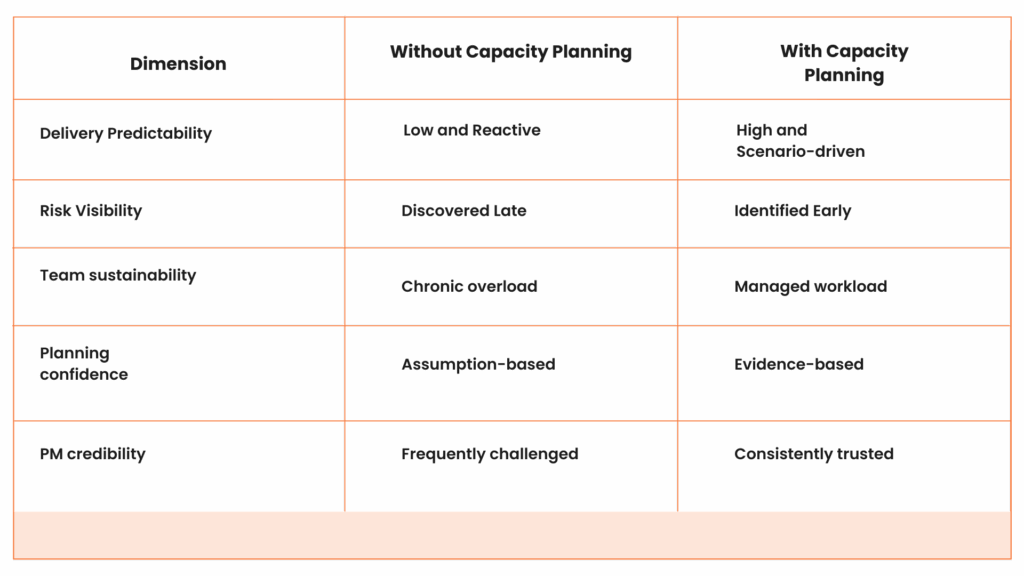
Resource allocation only becomes reliable when it is anchored in realistic capacity planning.
Capacity planning is not a one-time estimation exercise. It is a continuous practice of understanding how much work teams can absorb without degrading quality or sustainability.
Effective capacity planning distinguishes between theoretical capacity and effective capacity. Theoretical capacity assumes ideal conditions. Effective capacity accounts for interruptions, learning curves, dependencies, and cognitive load.
For PMs, this distinction is critical. Allocation decisions based on theoretical capacity almost always lead to optimism bias. Decisions grounded in effective capacity create plans that survive contact with reality.
Capacity planning also enables scenario thinking. Instead of asking whether a project can be delivered, leaders can ask what must change for it to be delivered responsibly.
Why Spreadsheets and Disconnected Tools Fail at Scale
Many teams begin with spreadsheets for resource planning. This works when portfolios are small and change is limited.
As complexity increases, spreadsheets struggle to reflect reality. Updates lag behind execution. Conflicting versions circulate. Scenario planning becomes manual and error-prone.
Disconnected tools introduce similar problems. When project plans, time tracking, and financial data live in separate systems, allocation decisions are made with partial information.
For project managers, this fragmentation increases cognitive load. More time is spent reconciling data than interpreting it. Decisions slow down precisely when speed matters most.
The issue is not tooling preference. It is the inability of disconnected systems to represent capacity dynamically across a portfolio.
What Resource Management Software Should Enable
From a PM-led perspective, resource management software should support decisions, not just record activity.
At a minimum, it should provide:
- Real-time visibility into capacity across projects
- Early detection of resource conflicts
- Scenario modeling for allocation trade-offs
- Alignment between delivery plans and financial impact
Most importantly, it should reflect how work actually happens, not how plans were originally designed.
When software mirrors reality, project managers spend less time defending plans and more time shaping outcomes.
Explore how Kytes brings clarity to resource allocation
The Allocation Model High-Performing Teams Use
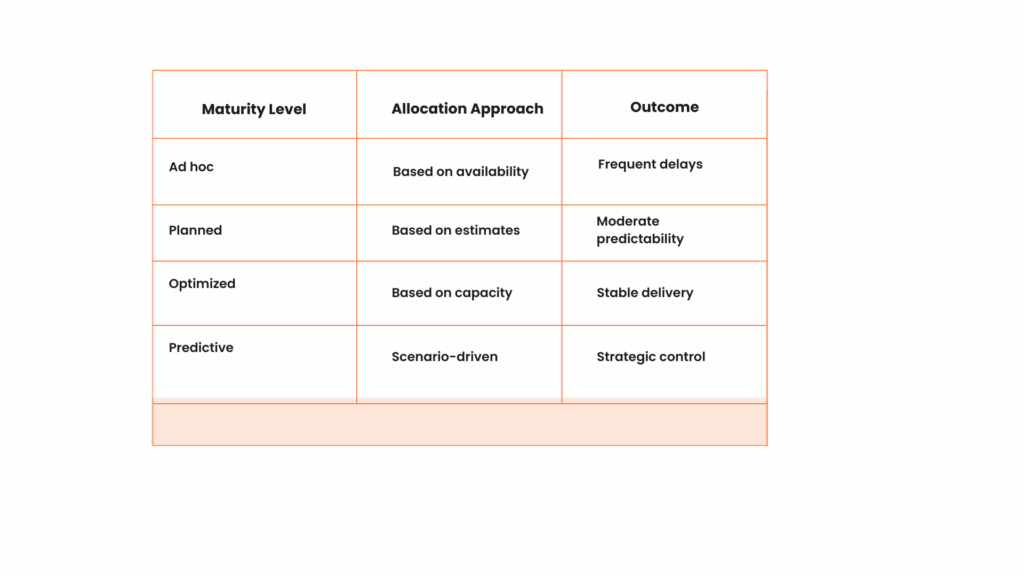
High-performing delivery organizations treat resource allocation as a continuous feedback loop.
Capacity informs prioritization. Prioritization shapes allocation. Allocation outcomes feed back into capacity assumptions.
Project managers are not expected to absorb risk silently. They surface trade-offs early, supported by data rather than intuition. Leadership decisions are documented, not implied.
This model does not eliminate constraints. It makes them visible and manageable.
Over time, teams develop a shared language around capacity and trade-offs. Delivery discussions become clearer. Commitments become more credible.
From Reactive Allocation to Strategic Control
Final Thoughts
Resource allocation is often framed as an operational task. In reality, it is a leadership discipline that reflects how organizations make choices under constraint.
When allocation is treated casually, teams absorb the cost through burnout, delays, and rework. When it is treated deliberately, delivery becomes predictable without becoming rigid.
For project managers, mastering allocation is not about better tools alone. It is about asking harder questions earlier and insisting on clarity when assumptions feel convenient.
Plans do not fail because teams lack effort. They fail because capacity was misunderstood long before execution began.
About Kytes
Kytes is an AI-enabled PSA and PPM platform designed for organizations that manage complex project portfolios and shared delivery teams. It brings resource allocation, capacity planning, and project execution into a single system so decisions are grounded in real operational data rather than assumptions. By connecting planning with reality, Kytes helps delivery leaders move from reactive coordination to predictable control. Explore how AI-enabled PSA and PPM can help project leaders allocate resources with confidence, clarity, and accountability. Book a demo now.