
Blog Summary
- AI Teammates are strategic collaborators, not just digital assistants.
- They adapt, learn, and proactively guide enterprise decision-making.
- Benefits include higher productivity, streamlined project delivery, and better team engagement.
- Building one starts with identifying workflows and defining clear roles.
- Pilot small use cases before scaling across the enterprise.
- The future of work is humans and AI working together as true teammates.
Picture this: it’s Monday morning, your email is full, project deadlines are piling up, and your team is clamoring for guidance on what to focus on first. You sit down at your laptop to plan—but what you get up to next is fighting fires with emails and hunting down data in several tools. Does that ring a bell?
Now imagine having a teammate who is with you 24/7. An individual who not only executes orders, but anticipates danger, proposes wiser choices, and assists in aligning your team prior to issues even arising. That’s what an AI Teammate is all about.
In contrast to legacy AI products that perform narrow directives, an AI Teammate is a strategic partner—a collaborator that learns, changes, and participates directly in decision-making. From scheduling optimization to raising compliance threats, AI Teammates are transforming how work is accomplished in contemporary businesses.
And organizations are taking note. A Harvard-led field study found that human–AI collaborations generated the highest quality outcomes, often outperforming traditional teams. In fact, the global potential of AI teammates is projected to reach $6 trillion, signaling a future where humans and AI operate as equals in driving growth and innovation.
What Is AI Teammate
For years, most of us have interacted with AI in the form of assistants: think chatbots that answer FAQs, or scheduling tools that block calendars when prompted. Helpful? Yes. Strategic? Not quite.
An AI Teammate goes several steps further. Instead of acting on a narrow command, it works alongside humans as a strategic AI collaborator—adapting to context, learning from feedback, and proactively guiding decision-making. Where an assistant responds, a teammate anticipates. Here’s a simple comparison:
AI Assistant vs. AI Agent vs. Agentic AI vs. AI Teammate
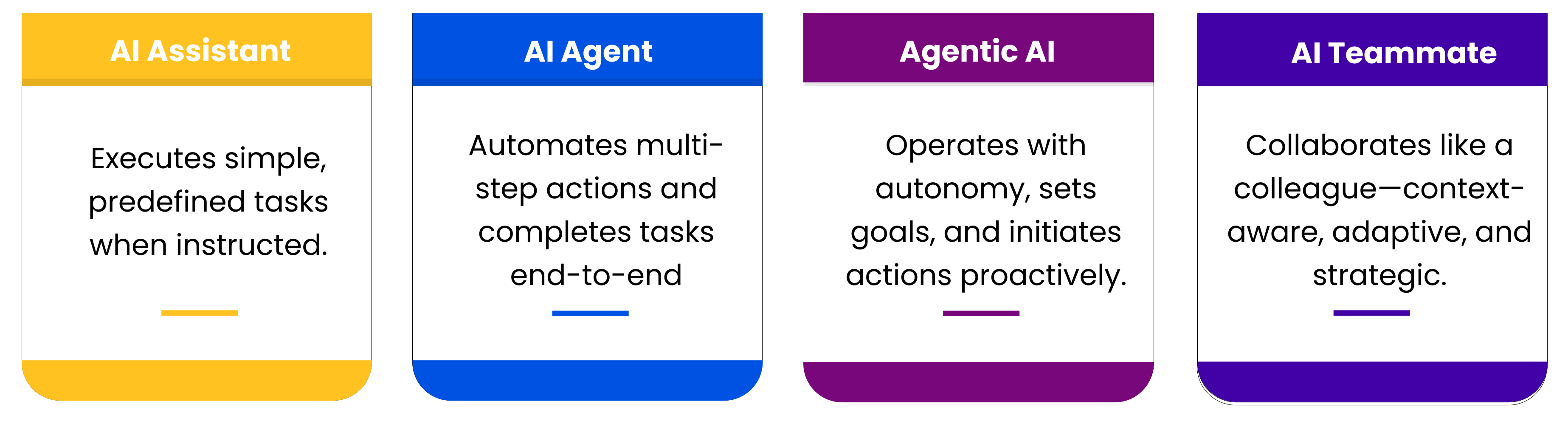
The distinction may sound subtle, but in practice it’s transformative. Research from the World Economic Forum highlights that companies treating AI as teammates—not just tools—unlock stronger productivity gains and better workforce morale. In fact, employees are 33% more likely to report improved performance when AI is framed as a collaborator rather than a replacement.
AI teammates are also memory- and context-aware. While bots of the past “forget” when a project is finished, AI teammates track project history, company objectives, and changing priorities—much as would a coworker.
This is where business platforms such as Kytes come in. Rather than providing organizations with standalone AI capabilities, Kytes brings together AI in project delivery, resource management, and compliance. This transforms the AI from a behind-the-scenes helper to a trusted partner that is adding meaningfully to business results.
By repositioning AI as a collaborator, not a passive instrument, businesses are letting in smarter, faster, and more directed decision-making—something all enterprises of the modern age require
Why Embrace AI Teammates?
Adopting an AI Teammate isn’t just about adding another digital tool to your stack—it’s about rethinking how work gets done. By shifting from reactive support to proactive collaboration, AI Teammates unlock a range of benefits that impact productivity, creativity, and even employee well-being.
1. Higher Productivity Without Extra Burnout
One of the clearest advantages of AI Teammates is efficiency. A study led by Harvard and Wharton found that employees using AI performed as well as two-person teams—and AI-augmented teams delivered the highest quality solutions overall. In other words, you get double the impact without doubling headcount.
In customer support, generative AI has already shown it can boost issues resolved per hour by 15% on average. For knowledge workers, this translates into faster document generation, automated reporting, and fewer hours wasted on manual data consolidation.
2. Accelerated Learning and Creativity
AI Teammates act as a force multiplier for talent. Research shows that less experienced employees rapidly close performance gaps when paired with AI. For example, GitHub Copilot users completed coding tasks 55.8% faster—proof that AI teammates shorten the learning curve.
But it’s not just speed. By automating repetitive edits and tasks, AI Teammates give professionals more time to innovate. A marketing experiment (MindMeld) revealed human–AI teams had 60% higher productivity per worker, with humans spending 23% more time creating and 20% less time editing.
3. Improved Employee Morale
Contrary to the fear that AI might replace jobs, evidence suggests the right framing makes AI uplifting. Participants in a Procter & Gamble trial reported higher excitement and lower frustration when working with AI. When teammates—human or digital—lighten the load, people feel more engaged and less drained.
This aligns with broader workforce studies showing employees are 33% more likely to report improved productivity when AI is positioned as a teammate rather than a tool.
4. Strategic and Scalable Growth
The opportunity isn’t just individual productivity—it’s enterprise-wide scale. The World Economic Forum estimates AI teammates represent a $6 trillion opportunity globally. In the UK alone, “downloadable employees” could boost GDP by 7% annually, adding £4.5 trillion in value to the labor market.
For organizations under pressure to do more with less, AI teammates represent not just a cost-saving measure but a strategic growth driver. Platforms like Kytes make this scaling seamless by embedding AI into core workflows—ensuring it doesn’t just help with one project but strengthens the entire delivery pipeline.
Put simply: the benefits of AI Teammates span the tactical and the strategic, empowering businesses to operate faster, smarter, and with more satisfied teams.
How to Build Your Own AI Teammate
The idea of having an AI Teammate sounds exciting—but how do you actually create one? Unlike off-the-shelf apps that offer fixed functions, an AI Teammate should be shaped around your team’s workflows, goals, and culture. Here’s a practical roadmap.
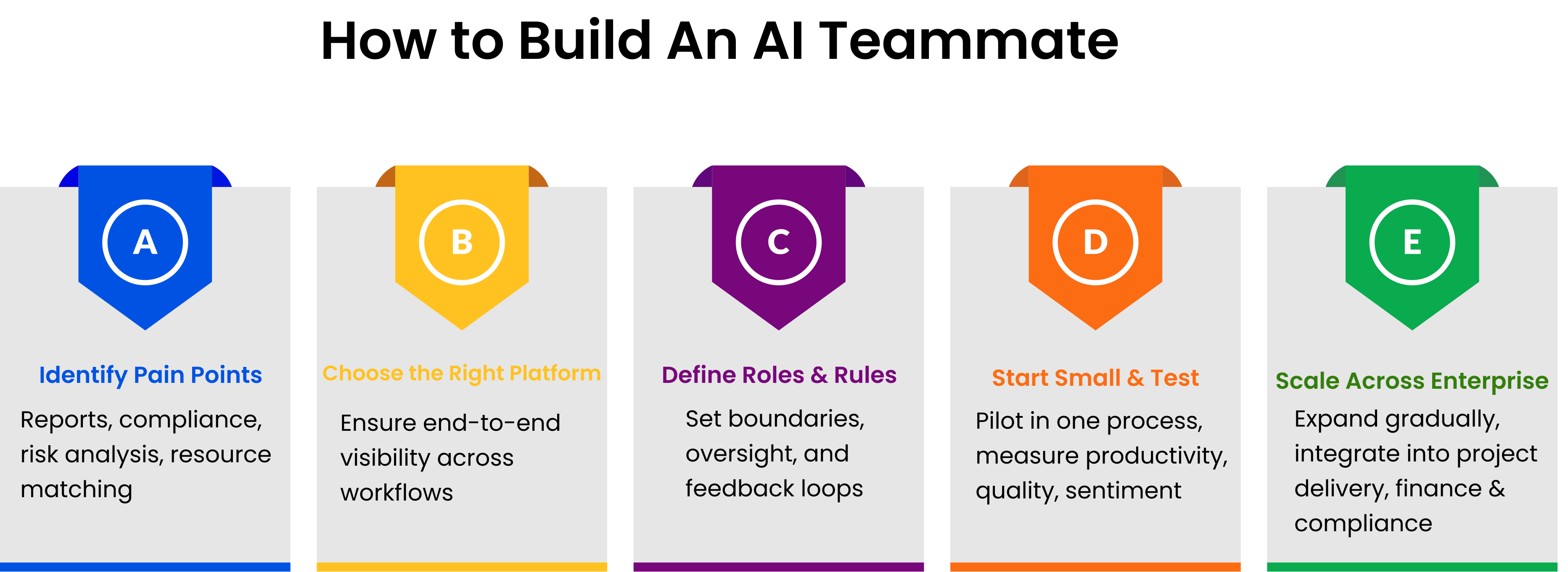
Step 1: Identify Pain Points Worth Solving
Every AI Teammate begins with a clear role. Start by mapping repetitive or time-consuming tasks that drain productivity. These could be:
- Generating weekly status reports
- Tracking compliance requirements
- Analyzing project risks
- Matching resources to projects
For example, in pharmaceutical R&D, project managers often spend hours collating trial data. An AI Teammate can automate this, freeing scientists to focus on innovation rather than admin.
Step 2: Choose the Right Platform and Tools
You don’t need to build from scratch. Enterprise systems like Kytes already embed intelligent capabilities—predicting risks, automating resource planning, generating WBS plans, and even creating status presentations—directly into project workflows.
By leveraging a unified platform, you ensure your AI Teammate isn’t siloed but has visibility across the entire project lifecycle, from planning to invoicing.
Step 3: Define Boundaries and Collaboration Rules
Trust is essential in any team, and AI is no exception. Decide upfront:
- What decisions can the AI make autonomously?
- Where does human oversight remain mandatory?
- How will feedback loops refine recommendations?
Clear role definitions reduce the risk of over-reliance and help employees see AI as a partner, not a threat.
Step 4: Start Small, Test, and Iterate
Think of your first AI Teammate as a pilot project. Launch it in one department or on a single process. For instance, a consulting firm could deploy an AI Teammate to generate initial project proposals by analyzing historical performance data.
Measure results across three dimensions:
- Productivity (time saved)
- Quality (accuracy or creativity of outputs)
- Team Sentiment (are employees more or less engaged?)
Iterate based on feedback. The goal isn’t perfection on day one—it’s continuous learning.
Step 5: Scale Thoughtfully Across the Enterprise
When an AI Teammate has demonstrated its value, scale slowly. The best practice is to embed it into enterprise workflows—such as project delivery, financial governance, and compliance—so the AI always has complete context and guardrails in place.
Scaling is not merely releasing features; it’s changing behavior. Train employees, instill trust, and make clear that AI is here to augment, not automate.
Pro Tip: Mentor your AI Teammate as you would a fresh recruit. Provide it with onboarding, critique, and definite career development within your company.
Curious about how an AI Teammate might be customized for your workflows? Get a demo from Kytes and experience how AI collaboration can transform your delivery pipeline.
Challenges & Responsible Integration
As wonderful as AI Teammates promise to be, they are not a magic wand. As with any new team member, there are challenges that organizations have to navigate carefully. Disregarding these risks can undermine adoption and dissolve trust.
Trust and Transparency
One of the biggest concerns is transparency. AI Teammates make recommendations based on data patterns, but if employees don’t understand how those decisions are reached, skepticism grows. A recent workforce study found a majority of employees lack clear guidelines on AI use, and only a few feel employer policies are “extremely clear.” This gap can make even the smartest AI solutions underutilized.
Team Dynamics and Over-Reliance
AI can change how teams collaborate. Research suggests that when people assume AI “always knows best,” they communicate less with colleagues, which can weaken teamwork. The goal is augmentation, not substitution—ensuring humans remain in control of strategic judgment.
Data Quality and Security
AI Teammates are only as good as the data they access. Poor data hygiene leads to poor recommendations, while sensitive information raises compliance risks. Industries like pharmaceuticals, IT, and financial services must pay particular attention to governance and regulatory standards.
Employee Concerns
Surveys show nearly 71% of U.S. employees are apprehensive about AI’s impact on jobs, with 75% worried about replacement. Addressing these fears through reskilling, transparent communication, and positioning AI as a partner—not a threat—is essential.
Ultimately, responsible integration means balancing innovation with accountability. Platforms like Kytes make this easier by embedding compliance checks, role-based access, and explainability into their AI features—helping organizations adopt AI teammates with confidence and control.
Future Outlook: From Assistants to Strategic Collaborators
The evolution of AI in the workplace is moving fast. Just a few years ago, AI was synonymous with chatbots or digital assistants—helpful but limited. Today, enterprises are entering a new phase where AI is no longer a background tool but a strategic teammate that can influence decisions, manage risks, and even drive innovation.
Industry forecasts suggest the global value of AI teammates could surpass $6 trillion, underscoring how central this shift will be to economic growth. In the UK, analysts estimate “digital teammates” could add up to 7% to annual GDP, equivalent to £4.5 trillion in labor-market opportunity. These aren’t distant projections—they’re signals that the era of collaborative intelligence is already here.
For organizations, the next frontier is trust and scale. AI Teammates will not only handle tasks but also join strategic discussions. They will provide data-backed insights in boardrooms, project planning sessions, and client meetings. They need to understand context, act responsibly, and work smoothly across departments.
This is where platforms like Kytes are important. By bringing together project delivery, finances, and resource management with built-in AI, they make sure that AI Teammates become real collaborators. This improves both business outcomes and human potential.
The future of work is not man versus machine, but humans and AI working together.
Conclusion: Building Your First AI Teammate
Workplaces are changing faster than ever. Deadlines are shorter, compliance requirements are more burdensome, and teams must achieve more with fewer resources. In this environment, the idea of an AI Teammate is no longer science fiction; it’s practical and necessary.
Conventional assistants simply follow commands, while AI Teammates are active partners. They learn and adjust, helping to drive business results. They handle routine tasks, speed up decision-making, and give human teams the freedom to innovate. The facts are clear: human-AI teams achieve better results, faster turnaround times, and improved morale.
However, technology alone won’t guarantee success. Clear communication, trust, and the right platform are essential to bring it all together. That’s where Kytes comes in, helping businesses turn AI from basic tools into smart collaborators that work together across project delivery, compliance, and financial management.
The future of work doesn’t involve replacing people; it focuses on empowering them. By designing AI Teammates thoughtfully, organizations can create teams that are not just more effective but also more resilient and innovative.
Are you ready to discover what an AI Teammate can do for your business? Request a demo with Kytes and start building your first AI collaborator today.