
Blog highlights
- AI in resource management goes beyond scheduling and timesheets to build a unified, intelligent system.
- It combines project planning, skill visibility, compliance automation, and accurate billing.
- Organizations reduce inefficiencies and better align people with profit.
- Industries like IT, healthcare, manufacturing, and finance can highly benefit by leveraging AI in resource management capabilities.
- Kytes AI-enabled PSA+PPM platform unifies timesheets, leave, attendance, and resource allocation.
- AI-powered resource management enables enterprises to scale with agility, insight, and confidence.
Every organization believes it understands how its people, time, and budgets are being used. In reality, most leaders operate with partial visibility. Project plans look solid on paper. Utilization reports appear acceptable. Yet margins quietly erode. Delivery timelines slip. Teams feel stretched while capacity still goes unused.
This gap between perceived control and actual execution is where resource management breaks down.
Resource management today is no longer about assigning names to tasks. It is about managing complexity at scale. Global teams. Multiple clients. Variable billing models. Changing skill requirements. Compliance rules that differ by region. Manual systems were never built for this level of coordination.
AI in resource management addresses this gap directly. It brings structure, accuracy, and foresight into areas that were previously driven by assumptions. Instead of reacting to overruns and staffing issues, organizations gain the ability to plan with confidence and act with precision.
This shift is not theoretical. Enterprises across IT services, healthcare, manufacturing, and finance are already using AI-driven resource management to protect margins, improve efficiency, and make faster, data-driven decisions.
Why Traditional Resource Management Falls Short
Most resource management systems still rely on disconnected tools. Spreadsheets for planning. Separate systems for timesheets, leave, attendance, and billing. Project data lives in one place. Financial data lives somewhere else.
This fragmentation creates real operational risk.
Timesheets are filled late or inaccurately. Billable hours go unrecorded. Finance teams spend days reconciling mismatched data. Managers lack real-time data on who is overloaded and who is idle. Leadership sees reports that reflect the past, not the current state of execution.
The problem is not effort. It is structure.
Traditional resource management software was designed to track activity, not to understand it. It cannot analyze past project data at scale. It cannot adapt resource allocation as conditions change. It cannot support complex project management across geographies without heavy manual intervention.
As organizations grow, these gaps widen. What once felt manageable becomes a source of constant friction.
AI in Resource Management: A Structural Shift
AI-powered resource management changes how organizations manage resources at a foundational level. It replaces static planning with continuous intelligence. It connects people, projects, and financials into one system of record.
Artificial intelligence and machine learning enable systems to process real-time data across workloads, skills, timelines, and costs. Instead of relying on assumptions, leaders can see how resources are actually being used.
This is not about removing human judgment. It is about strengthening it.
AI surfaces patterns that manual systems miss. It highlights risks before they become issues. It supports better resource planning without adding administrative burden.
Human-Centric Decisions Backed by Intelligence
One common misconception is that AI-driven resource management focuses only on efficiency. In practice, its biggest impact is on people.
AI can identify workload imbalances early. It flags sustained overutilization before burnout sets in. It highlights underutilized talent that could be redeployed to priority projects.
This allows managers to act earlier and with better context. Decisions feel fairer because they are grounded in data, not perception.
AI also supports long-term workforce growth. By analyzing past project work, systems can map evolving skill profiles automatically. This creates a clear view of current capabilities and future gaps.
Instead of guessing who fits a role, managers can match skills to project requirements with confidence. Employees benefit from clearer development paths aligned with real demand.
Predictive Analytics for Smarter Resource Planning
Predictive analytics is one of the most valuable capabilities of AI in resource management.
By learning from historical performance and real-time conditions, AI can forecast future needs with accuracy. It helps organizations anticipate demand rather than scramble to respond.
Key outcomes include:
- Early identification of capacity constraints
- Better alignment between skills and upcoming projects
- Reduced dependency on last-minute staffing decisions
This level of foresight transforms project management. Plans become adaptive rather than rigid. Leaders gain the ability to commit to timelines and budgets with greater certainty.
Timesheet Accuracy and Billing Integrity
Revenue leakage is rarely dramatic. It happens through small gaps that accumulate over time. Missed entries. Incorrect allocations. Delayed approvals.
AI-powered resource management eliminates much of this risk.
Automated time capture improves accuracy without adding friction. Intelligent nudges flag missing or inconsistent entries before submission. Approval workflows become faster and more reliable.
For finance teams, this means fewer reconciliations and cleaner billing cycles. For leadership, it means predictable revenue and stronger cost control.
Accurate timesheets are not just an administrative win. They directly support cost savings and margin protection.
A Single Source of Truth for Execution
One of the strongest advantages of AI resource management software is unification.
When timesheets, leave, attendance, resource allocation, and financials operate in silos, decision-making slows down. Data conflicts erode trust in reports.
A unified system creates a single source of truth.
Leaders gain real-time visibility into utilization, project progress, and profitability. Managers work from the same data as finance teams. Global operations follow consistent standards without losing regional flexibility.
This alignment supports faster, cleaner decisions across the organization.
Beyond Automation: Strategic Impact
Automation alone does not create competitive advantage. Insight does.
AI-driven resource management turns operational data into strategic input. It shows where value is created and where it is lost. It reveals which projects scale well and which ones drain resources.
This insight supports better portfolio decisions. It helps organizations focus on work that aligns with long-term goals, not just short-term capacity.
Over time, resource management shifts from a support function to a strategic lever.
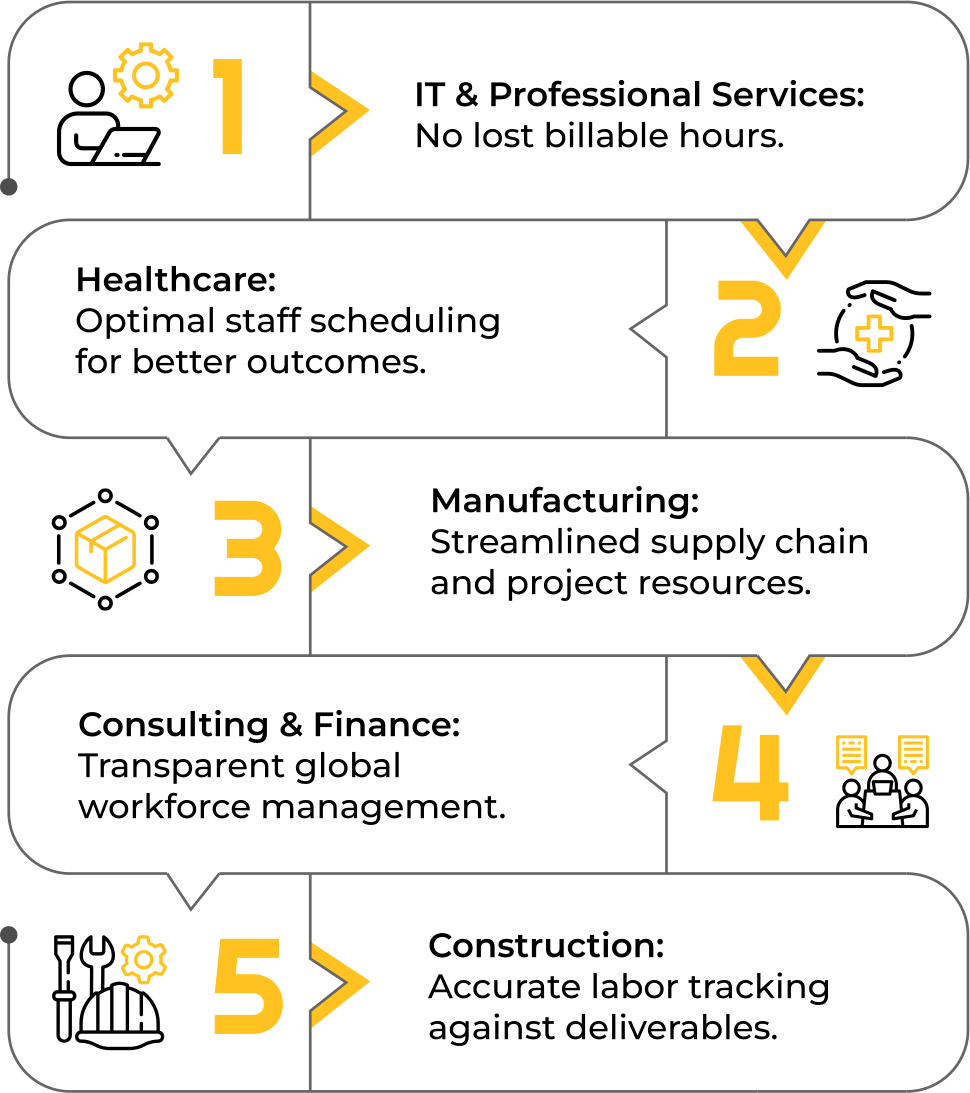
Find out how Kytes AI Resource Management can streamline operations for your industry-specific workflows.
Benefits of AI-Powered Resource Management
The advantages of AI are clear. What matters is how it changes daily operations and long-term results. AI-powered resource management delivers real gains in profitability, workforce utilization, global consistency, administrative efficiency, and client trust.
Higher Project Profitability
Profitability depends on accuracy. AI ensures every billable hour is captured and aligned with project budgets. Variances surface early, not after the fact.
Organizations reduce revenue leakage and improve forecasting reliability.
Smarter Workforce Utilization
AI balances workloads based on skills, availability, and timelines. It prevents overbooking while reducing idle capacity.
Teams deliver better results without burnout.
Consistency Across Global Operations
AI standardizes resource management processes across regions. It supports compliance without manual enforcement.
Leadership sees a unified view of global performance.
Reduced Administrative Overhead
Automation removes repetitive tasks from managers’ plates. Approvals, reporting, and compliance checks run in the background.
Managers spend more time leading and less time reconciling data.
Stronger Client Relationships
Transparent billing and predictable delivery build trust. Clients see clear evidence of value through accurate reporting and timely execution.
Long-term relationships become easier to sustain.
The ROI of AI-Driven Resource Management
For leadership and CFOs, the value of AI resource management is measurable.
Organizations see reduced project overruns through predictive planning. Workforce utilization improves without increasing headcount. Operational costs decline as manual effort drops.
Attrition costs also fall. Balanced workloads support retention. Recruitment and training expenses decrease over time.
Most importantly, AI enables faster scaling. Enterprises respond to new opportunities without destabilizing existing operations.
AI-driven resource management becomes a financial strategy, not just a technology investment.
Kytes AI Resource Management
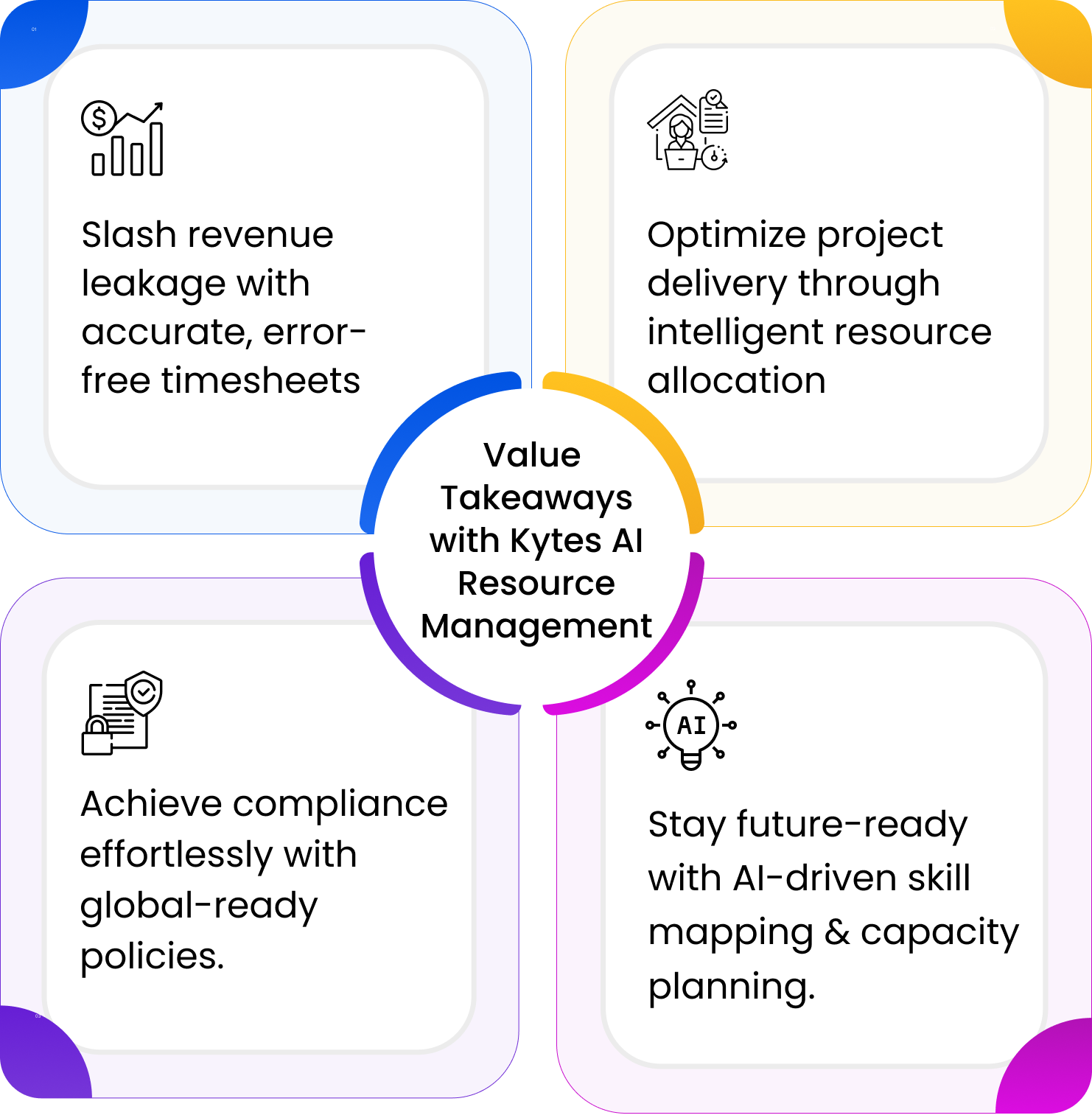
In today’s competitive landscape, resource management extends far beyond allocating people to projects—it’s about accuracy, compliance, intelligent utilization, and future readiness. This is where Kytes AI-enabled PSA+PPM software transforms the game. By combining time, leave, attendance, resource allocation, and capacity planning into a unified ecosystem, Kytes creates a single source of truth for people, projects, and profits.
Key Features That Set Kytes Apart
- Flexible time logging across daily, weekly, or project-based models
- Shift-based calendars aligned with regional work patterns
- Advanced leave management with region-specific compliance
- AI-powered error detection to prevent inaccurate entries
- Seamless integration with payroll, billing, and HR systems
- Transparent approval workflows with full audit trails
- AI-driven resource allocation based on skills and availability
- Automatic skill updates by analyzing past project work
- Predictive capacity planning to identify future gaps
Kytes does not add complexity. It removes it.
The Impact
With Kytes, organizations gain control without rigidity. Forecasts become dependable. Staffing decisions improve. Billing aligns with actual effort.
Teams move from reactive management to proactive planning. Leadership gains confidence in the numbers guiding strategic decisions.
Resource management becomes a driver of improved efficiency, not a source of friction.
Conclusion
AI in resource management is no longer optional for organizations operating at scale. Complexity has outgrown manual systems. Accuracy has become non-negotiable.
Enterprises that leverage AI gain clarity where others rely on estimates. They reduce costs without cutting capability. They manage resources with intention, not guesswork.
Kytes brings this intelligence into everyday operations. By combining AI-powered resource management with unified execution data, it helps organizations move forward with confidence.
The advantage is not speed alone. It is control, insight, and sustainable growth.