Blog Highlights
- Resource management is no longer about allocation—it’s about controlling delivery, capacity, and revenue in real time
- Lack of visibility across projects, resources, and financials is the root cause of delays, inefficiencies, and margin leakage
- Traditional tools fail due to fragmented systems, static planning, and no linkage between execution and billing
- Modern resource management software enables predictive capacity planning and intelligent resource allocation
- Connecting execution with billing directly improves cash flow, reduces DSO, and strengthens margin control
- A unified system creates a single source of truth, enabling faster decisions and predictable project success
It is Monday morning, and our Delivery Manager is entering a review meeting carrying three reports-resource allocation, project schedule, and the forecast revenue. Each report is a story of an organization operating with multiple views on what is actually happening-the people look productive, projects seem to be on schedule, but the margins are down and the bills haven’t been sent. This is a reality of most enterprises today.
Resource Management Software is defined as a system that facilitates planning, allocation and utilization of resources across various projects in real-time. Resource management software is an integrated way to link people, capacity and financial outcomes to a single, synchronized picture. In today’s execution environment, it’s not a “nice to have”-it is a “must-have” for controlling delivery and business results.
The Reality: Projects Don’t Fail, Visibility Does
Projects in areas such as IT services, consulting, and Pharma CRO/CDMOs do not typically fail because there is a lack of planning. They fail because of a lack of visibility. Organizations are likely to have documented project plans, project schedules and teams dedicated to specific projects, however lack clarity of execution at a real-time level.
Resources are often assigned based on availability not ability. Capacity planning is divorced from revenue planning. PM’s will report on execution, whilst finance will only look at the numbers retrospectively. This leads to organizations feeling in control-as the project looks planned, but ultimately isn’t coordinated at all.
From Resource Allocation to Predictive Capacity & Revenue Control
The concept of traditional resource planning is largely about assigning the right individuals to tasks. But in the context of a company on the enterprise scale, there is a lot more required from the organization than just allocation: “foresight and control.”
The ability to see whether the correct expertise is placed on the right tasks, and whether work can be delivered using current resources with the demand placed on capacity, or what implications resource allocation has on income and margins are critical decisions for current leaders. Resource management is not simply scheduling in these enterprises, it becomes a strategic capability.
It is a system that bridges the execution and financial consequences of the decisions made, and as a result turns planning into forecasting.
Day-to-Day Challenges Leaders Face
The problems faced by CxOs, Heads of PMOs, delivery leaders, are operational and ongoing.
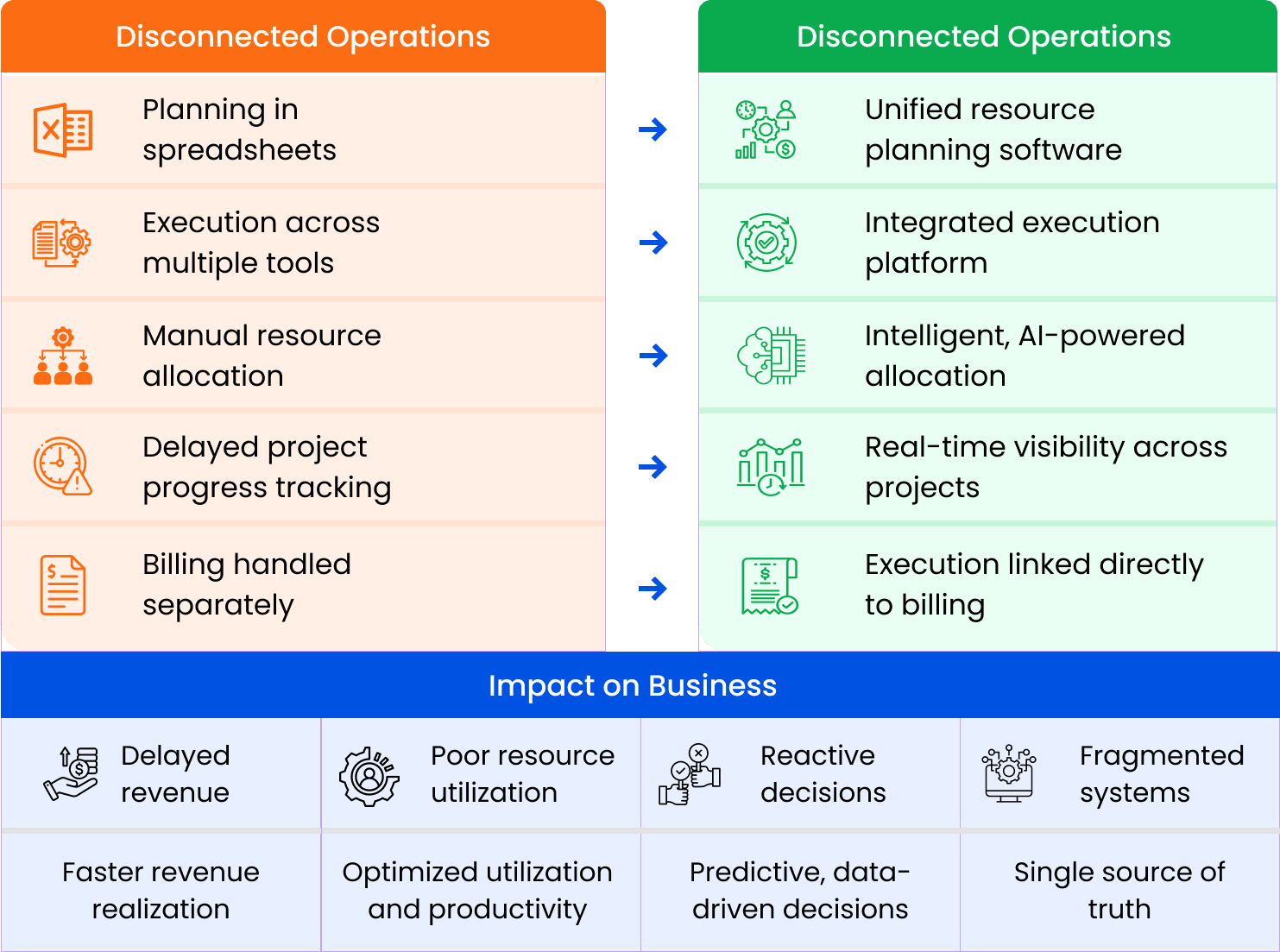
Siloed planning across spreadsheets and tools gives rise to multiple versions of truth and makes decision making sluggish and uncertain. Lack of real-time visibility leads to issues being noticed only after they impact delivery, actual resource utilization seems higher on paper than in reality due to skill mismatch and resource overloading.
Predicting future projects involves educated guesses about actual capacity leading to over-commitment of resources or idle resources. Simultaneous, delayed billing for missed timesheets and disconnected execution flow contribute to a higher DSO and negatively impact cash flow.
These are not isolated operational inefficiencies but fundamental systemic issues in how organizations utilize resources.
Why Existing Systems Fail
Most companies use planning and/or project management and financial applications today, yet the problems persist. Why? Lack of integration and silos. Planning, execution and finances exist in three different compartments, each unable to see the bigger picture of your organization. Capacity planning is a one-time static planning that does not respond to changes dynamically. Decisions about resource assignment based on gut feeling instead of data.
These old applications are blind in another respect: they are purely reactive, reporting the past and not what is coming. Most importantly, these systems do not link project execution and billing, leaving your organization with poor financial visibility and little control on the bottom line. The result is a system where your teams have to constantly react to issues rather than proactively address them.
What Modern Resource Management Software Should Deliver
The real time, multi-project visibility that this type of system offers, across resources and finance provides leaders with actionable information at the right time. Intelligent resource assignment to get the most appropriate team for the task is available.
Accurate future demand prediction through dynamic capacity planning, ensures the enterprise can manage resources effectively and a system of integrated execution and billing means that revenue is closely linked to delivery. The ability to use predictive inputs makes the planning smarter still by identifying risks prior to their potential effect on the delivery of work.
All in all resource management becomes a control system for enterprise execution.
Key Capabilities That Drive Real Impact
A high-performing resource management system is built on a few critical capabilities:
- Real-time visibility into project progress, resource allocation, and financial outcomes
- Intelligent resource allocation based on skills, availability, and complexity
- Capacity planning and resource forecasting across future projects
- Seamless management of multiple projects with clear dependencies and priorities
- Improved resource utilization without overloading teams
- Direct linkage between execution and billing, reducing revenue leakage
- Support for project managers and team members with unified planning tools
These capabilities ensure that resource management is aligned with both operational and financial goals.
From Fragmentation to Real-Time Control
Moving from Improvisation to Intelligent Execution
Experience and intuition guide the decisions within teams working in traditional environments, which is great but unscalable in an environment characterized by many projects in complex organizations.
Thanks to intelligent systems, decisions can be made based on data. Manual tracking can be reduced and, once decisions are data driven, an organization can look ahead more and prevent future risks from developing further.
Guesswork is reduced to a minimum; the delays can be minimized and projects can be more successful. The organization changes from reactive mode to control mode.
Where Kytes Fits In
For the most companies the problem is not that they don’t have the tools; it is that they don’t have the right integration.
Kytes solves this by tying the elements of resource planning, project execution, and financials together in one system. That provides one source of the truth and ties together an organization’s resources, projects, and revenue.
In Kytes, resource planning comes from project and skills requirement, instead of based on some pre-planned estimates. Leaders get real-time project status and performance data. Capacity planning turns into precise, data-driven planning decisions that predict the demands on future projects.
Crucially, execution ties directly to billing and revenue recognition, directly connecting operations to financial results. This closes the loops that lead to delayed billing, poor cash flow, and weaker control over profit margins.
Leadership-Level Impact
When the way resources are managed becomes a system rather than independent elements. Benefits spill over.
Decision making improved as leaders get better visibility more quickly. Resource utilization is increased because tasks are performed based on availability. Project completion times are more certain and less risky.
Faster payment cycles improve cash flow and bring down DSO. Margins are better managed as costs are traced to revenue. The scale up process becomes methodical for an increasing number of concurrent projects.
It isn’t only about operating efficiency-it’s about competitive advantage.
Final Thought
Resource management is no longer simply about allocation. Now it’s about control over execution, the top line and the business itself.
Those companies that stick with disparate systems will always struggle with visibility and scalability. The companies that implement an integrated, intelligent system will get clear, predictable control.
It’s likely that enterprise leaders assessing this transition will find the exploration of new resource management software to be strategically wise. And perhaps the implementation of tools such as Kytes provides a realistic solution to this transition, and the quietly optimized processes and success that results.
Moving from fragmented tools to a connected system can transform execution. It may be worth seeing how that shift can work within your organization.