
Blog Highlights
- Resource planning failures surface quietly through delays, overload, and eroding trust, long before deadlines are missed or budgets break.
- In complex IT environments, resource planning is not static allocation but continuous trade-off management across shifting priorities and shared constraints.
- Traditional definitions fail because they assume stability, while real delivery operates in constant flux with overlapping commitments and hidden dependencies.
- Treating availability as capacity creates systemic overload, as context switching, invisible work, and cognitive load reduce real output.
- Time is not neutral in planning; frequent reallocations, ramp-up costs, and sustained pressure degrade quality before speed or morale visibly decline.
- Project management models often conflict with delivery reality, leading to performative planning and reactive execution.
- Poor resource planning creates hidden costs such as rework, burnout, leadership distraction, and weakened client confidence that dashboards rarely capture.
- Mature organizations shift from perfect allocation to accountable decision-making, making constraints, risks, and trade-offs explicit.
- Platforms like Kytes support this shift by revealing real capacity, forecasting strain, aligning delivery with finance, and enabling proactive, scenario-based planning.
Most delivery failures do not announce themselves loudly. They show up quietly, weeks or months before a missed deadline or a blown budget. A senior engineer becomes unavailable for a “short while.” A project manager reshuffles timelines to accommodate another urgent ask. A delivery lead approves one more parallel assignment because, on paper, capacity still exists.
Nothing looks broken. Yet the system is already under strain.
This is where resource planning reveals its true nature. Not as a spreadsheet exercise or a PMO ritual, but as the discipline that determines whether an IT organization can deliver consistently without burning out its people or eroding trust with clients. In complex IT delivery environments, resource planning is not about control. It is about clarity under pressure.
This blog examines what resource planning actually means when delivery is messy, priorities shift constantly, and teams operate across overlapping commitments. It moves beyond textbook definitions and exposes the operational truths IT leaders rarely hear, even though they experience them every day.
What Is Resource Planning Beyond the Textbook Definition
At its simplest, resource planning is the process of identifying, allocating, and managing people, skills, time, and cost across projects and initiatives. In theory, it ensures that the right people are working on the right work at the right time.
That definition is clean, logical, and largely insufficient.
In real IT organizations, resources are not static units. People do not work in isolation on single projects. Skills are unevenly distributed. Priorities change mid-sprint. Sales commitments collide with delivery realities. Internal initiatives compete with billable work. Under these conditions, resource planning stops being a planning activity and becomes a continuous decision-making process.
A more accurate definition of resource planning in complex environments would be this:
Resource planning is the practice of making trade-offs visible and deliberate across competing delivery demands.
This shift in definition matters. It changes how leaders approach planning, how teams experience it, and how success is measured.
Why Resource Planning Breaks Down in Complex IT Delivery Environments
Complexity does not come from scale alone. It comes from interaction. An IT delivery organization becomes complex when multiple factors overlap:
- Shared specialists supporting several teams at once
Critical specialists often become invisible bottlenecks, splitting attention across multiple projects without any single team owning their capacity. The result is delayed decisions, slower progress, and a false sense of availability that only becomes obvious when delivery starts slipping. - Projects running in parallel with interdependencies
Parallel projects create hidden coupling, where progress in one stream quietly depends on outputs from another. When those dependencies shift or stall, resource plans unravel even if individual project timelines still look intact. - Clients with changing expectations
Client priorities evolve as business conditions change, introducing new scope, urgency, or delivery pressure midstream. These changes rarely come with corresponding adjustments to resource commitments, forcing teams to absorb the impact silently. - Internal initiatives that pull senior talent away from delivery
Senior contributors are frequently reassigned to strategic or internal initiatives without formally updating delivery plans. This drains critical expertise from active projects while resource plans continue to assume full availability. - Financial targets that reward utilization over sustainability
Utilization-driven targets push teams toward maximum allocation, leaving no margin for recovery, learning, or unplanned work. Over time, this creates brittle delivery systems that appear efficient but fail under even minor disruption.
Each factor on its own is manageable. Together, they create conditions where traditional resource planning methods struggle to cope.
The core problem is not a lack of planning. It is planning based on assumptions that no longer hold true. Most planning models assume relative stability. Complex environments operate in constant flux.
When planning fails to acknowledge that instability, it produces confidence on paper and fragility in practice.
The Difference Between Availability and Capacity
One of the most common and damaging mistakes in resource planning is treating availability as capacity.
Availability answers a narrow question. Is this person free during this time period?
Capacity answers a more meaningful one. How much focused, productive work can this person realistically deliver given their existing commitments, cognitive load, and context switching?
In complex IT delivery environments, capacity is always lower than availability suggests. Meetings fragment days. Context switching reduces efficiency. Senior contributors absorb invisible work such as mentoring, reviews, escalations, and stakeholder conversations.
Planning that ignores these factors creates systemic overload while appearing reasonable on the surface. This is why teams feel stretched even when dashboards show acceptable utilization.
The Time Dimension Most Resource Plans Ignore
Most resource plans treat time as a neutral container. Work goes in. Output comes out. Reality is more uneven.
New assignments have ramp-up costs. Even experienced people need time to rebuild context. Productivity does not reset instantly when work changes.
Sustained overload has a decay effect. Output may hold temporarily, but quality drops first. Then speed follows. Burnout appears last, long after damage has begun.
Short-term reallocations often solve visible problems while creating invisible ones. Each quick fix adds friction that compounds over time.
Good resource planning respects time as a force, not a backdrop. It recognizes that decisions made today shape delivery capacity weeks or months later.
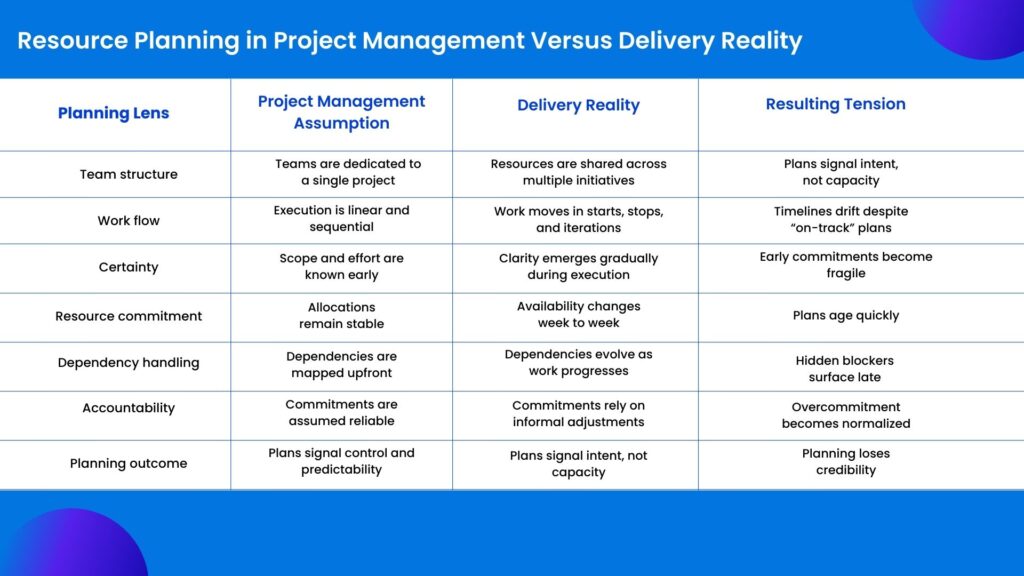
Resource planning in project management frameworks is often designed for predictability. Projects are defined, scoped, scheduled, and staffed. Dependencies are mapped. Risks are logged. Everything appears orderly.
Delivery reality is rarely so accommodating.
Project plans assume dedicated teams. Delivery organizations rely on shared pools. Project timelines assume linear execution. Delivery work unfolds in bursts, pauses, and course corrections. Project plans assume early certainty. Delivery gains clarity gradually.
This disconnect creates tension between PMO structures and delivery teams. Project managers plan based on commitments that delivery leads know are fragile. Delivery leads compensate by overcommitting, hoping experience will fill the gaps.
Over time, this gap erodes trust. Planning becomes performative. Delivery becomes reactive.
Resource Planning Across Different IT Operating Models
Resource planning behaves very differently depending on how an IT organization is structured. A model that works in one setup often fails silently in another.
In centralized delivery models, resource planning struggles with distance from execution. Decisions are made far from day-to-day work, which delays correction when plans start to drift. Visibility exists, but context is often missing.
Decentralized or product-led teams face the opposite problem. Teams move fast, but shared resources become contested. Without strong planning discipline, prioritization becomes informal and inconsistent.
Matrix organizations are the most fragile. People report into one structure while delivering into another. Resource planning turns political because accountability is split.
In services-led firms, revenue pressure adds another layer. Planning must balance utilization, margin, and delivery quality at the same time. In product-led environments, long-term capability often competes with short-term delivery needs.
Resource planning only works when it reflects how the organization actually operates, not how it is drawn on paper.
The Hidden Failure Points in Resource Planning
Many resource planning failures are not visible until it is too late. They sit quietly inside everyday decisions.
One failure point is optimizing for utilization instead of outcomes. High utilization looks efficient, but it leaves no room for learning, recovery, or unexpected work. It creates brittle systems that collapse under minor disruptions.
Another is treating skills as interchangeable. Two engineers with the same title are not interchangeable in practice. Context, domain knowledge, and problem-solving style matter. Ignoring this creates quality issues that surface downstream.
A third is planning in isolation from financial reality. Resource decisions affect margins, revenue recognition, and cash flow. When delivery planning and financial planning operate separately, organizations optimize one at the expense of the other.
These failure points persist because they are structurally reinforced. They reward short-term appearances over long-term resilience.
How Resource Planning Fails During Growth and Scale
Resource planning often works best when organizations are small. Problems appear as scale increases.
Past performance data becomes unreliable. What worked for ten teams does not work for fifty. Coordination overhead grows faster than headcount.
Leadership attention becomes a constrained resource. Decisions slow down. Escalations multiply. Planning cycles stretch longer than delivery cycles.
Hiring adds capacity, but not immediately. New teams need structure, support, and clarity. Without strong planning, growth amplifies chaos instead of reducing it.
Scaling delivery without scaling resource planning discipline leads to fragile systems. Output increases, but predictability disappears.

From Allocation to Accountability
Mature organizations approach resource planning differently. They do not aim for perfect allocation. They aim for accountable decision-making.
This means planning around teams rather than individuals. Teams absorb variability better than individuals do. It means acknowledging trade-offs explicitly. If a senior architect supports three initiatives, leaders must accept that none will move at full speed.
It also means linking resource decisions to delivery risk. When capacity is stretched, risk increases. Making that relationship visible allows leaders to make informed choices instead of reactive ones.
Resource planning becomes less about filling calendars and more about protecting delivery integrity.
Why Governance Breaks Without Strong Resource Planning
Governance relies on prioritization. Prioritization relies on capacity truth.
When resource visibility is weak, governance becomes symbolic. Approvals happen without understanding impact. Committees manage lists instead of outcomes.
Portfolio decisions lose credibility. Teams receive conflicting signals. Execution slows under constant reprioritization.
Strong resource planning grounds governance in reality. Leaders can see what work displaces other work. Decisions carry consequences that are visible and shared.
Without this foundation, governance adds process without control.
Resource Planning Maturity Levels in IT Organizations
Resource planning evolves in stages.
At the first level, planning is reactive. Work is assigned when problems appear. Visibility is limited. Firefighting dominates.
At the second level, tools provide visibility. Allocation improves, but decisions remain short-term. Plans explain the past more than they guide the future.
At the third level, planning integrates delivery and finance. Capacity decisions reflect margin, risk, and priority. Trade-offs are explicit.
At the highest level, organizations plan with scenarios. They anticipate strain. They adjust early. Planning becomes a strategic capability.
Most organizations operate between levels, often without realizing it.
Why Spreadsheets and Static Tools Fall Short
Spreadsheets remain popular because they are flexible and familiar. They are also dangerously limited in complex environments.
They struggle with real-time updates. They rely on manual input. They capture snapshots, not flow. Most importantly, they reinforce static thinking in dynamic systems.
Static tools encourage retrospective explanations instead of proactive adjustments. By the time a spreadsheet reflects a problem, the problem has already impacted delivery.
This is where many project and resource management initiatives stall. The tool becomes a reporting artifact instead of a decision support system.
Are Your Resources Scheduled, Yet Teams Overloaded?
Kytes brings real-time visibility and AI-driven insights to uncover hidden bottlenecks and make planning actionable
Scenario-Based Resource Planning: Planning for What Might Break
Complex delivery environments demand planning beyond single-point forecasts. Scenario-based resource planning considers multiple futures. An expected case. A constrained case. A stress case.
The goal is not prediction. It is preparedness. Leaders see where plans bend and where they break. This approach surfaces risk early. It clarifies which decisions are safe and which are fragile. It replaces optimism with informed judgment.
Scenario planning also improves conversations. Trade-offs become explicit. Assumptions are tested, not defended. In uncertain environments, resilience matters more than precision.
The Role of Resource Management Software in Complex Environments
Resource management software should not exist to enforce plans. It should exist to reveal reality.
In complex IT delivery environments, the value of software lies in visibility. Leaders need to see not just who is allocated where, but how work is actually distributed over time. They need early signals of overload, not post-mortems.
Effective resource management software connects project data, time data, and financial data into a coherent view. It supports scenario planning, allowing leaders to test decisions before committing to them. It surfaces risk instead of hiding it behind averages.
Crucially, it adapts as delivery changes. Static systems age quickly in dynamic environments.

Software does not replace judgment. It sharpens it.
Many costs of poor resource planning remain invisible to standard metrics.
Rework increases quietly. Teams rush to meet timelines and fix issues later. Defects leak into production. Support load grows.
Client confidence erodes gradually. Missed commitments are explained away, until trust weakens. Renewals become harder. Margins tighten.
Opportunities are delayed or abandoned. Leadership hesitates to start new initiatives because capacity feels uncertain.
Senior leaders spend more time resolving conflicts than setting direction. Escalation replaces execution.
These costs do not appear as line items. They accumulate as friction, fatigue, and lost momentum.
The Human Consequences of Persistent Resource Misalignment
When resource plans remain misaligned, people adapt in unhealthy ways.
High performers absorb extra work quietly. They solve problems without visibility. Over time, engagement fades.
Decision fatigue sets in for senior contributors. Every request feels urgent. Every choice feels costly.
Knowledge drains slowly. Experienced people leave first. Teams lose context that cannot be replaced quickly.
These outcomes are not caused by workload alone. They stem from systems that normalize overload.
Good resource planning protects people by making pressure visible before it becomes personal.
Resource Planning as a Strategic Lever
When done well, resource planning shapes more than schedules. It shapes organizational behavior.
It influences how confidently sales commits to timelines. It affects how sustainably teams operate. It determines whether growth feels controlled or chaotic.
Poor resource planning creates hidden costs. Burnout increases attrition. Quality issues damage reputation. Leadership time is consumed by escalation instead of strategy.
Strong resource planning, by contrast, creates trust. Teams trust leadership to make fair decisions. Clients trust delivery commitments. Finance trusts forecasts.
This is why resource planning belongs in strategic conversations, not just operational ones.
What Good Resource Planning Looks Like in Practice
- Uncertainty is expected, not denied: Plans are built with the assumption that priorities will shift and constraints will emerge. The goal is not to avoid change, but to respond to it without destabilizing delivery.
- Changes are deliberate and visible: When plans change, the reasons are clear and shared. Teams understand what is being deprioritized, what is accelerating, and why those choices were made.
- Trade-offs are discussed openly: Resource decisions are framed as choices, not directives. Leaders acknowledge what will slow down or stop when something new is added.
- Capacity limits are treated as real constraints: Work is delayed or reshaped when teams approach overload. Strain is addressed early instead of being absorbed quietly by a few individuals.
- Teams are planned as units, not individuals: Planning focuses on team capacity and collective ownership. This reduces fragility and allows work to continue even when individual availability changes.
- Data informs decisions without creating false certainty: Leaders use data to understand patterns and risk, not to justify unrealistic commitments. Numbers guide conversations rather than ending them.
- Judgment remains central to planning: Experience and context shape final decisions. Tools provide insight, but accountability stays with leaders, not systems.
- Delivery conversations shift from blame to impact: Discussions focus on consequences and outcomes instead of missed estimates. This builds trust across delivery, finance, and leadership.
- Stability is valued over short-term speed: Success is measured by consistent delivery and fewer disruptions, not by maximum utilization or constant urgency.
- Trust improves across teams and stakeholders: Teams trust leadership to make fair decisions. Leaders trust delivery signals. Clients experience fewer surprises and clearer commitments.
Conclusion
Resource planning is not about predicting the future perfectly. It is about navigating uncertainty responsibly.
In complex IT delivery environments, planning must acknowledge variability, expose trade-offs, and support continuous adjustment. It must serve delivery, not appearances.
Leaders who treat resource planning as a strategic discipline gain more than control. They gain clarity, credibility, and resilience.
Those who do not will continue to fight the same fires, wondering why planning never seems to work.
Kytes: Built for Real Delivery Complexity
Kytes is an AI-enabled [PSA+PPM] platform built for organizations where delivery complexity is the norm, not the exception. It brings project execution, resource planning, and financial insight into a single operational system, allowing leaders to see demand, capacity, and constraints as they actually exist.
At the core of Kytes is a resource management approach that prioritizes fit, timing, and sustainability over manual allocation. Instead of treating people as interchangeable units, Kytes helps organizations align the right expertise to the right work at the right moment.
- Forecasting and Demand Planning That Anticipates Strain
Resource demand rarely appears suddenly. Kytes analyzes project pipelines, backlogs, and historical trends to forecast future needs before they disrupt delivery. Leaders can compare current and projected capacity across business units and geographies, allowing proactive decisions around hiring, upskilling, or redistribution.
This forward-looking view shifts planning from reactive adjustments to deliberate preparation.
- Bench Management Without Guesswork
Idle capacity is as costly as overload. Kytes continuously identifies underutilized talent in real time and recommends redeployment based on skill tags, upcoming roll-offs, and live project demand. This reduces bench time while ensuring people are assigned to work that aligns with their strengths.
The result is higher billability without forcing artificial utilization.
- Contractual Resource Management with Built-in Compliance
Managing contractors and consultants introduces additional complexity. Kytes supports SOW-driven time logging and billing rules, with AI-assisted validation of timesheets. Missing or inconsistent entries are flagged early, maintaining audit trails, contract visibility, and compliance with labor and regulatory requirements.
This ensures contractual resources are governed with the same rigor as internal teams.
- Skills and Resume Management as a Living System
Kytes maintains a centralized, continuously updated skills repository across the organization. Employee profiles, resumes, certifications, and proficiencies evolve as people do. AI-generated resume templates can be tailored per client or project, while searchable skill matrices enable faster, more accurate staffing decisions.
Skill gaps become visible early, supporting informed upskilling and hiring strategies.
- Leave, Attendance, and Real Availability Mapping
Availability is never theoretical in Kytes. Global leave policies, country-specific holidays, and attendance data are mapped directly to staffing plans. Approved leave automatically reflects in project timelines, allowing teams to adjust early and minimize disruption.
This ensures resource plans reflect real capacity, not assumed availability.
- Time Tracking That Reduces Friction
Kytes supports accurate, AI-assisted time tracking without increasing administrative load. Intelligent prompts nudge users when entries are missing, based on past behavior and calendar context. Multi-level approvals and role-based workflows ensure governance while reducing manual follow-ups.
Time data becomes reliable enough to support planning, forecasting, and billing decisions.
- Enterprise-Grade Integrations Across the Delivery Stack
Kytes integrates seamlessly with ERP, HRMS, CRM, and payroll systems through bi-directional sync. Platforms such as SAP, Salesforce, Oracle, Zoho, and others remain connected, ensuring real-time data consistency across finance, delivery, and operations.
This unified data flow prevents planning decisions from being made in isolation.
If your organization is ready to move from reactive planning to deliberate decision-making, explore how Kytes supports mature project and resource management at scale.