

Blog Highlights
- Resource utilisation reflects allocation quality, not individual effort or productivity
- Misaligned resource allocation is the hidden cause behind overload, idle time, and delivery slippage
- Spreadsheets fail to capture real-time utilisation shifts as projects and priorities change
- Effective resource management software connects demand, capacity, and execution in one view
- Utilisation should guide leadership decisions, not serve as a static performance KPI
- Kytes enables realistic utilisation planning through AI-driven PSA and PPM visibility
Talent isn’t the missing piece in project delivery. The missing piece is a clear map of where that talent is actually going.
On paper, utilisation looks healthy. Capacity plans appear balanced. Forecasts suggest enough bandwidth to take on the next project. Yet delivery leaders still see missed deadlines, uneven workloads, quiet burnout, and idle hours hiding in plain sight. The problem is not effort. It is visibility. More precisely, it is how resource utilisation is understood, measured, and managed across projects that never stay still for long.
This gap between planned work and real work is where utilisation quietly breaks down.
What resource utilisation really measures
At its simplest, resource utilisation answers a basic question: how much of your available team capacity is being used for productive, billable, or value-generating work. But that definition alone hides complexity.
Utilisation is not about keeping people busy. It is about aligning time, skills, and demand in a way that sustains delivery quality without creating hidden risk. High utilisation can signal efficiency. It can also signal fragility. Low utilisation can indicate waste. It can also reflect deliberate slack built to absorb change.
Understanding what resource utilisation means in your context matters more than hitting an arbitrary percentage.
This is where many teams go wrong. They treat utilisation as a static metric instead of a dynamic outcome shaped by planning accuracy, scope volatility, and decision latency.
The invisible link between utilisation and allocation
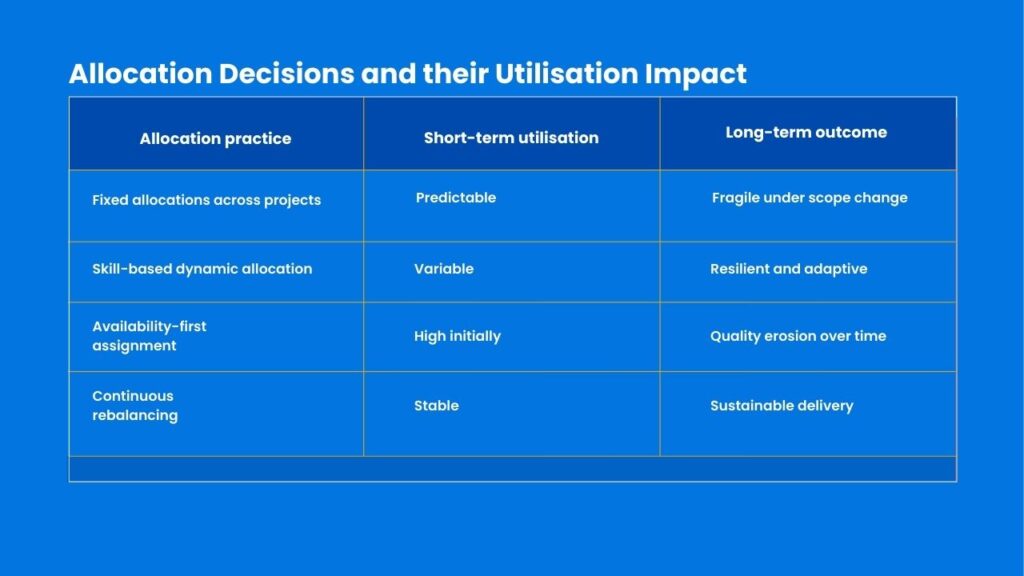
Resource utilisation is always downstream of resource allocation. Allocation decisions determine who works on what, when, and for how long. Utilisation simply reflects whether those decisions match reality.
When allocation is driven by availability instead of capability, utilisation numbers may look fine while delivery suffers. When allocation is frozen too early, utilisation spikes during change. When allocation is revisited too late, idle capacity appears without warning.
The operational truth is this: poor utilisation is rarely a people problem. It is almost always an allocation problem compounded by slow feedback loops.
Why spreadsheets fail at managing utilisation
Many IT leaders still rely on spreadsheets to track utilisation. The logic feels sound. They are flexible, familiar, and quick to update. What they fail to provide is trust.
Spreadsheets collapse under three pressures: concurrency, change, and scale. They cannot reflect real-time shifts across multiple projects. They do not expose dependency conflicts early enough. They depend on manual discipline in environments where priorities shift weekly.
As delivery complexity increases, spreadsheet-based planning produces utilisation reports that describe the past, not the present. By the time issues surface, corrective action costs more than it should.
This is where purpose-built resource management software becomes less about tooling and more about operational hygiene.
What to look for in resource management software
Choosing the right tool to manage resource utilisation requires more than feature comparison. It requires clarity on how decisions are made inside your organisation.
Effective resource management software connects three layers that are often fragmented: demand, capacity, and execution. It allows leaders to see not just who is allocated, but how utilisation changes when scope shifts, timelines compress, or priorities collide.

Is your team really utilised, or just stretched?
Kytes shows how allocation decisions play out in real work, so utilisation reflects reality, not assumptions.
Utilisation as a leadership signal, not a KPI
Mature organisations treat resource utilisation as a leadership signal. They look for patterns rather than targets. They ask why utilisation spikes in specific roles. They examine which projects consistently distort capacity. They use utilisation data to adjust intake, not just execution.
This shift changes how teams plan work. Instead of squeezing more output from the same capacity, leaders create systems that absorb change without burning people out. Utilisation becomes a reflection of operational design, not a blunt performance lever.
Final Thoughts
Resource utilisation sits at the intersection of planning discipline and execution reality. When misunderstood, it becomes a source of tension. When managed well, it becomes a stabilising force that supports growth.
The difference lies in how clearly organisations see their capacity and how quickly they act on that insight. Tools do not solve utilisation by themselves. But the right ones remove the blind spots that make poor decisions feel reasonable.
How Kytes supports intelligent resource utilisation
Kytes is built for organisations that recognise utilisation as a system-level outcome. The AI-enabled [PSA+PPM] software connects resource allocation, project planning, and real-time execution into a single operational view.
By combining skill-based allocation, live capacity insights, and predictive forecasting, Kytes helps teams manage utilisation without relying on rigid assumptions. Leaders gain the confidence to commit to work knowing how it will affect delivery balance, not just timelines. See how Kytes helps teams turn resource utilisation into a strategic advantage rather than a recurring concern. Schedule a demo now.