Blog Highlights
- Project reporting software transforms scattered project, resource, time, and financial data into one real-time system for predictable business outcomes.
- Most enterprises don’t struggle with planning—they struggle with disconnected reporting that delays decisions and hides execution risks.
- Traditional project management tools track tasks, but often fail to connect execution with billing, margins, and portfolio-level financial control.
- Modern project reporting software must deliver real-time visibility, system integration, predictive insights, and standardized reporting across teams.
- The shift from static dashboards to execution intelligence helps leaders move from reactive firefighting to proactive business control.
- Kytes bridges project execution with resource utilization, billing, and financial outcomes, turning reporting into a strategic growth engine.
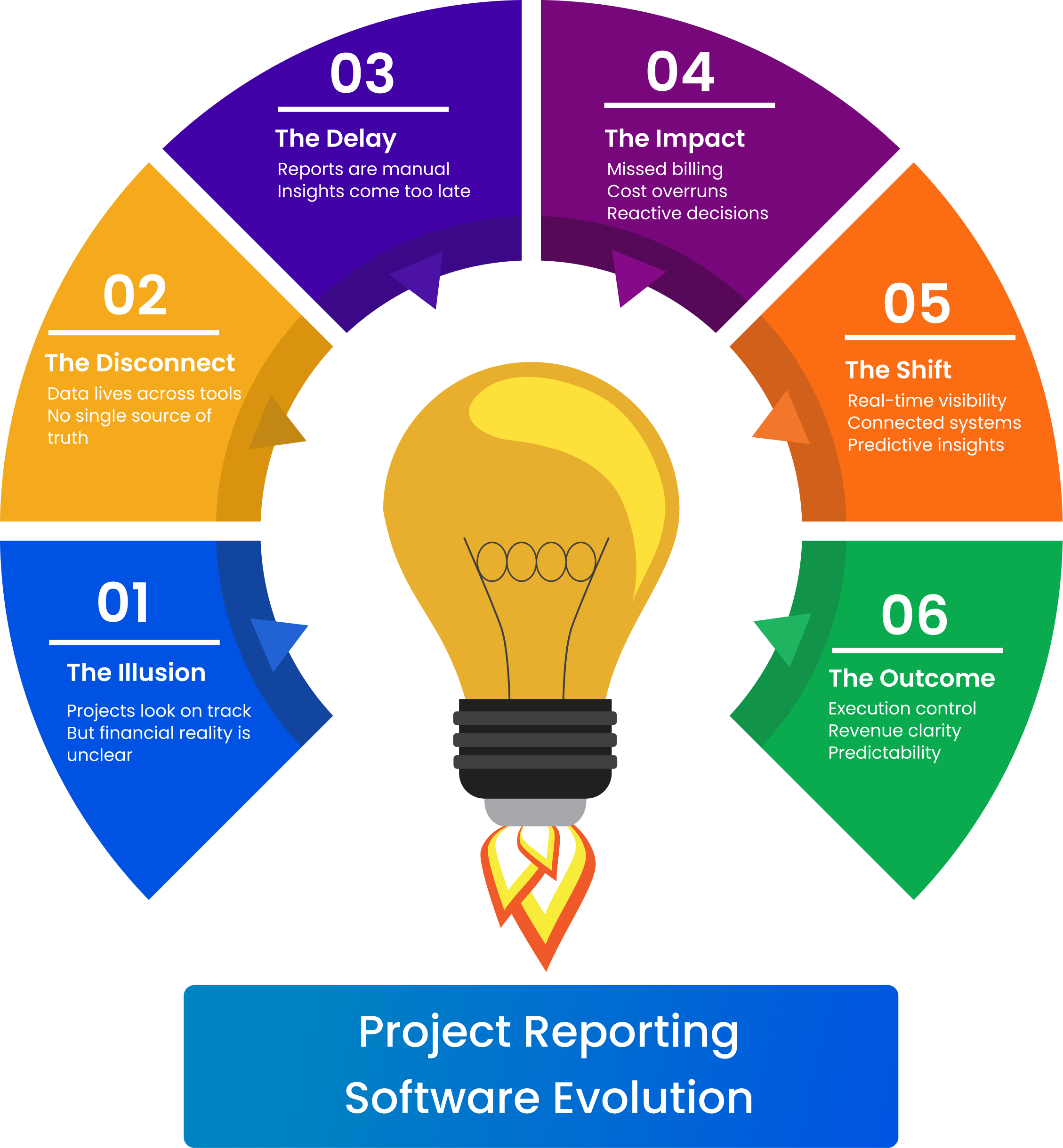
The project “appears to be on track” in meeting reviews: green statuses, clean timelines, sure updates. Then, when finance looks at the exact same project, things appear different: missed billings, cost overruns, unclear margins. It’s not a frequent anomaly. It is a structural defect.
Project reporting software is a system that aggregates all project related information, including tasks, resources, times and financials into one cohesive, real-time and actionable view to provide insights into how projects are performing and to enable sound business decisions. In today’s enterprise, project reporting software is about more than simple dashboards; it is about moving from execution to predictable business results.
The Reality: Planning Exists, But Predictability Doesn’t
Organizations today are largely sophisticated, with mature processes. The plan is known, timeframes and expectations defined, teams are clear on who does what. The tools are there to assign tasks, manage deadlines and track progress – Gantt charts or Kanban boards make this clear visually. At first glance, it seems all is in control.
But still, predictability remains a pipe dream.
The real problem lies in how reporting is done. The information that makes up projects is split across many sources: spreadsheets, collaborative tools, PM tools, financial systems, etc. Each has a part of the story but only one piece of the puzzle. By the time the report is compiled and circulated to the leadership it is out of date.
This disconnect the process of work from the decision process. People keep moving forward but the analysis falls behind. Decision-makers have to be reactive, putting out fires rather than proactively solving problems.
The Day-to-Day Challenges Behind the Reports
It’s not the lack of data for CXOs, PMO heads and delivery leaders. It is lack of alignment and lack of clarity.
The challenge of managing multiple projects across teams and geographies, the data from each team, be it the project updates or the status reports-all comes in different formats and at different times. Consolidating it at the portfolio level thus becomes time-consuming and resource-intensive task. It also delays the decision-making process.
Reporting cycle further aggravates the problem. While it could be weekly or monthly reporting cycle; a lack of real-time visibility into critical risks delays the identification of issues and correction takes much longer to become implemented, ultimately escalating costs and timelines.
Resource management is also one of the key challenges. While tasks might be assigned; real-time visibility into resource utilization, availability and workload is not always present, thereby leading to an over-utilization of resources in certain domains and an under-utilization in others, both impacting the productivity and delivery timeline.
Financial alignment is a critical challenge as well. Project reports are rarely tied with financial data. It is usually in the later stages of a project that problems relating to revenue recognition, inaccurate cost tracking, and unreliable forecasts become apparent.
Even the dashboards, when they do exist, may be presented without context, providing visibility into “what” has occurred rather than “why” and its implications on the business. Leaders end up spending more time understanding what the data represents rather than deciding what actions to take.
Why Traditional Project Management Tools Fall Short
Companies often use project management and collaboration software to overcome reporting issues. These applications, although very useful in tracking task, effort and workflow, have not been developed to address enterprise reporting.
Firstly, reporting has become a secondary functionality that needs to be added-on to these systems. The primary focus is the assignment of tasks, due dates and tracking workflow, reporting comes as a supplement, often needing to be manually processed and amended.
Secondly, there is no real time integration. Time and resource data, as well as financial information, are not updated in real time and a report, for instance, reflects nothing more than a snapshot in time rather than a real-time display.
The link between the execution and the revenue, the traditional systems just present information on the effort being undertaken, not on how the activity translates to a bill, progress relative to revenue, or the effect of delays on profit margins.
Collaboration between team is often disparate; different tools make updates inconsistent resulting in data loss between systems, the dashboard may provide visually appealing but often historical reports and fail to warn about future business risks. These limitations are not conducive in today’s fast moving world.
What Modern Project Reporting Software Must Deliver
In order to ensure the tight integration of execution and results, project reporting must progress. Reporting needs to become less about static reports and more about being woven into the execution of the project.
First, project teams must have real-time visibility into the state of the project. The executive leadership must be able to access information on the progress of each project, individual task execution, resource allocation and usage, project schedules etc., so decisions can be made based on today’s environment rather than yesterday’s reports.
Second, systems must be tightly integrated. A project reporting system should ideally integrate with systems involved in planning, execution, resource management, time and expense reporting and financials in a single place for the ultimate view of operations.
Third, project reporting must enable better decision making. It must go beyond simply presenting information; it must point out project risks, time slippage, cost over runs, project performance trends and more.
The system must have some predictive capability. The tool must be able to forecast issues before they even occur so that organizations can preemptively take action to prevent potential negative project impacts and control project outcomes.
Standardized reporting formats are needed so that reporting can be used at the portfolio level, in a uniform way, across teams and throughout the organization.
From Reporting to Execution Intelligence
The function of project reporting is evolving. It is no longer sufficient to know whether tasks are done, or whether the schedule is being adhered to.
Companies must now discover if the project is delivering value. They must also know if resources are being utilized properly, if the team is running efficiently, and how execution is impacting financial performance.
The shift transforms project reporting into execution intelligence.
Execution intelligence offers more meaningful insight. Operational data and business outcomes are linked together enabling decision makers to react quickly. This enables organizations to go from reactive management to proactive control.
Where Kytes Fits into This Shift
This is where solutions like Kytes offer a genuine differentiator.
Kytes redefines reporting by bringing it into the execution workflow instead of it being a separate activity. It provides an integrated system with project planning, resource management, time tracking, and financials.
Having integrated data throughout the lifecycle, from opportunity to delivery and then to billing, allows for a seamless, consistent view of the organization. This removes the manual processes for consolidation and eliminates errors associated with it.
Reporting is provided in real-time, so resource allocation, project status, and financials are up-to-the-minute, so that leaders can make immediate decisions based on current, accurate information without waiting for a report run.
Kytes’ reporting is aligned with the financials. It connects effort to billing milestones so that how execution leads to income and profit margins is clear.
The tool provides real-time resource management data within the reporting framework allowing visibility into resource utilization, capacity gaps, and optimization opportunities.
AI-driven insights will also give the organization visibility into what resources or what part of the project is on the path to a potential bottleneck, so this can be addressed in a proactive manner.
The Business Impact: From Visibility to Control
The result of real-time, embedded and intelligent reporting is profound.
Decisions are made more rapidly and effectively as decision-makers are equipped with factually-correct and timely information. Profitability is increased as the company develops the control it requires over costs, billing and the resources being deployed.
Execution becomes less uncertain. Projects will no longer be delayed, or exceed their budgets, due to unforeseen risks that arise because of a late discovery.
Resource efficiency is enhanced as the optimum teams are allocated, based on the real-time availability and demand. This reduces burnout and idle time, for all staff members.
Operational complexity is lowered, as the team spend less time on preparing reports and more on execution and strategy.
A Shift Worth Exploring
Project reporting has moved from a supportive function to a strategic competency. The connection between execution and business results is increasingly important for organizations with a multitude of projects running.
Today’s project reporting software can make this possible. These tools provide visibility, integration and intelligence that can lead to more efficiently managed organizations.
Missed billings, delayed decisions, and unclear margins don’t start in finance—they start in disconnected reporting. Kytes helps you fix that at the source.