
Blog Summary
- AI-driven project management tools are now the backbone of modern teams in 2025
- Features like automated scheduling, predictive risk management, and intelligent resource allocation free leaders to focus on strategy.
- Early adopters report faster delivery, lower costs, better collaboration, and higher client satisfaction.
- From IT to consulting, construction, and healthcare, AI tools are driving efficiency and compliance across industries.
- The best solutions adapt to work patterns, evolve with business needs, and deliver generative insights.
- The future of project management is lean, resilient, and powered by AI-driven intelligence.
The pressure to deliver has never been greater. Businesses are expected to bring products to market at speed, run leaner operations, and maintain consistent quality even when working across geographies and time zones. What once relied on intuition and manual oversight now demands sharper intelligence.
For many leaders, project management is where this pressure is felt most. Delayed timelines, misaligned teams, and budget overruns continue to be the silent obstacles holding back growth. Traditional project management software eased some of these pains but often left decision-makers still grappling with fragmented data and guesswork.
This is where AI-driven project management tools enter the conversation—not as futuristic concepts but as practical systems already transforming how teams work. By weaving machine intelligence into planning, execution, and reporting, they allow businesses to operate smarter, faster, and leaner. In 2025, they are not an optional enhancement but a foundation for resilience and competitiveness.
What AI-Driven Project Management Tools Really Mean
The term “AI for project management” is often used loosely. To understand its real value, it helps to contrast it with the software that came before it.
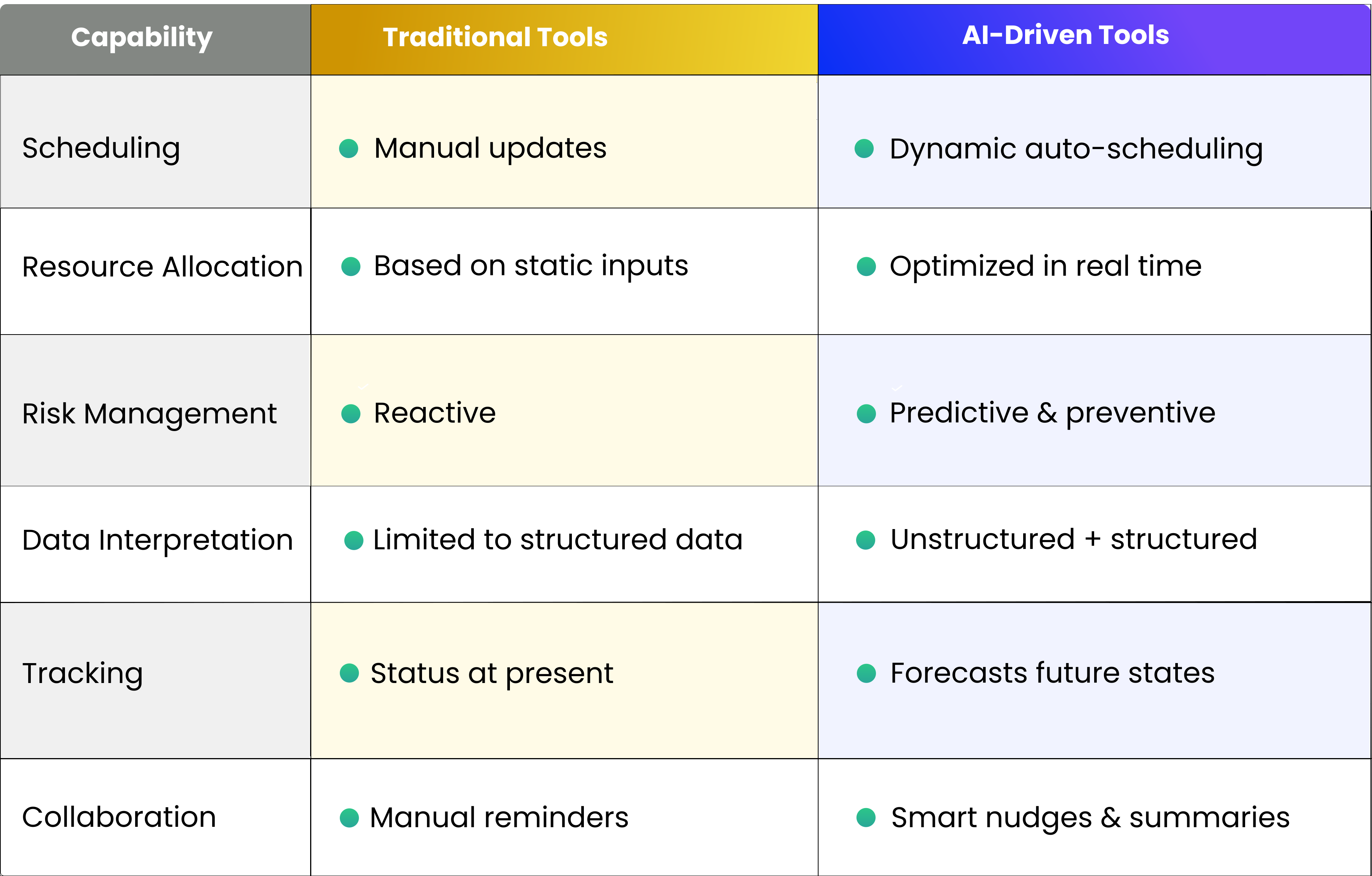
Traditional project management software digitized workflows—it offered Gantt charts, task lists, dashboards, and resource-tracking modules. It improved visibility but relied almost entirely on human inputs. Managers still needed to make sense of the data, adjust priorities, and manually optimize resources.
AI project management software builds on this foundation by adding intelligence. It doesn’t just store or display data—it interprets it. Through predictive algorithms, natural language processing, and optimization models, these systems surface risks before they happen, recommend the best allocation of people and resources, and even generate status reports without prompting.
Put simply, AI-driven project management tools act less like static platforms and more like proactive partners—quietly analyzing complexity and presenting options that allow teams to move with confidence.
Why AI in Project Management Matters in 2025
The business landscape of 2025 has unique characteristics:
- Teams are increasingly distributed and hybrid.
- Product cycles are shorter, with markets demanding near-instant launches.
- Budgets are tight, and efficiency is scrutinized at every level.
- Data volumes are overwhelming, yet insights remain underutilized.
Against this backdrop, human intuition—valuable as it is—cannot keep pace with the variables at play. AI for project management doesn’t remove human judgment; it enhances it. It handles the repetitive, data-heavy analysis, leaving leaders free to focus on strategy.
Think of AI as a “silent project co-pilot.” It never replaces the pilot but ensures the plane flies smoother, detects turbulence earlier, and optimizes the path forward. This shift matters because businesses that embrace AI tools for project management can move with precision while others are still reacting to problems after they’ve already escalated.
Key Capabilities of AI Tools for Project Management
The most impactful contributions of AI in project management can be grouped into six key capabilities. Each addresses challenges that traditional software could not fully resolve.
- Automated Scheduling & Task Prioritization
AI recognizes dependencies and reallocates tasks dynamically when conditions change. This prevents the domino effect of missed deadlines. - Resource Allocation Optimization
Instead of overloading high performers or underutilizing specialists, AI distributes workloads based on real-time availability, past performance, and future project needs. - Risk Prediction & Mitigation
By analyzing historical data, team patterns, and external variables, AI predicts bottlenecks—flagging risks such as budget overruns, missed deadlines, or compliance issues. - Natural Language Processing & Smart Dashboards
AI can interpret unstructured inputs like meeting notes, emails, or chat threads to surface actionable items. Dashboards become less about static numbers and more about dynamic, context-aware insights. - Real-Time Progress Tracking & Forecasting
AI doesn’t just show where the project stands—it forecasts where it’s heading, offering a forward-looking perspective that helps leaders make timely adjustments. - Intelligent Collaboration & Communication
Teams working across time zones benefit from AI-powered nudges—reminders to update deliverables, summaries of what has changed, and recommendations for next best actions.
Strategic Benefits for Businesses
AI-driven project management software is not only about efficiency—it is about strategy. When teams work faster and leaner, organizations gain competitive resilience. The benefits manifest in four major ways:
- Efficiency Gains: Automating administrative work reduces time wasted on manual reporting, freeing teams to focus on high-value tasks.
- Smarter Decision-Making: With predictive insights, leaders make informed choices, minimizing guesswork.
- Faster Time-to-Market: When projects run with fewer disruptions, products reach customers sooner.
- Enhanced Employee Experience: By removing repetitive overhead, employees can spend more time on creative and meaningful contributions.
These are not marginal improvements—they are transformative. Companies adopting AI tools for project management in 2025 are better positioned to operate lean while scaling with confidence.
Ready to explore how Kytes AI-enabled [PSA+PPM] software can transform the way your teams work?
Real-World Applications Across Industries
The strength of AI project management software lies in how it adapts to the realities of different industries, addressing challenges that often derail projects:
- IT & Software: Beyond simple backlog tracking, AI evaluates bug severity, user impact, and business value to prioritize work. It balances sprints automatically and reallocates tasks when delays occur, keeping development velocity consistent across distributed teams.
- Consulting: Staffing decisions become sharper. By analyzing availability, expertise, and project complexity, AI ensures the right consultants are assigned to the right clients—improving both utilization rates and client satisfaction.
- Construction: Large-scale projects benefit from AI’s predictive scheduling. It recalculates timelines when conditions shift—whether weather delays or supply shortages—while surfacing risks before they escalate, helping managers maintain cost and delivery discipline.
- Marketing: Campaigns that span multiple teams and channels are streamlined as AI integrates dependencies into a single view. It can recommend sequencing, flag overlaps, and align deadlines so creative and execution move in sync.
- Healthcare & Pharma: Compliance-heavy projects are made manageable. AI tracks regulatory requirements, issues early alerts, and forecasts timelines more accurately—whether for clinical trials or large-scale program rollouts.
Across these diverse applications, one theme stands out: AI-driven project management doesn’t just automate—it anticipates, adapts, and elevates results where the stakes are highest.
The Future of AI Project Management Software in 2025 and Beyond
As AI matures, its role in project management is shifting from assistance to foresight. Four directions in particular are shaping the future:
- Hyper-Personalized Project Recommendations: Tools will move beyond generic automation, tailoring suggestions to individual work patterns—whether it’s how a project manager sequences tasks or how a designer structures creative cycles.
- Generative Insights: Instead of static dashboards, AI will draft status reports, executive summaries, and even propose alternative delivery strategies, reducing the burden of documentation and analysis.
- Seamless Integration: Project management won’t sit in isolation. AI will embed into CRM, ERP, and communication platforms, creating a single connected ecosystem where information flows without friction.
- Ethical and Responsible AI: With greater reliance on machine intelligence, accountability becomes critical. Bias detection, explainable recommendations, and strong data privacy safeguards will be as essential as speed and efficiency.
The trajectory is clear: AI project management software is evolving from a supportive tool to a strategic partner—one that anticipates, advises, and integrates deeply into the way organizations operate.

Challenges and Considerations Before Adopting AI Tools
The shift to AI-driven project management is promising, but success depends on approaching adoption with clarity. Several challenges deserve attention:
- Data Quality
AI thrives on reliable inputs. If project data is inconsistent, incomplete, or siloed across tools, the outputs will be misleading. Before deploying AI, organizations need to invest in data hygiene—standardizing processes and ensuring accurate information flows across systems. - Change Management
Technology alone does not transform an organization; people do. Employees may resist new workflows, especially if AI feels like a replacement rather than an enabler. Clear communication, training, and pilot projects can help teams build trust and confidence in the new tools. - Balance of Automation and Oversight
AI can automate reporting, forecasting, and task assignment, but final accountability rests with human leaders. Organizations must set clear boundaries—deciding what should be automated and what requires human judgment—to avoid blind reliance on algorithms. - Vendor Evaluation
The market is crowded with tools marketed as “AI,” but capabilities vary widely. Leaders need to distinguish between platforms that genuinely predict, adapt, and optimize versus those that simply add surface-level automation. Evaluating vendors on transparency, explainability, and proven use cases is critical.
By addressing these considerations early, organizations ensure that AI adoption is not rushed or superficial, but a deliberate step toward smarter, more resilient project management practices.
How to Approach AI in Project Management: A Step-by-Step Guide
Adopting AI in project management is not just a technology decision—it’s an organizational shift. A thoughtful, phased approach ensures that the investment translates into lasting value.
- Audit Current Workflows
Begin with clarity. Map how projects are managed today, identifying recurring inefficiencies, delays, or communication gaps. This baseline helps determine where AI can be most effective, rather than applying it indiscriminately. - Pinpoint Areas of AI Value
Narrow the focus to high-leverage tasks: risk prediction, scheduling accuracy, workload balancing, or automated reporting. When targeted well, these use cases demonstrate tangible improvements and create internal advocates for broader adoption. - Start with Pilots
Introduce AI on a smaller stage—perhaps a single project, product team, or department. Pilots act as controlled experiments: they validate outcomes, highlight integration needs, and surface user concerns before scaling across the enterprise. - Train Teams
Tools are only as effective as the people using them. Training should extend beyond technical instructions to address cultural adaptation—helping teams understand how AI supports decision-making, rather than replacing human judgment. - Measure ROI Continuously
Evaluate results against meaningful metrics: reduced project overruns, improved resource utilization, faster reporting cycles, and clearer risk visibility. Continuous measurement ensures the system adapts as business priorities evolve.
By embedding AI in a structured manner, organizations shift from experimenting with technology to embedding it as a strategic advantage. It transforms AI from a “tool” into an integral partner in project success.
Conclusion
In 2025, AI-driven project management tools are not just good to have; they are a necessity. The complexity of modern business demands intelligence that augments human skill, making teams sharper, organizations more adaptive, and projects more reliable.
The takeaway for decision-makers is clear: those who harness AI now will gain a foundation for resilience, while those who wait risk playing catch-up in a market that moves too quickly to forgive delays.
About Kytes [PSA + PPM]
At Kytes, we’ve always believed that project management should be both intelligent and human-centered. As an AI-enabled PSA + PPM software, Kytes brings together professional services automation and project portfolio management into one seamless system.
Designed for organizations that want to scale without losing control, Kytes helps leaders align people, budgets, and projects with precision—while ensuring teams remain empowered to do their best work.
Discover how Kytes [PSA + PPM] can help your business unlock the future of project management. Request a personalized demo today.