
Blog Summary
In 2025, AI project management software has become essential for delivering projects with speed, accuracy, and control. This blog explains how AI transforms project management tools into intelligent ecosystems that predict risks, optimize resources, and provide real-time decision intelligence. It highlights the top 5 must-have features in the best AI project management software—true AI core, deep integration, scalability, user-centric design, and actionable insights—while busting myths around cost, complexity, and job replacement. Real-world use cases from IT services, construction, and consulting demonstrate how AI improves forecasting, reduces delays, and enhances profitability. The blog concludes with how Kytes, an AI-powered [PSA + PPM] platform, future-proofs project delivery with predictive analytics, seamless workflows, and financial visibility.
Projects no longer fail because teams lack talent or intent—they fail because complexity outruns control. Customers alter requirements overnight, markets turn mid-cycle, and remote teams demand decisions quicker than managers can give them. The divide between planning and implementation has never been more pronounced.
This is why the discussion of AI in project management seems so different in 2025. It’s not about playing with automation—it’s about survival. The top AI project management software doesn’t just assist you in keeping up; it gives you the vision to do something before issues arise, the clarity to identify what to prioritize, and the agility to achieve results at scale.
Yet here’s the catch: “AI-driven” is becoming the new buzzword, and not every platform carrying the label can back it up. Some promise intelligence but offer little more than dashboards; others are quietly redefining how projects succeed. For leaders, the question isn’t whether to adopt AI project management—it’s choosing the kind that actually moves the needle.
The Evolution of Project Management Tools
Project management has always been about control—first over timelines, then over resources, and eventually over entire business outcomes. Early tools like Gantt charts gave managers structure, but only on paper. As projects scaled, software arrived to digitize scheduling and reporting. The rise of cloud platforms pushed collaboration forward, making it easier for distributed teams to share updates in real time.
Yet even these advancements hit a ceiling. Cloud tools could centralize information, but they couldn’t make sense of it. Integrated PSA and PPM systems took it further, bringing planning, finances, and resources together as one ecosystem. Yet the problem still existed: data existed, but intelligence needed to quickly interpret and act on it was lacking.
This is where AI shifts the course. Rather than just documenting what’s already transpired, AI-powered project management software predicts what’s most likely to occur next. They identify potential threats before they become hurdles, dynamically allocate resources, and provide leaders with the autonomy to guide projects with assurance in spite of continuous changes.
What started with charts and to-do lists has evolved into intelligent ecosystems. By 2025, AI is not a “next step”–it’s the single step that matches the pace, scale, and uncertainty of projects today.
What AI Really Brings to Project Management
AI-enabled project management is not about bells and whistles–it’s about fixing the issues that cause projects to derail.
Predictive analytics convert hindsight to foresight, identifying risks in timelines, budgets, and dependencies in advance of them becoming expensive surprises. No longer are resource plans forced by gut intuition but data-driven precision so that the right individuals are on the right tasks without overloading teams.
With natural language processing (NLP), comments and updates become actionable intelligence, cutting down the time teams spend on report builds. And with AI-driven scheduling and planning, plans no longer remain fixed in place—they shift in real-time as projects unfold.
The result is uncomplicated yet powerful: less overrun, faster delivery, and smarter use of every hour and every asset.
Yet it’s worth noting—AI on paper and AI in practice are very different. Certain tools simplify the surface, and others infuse intelligence deep within each execution layer. Being aware of that difference makes all the difference in selecting the optimal AI project management tool in 2025.
What Defines the Best AI Project Management Software in 2025?
With “AI” stamped on almost every platform, separating marketing buzz from real intelligence is critical. The best AI project management software in 2025 shares a few defining traits that go far beyond automation.
Top 5 Must-Have Features in AI Project Management Software 2025
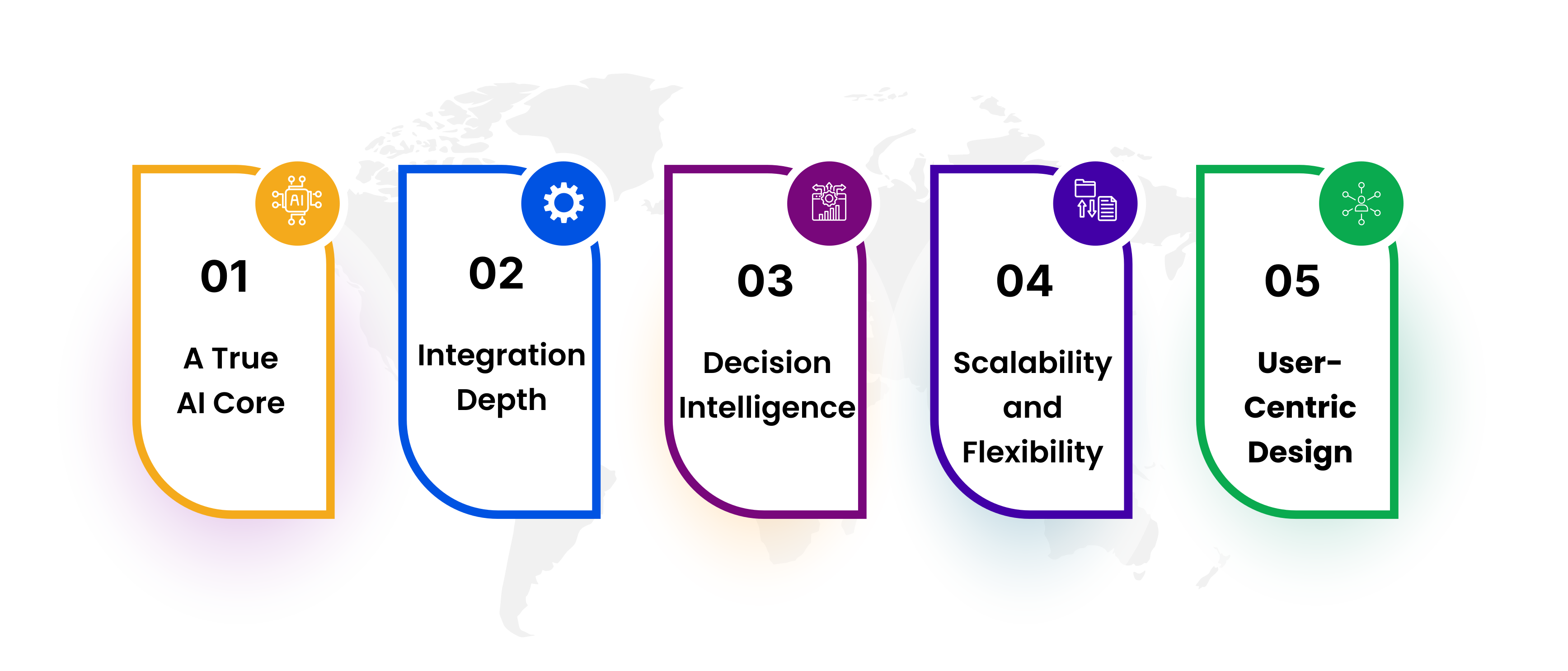
1. A True AI Core
Surface-level automation—auto-scheduling, templated workflows, dashboards—is not intelligence. The optimal platforms have AI embedded in their DNA, learning from project data to enhance predictions, optimize decisions, and adjust as conditions evolve.
2. Integration Depth
Projects do not exist in silos. They span finance, sales, HR, and operations. A pioneering AI solution elegantly integrates with ERP, CRM, HRMS, and financial software, providing an end-to-end perspective of performance and decision-making that encompasses the entire business, not the project silo.
3. Decision Intelligence
There is abundant data; there is a lack of insight. The right software takes reporting of past charts and graphs by offering context—why something is being delayed, how to fix it, and what the trade-offs of other decisions are. It offers leaders clarity, not just numbers.
4. Scalability and Flexibility
Whether a startup with several projects or a company that oversees a worldwide portfolio, the finest AI solutions are scalable without compromising performance or ease of use. They are able to fit into industries, organizational teams, and project methodologies.
5. User-Centric Design
The best system is irrelevant if groups won’t use it. Simple-to-use interfaces, purpose-driven recommendations, and painless adoption guarantee that AI smarts deliver real results.
Use Cases: How AI Project Management Gets Results
The real measure of AI in project management isn’t in features—it’s in outcomes. Across industries, organizations are already seeing how intelligent systems translate into sharper execution and stronger results.
IT Services: Smarter Resource Forecasting
For global IT service providers, managing distributed teams across multiple projects often leads to bottlenecks. AI alters that equation by predicting resource needs based on project size, previous performance, and changing client needs. Rather than racing to fill gaps, managers can weeks in advance know where workloads will surge, allowing them to proactively assign and staff evenly. The outcome: smoother completion, better-satisfied clients, and fewer burnouts for teams.
Construction: Predicting and Preventing Delays
In construction, even minor delays cascade into cost overruns. A company can use AI-based risk modeling to its project timelines. The system highlights weather risk, material shortages, and subcontractor delays ahead of time before they occurred, enabling managers to re-sequence activities and modify procurement in advance. What would have been a multi-week delay is minimized to a simple adjustment-saving both time and money.
Consulting Firms: Freeing Time for Clients
Consulting firms live on client-facing value, but consultants find themselves wasting hours on reporting, timesheets, and internal coordination. With natural language processing and automation, AI tools are now doing status reports, updating the project tracker, and handling recurring workflows in the background. Consultants gain back that time to spend on strategic problem-solving, increasing both client satisfaction and firm profitability.
Ready to see AI in action? Kytes brings predictive insights, seamless workflows, and real-time visibility to every project
Challenges & Misconceptions
With each innovation wave comes caution, and project management AI is no different. A couple of misconceptions continue to refrain leaders from unleashing its full potential.

The first is the fear of AI replacing project managers. In fact, AI takes care of the rote and predictive work—predicting risks, redeploying resources, creating reports—so that managers can attend to leadership, strategy, and stakeholder alignment. Judgment and context continue to be human strengths; AI just scales them up.
Another myth is that AI systems are too complicated for teams to adopt. Today’s platforms are built around usability—surfacing insights through intuitive dashboards and natural language queries instead of dumping raw data into the hands of users. The top systems push intelligence into the workflow rather than requiring steep learning curves.
Lastly, cost is usually cited as a hindrance. Although there is a cost initially, the ROI soon surpasses it. By avoiding overruns, enhancing utilization, and speeding up delivery, AI-based tools usually pay for themselves over the course of the initial couple of projects.
Change Management
Even the best AI system won’t succeed if teams don’t embrace it. Adoption is less about technology—and more about people.
- Start with leadership. When executives frame AI as a strategic partner (not just another tool), teams pay attention.
- Communicate clearly. AI isn’t here to replace managers; it’s here to handle the repetitive and predictive tasks so humans can focus on leadership and strategy.
- Train with context. Onboarding works best when it’s role-specific. Show project managers how schedules adapt in real time, or consultants how reporting is automated. Relevance builds trust.
- Build culture. Recognize early adopters, showcase quick wins, and reward teams who put AI to use. Culture shifts faster when success is visible.
Trends Defining 2025 & Beyond
The pace of change means that what is already perceived as cutting-edge will soon become standard. By 2025, AI project management will evolve far beyond predictive analysis to systems that actively shape the way projects are envisioned and executed.
Autonomous project planning is just around the corner. Instead of managers spending hours concocting plans from scratch, AI will offer foundation-level schedules, resource allocation, and cost estimates in minutes—leaving human beings to hone strategy rather than struggling with spreadsheets.
Manager AI copilots will operate as live mentors, monitoring progress in real time and calling up recommendations in natural language. Instead of burrowing through reports, leaders will query, “What’s my largest delivery risk this week?” and receive clear, actionable responses.
Financial visibility will also deepen. AI-driven scenario modeling will allow organizations to experiment with varied configurations of resources, budgets, and timelines in real time. Executives can balance cost vs. speed of delivery before making a commitment, with improved profitability predictability.
Last but not least, end-to-end enterprise ecosystem integration will render AI project management less of a dedicated product and more of an integration enabler. From ERP to CRM to HR systems, AI will bring data together to inform decisions based on the larger business picture.
Measuring Success
AI in project management should prove its value quickly. The ROI is real, but it needs to be measured. Key markers include:
- Fewer delays and overruns. Predictive analytics surface risks early, saving both time and money.
- Smarter resource use. Better alignment of talent reduces burnout and boosts productivity.
- Financial visibility. Scenario modeling lets leaders test “what if” decisions before committing, protecting margins.
- Client satisfaction. Predictable delivery translates into stronger trust and repeat business.
Conclusion
AI project management is no longer a science fiction novel concept—it’s already revolutionizing how organizations plan, deliver, and implement. From pre-emptive risk identification before risks cause timelines to come off course to real-time allocation of resources, AI-powered platforms are delivering their worth in bottom-line terms: less overruns, accelerated delivery, and more predictable profitability.
For those in leadership, the question is now no longer if they should adopt AI but how they should do so smartly. Choosing the right software is not about checking off boxes of features but future-proofing implementation in an environment where speed, accuracy, and adaptability are what success looks like.
The companies that do this in 2025 will be the ones who secure a clear edge. They will close projects with confidence, predict with more accuracy, and guide talent where it makes the most difference. In contrast, those that delay risk being held back by outdated tools and avoidable inefficiencies.
Why Kytes Is the AI-Driven [PSA + PPM] That Gets Results
In a market crowded with tools claiming “AI capabilities,” Kytes stands apart as a platform where intelligence is not an add-on but the foundation. Built as a true end-to-end [PSA + PPM] system, Kytes brings together project execution, financial clarity, and resource optimization—elevated by AI woven through every layer.
Its predictive resourcing allows leaders to anticipate demand and align talent ahead of bottlenecks occurring. Mundane coordination is automated, leaving teams time for high-value work. And with real-time insights powered by AI, managers have real-time visibility into risk, dependencies, and cost trade-offs—allowing wiser, faster decisions.