Blog Highlights
- Engineering resource management software improves project efficiency by enabling skill-based resource allocation, reducing scheduling conflicts, and ensuring the right engineers are assigned to the right projects.
- Effective capacity planning helps engineering firms forecast resource demand, identify skill gaps, and balance workloads across multiple projects to prevent staffing shortages and delivery delays.
- Optimizing resource utilization helps organizations minimize bench time, prevent resource overallocation, increase billable hours, and protect project profitability.
- AI-driven resource management enables smarter staffing decisions through intelligent skill matching, predictive capacity forecasting, and early identification of potential resource risks.
- Integrated resource and financial management solutions like Kytes provide centralized visibility into workforce availability, project costs, and resource allocation, helping engineering firms improve delivery performance and profitability.
Introduction
On a Monday morning, the head of delivery at an engineering services company in Pune glanced over the staffing sheet. There were three senior engineers. One was on paid time off, two were already booked for a client sprint in Dallas. By Wednesday, a new project had started two hours late, the client had been escalated, and the engagement margin had fallen four points.
That’s reality for firms every week. Engineering resource management software can prevent it – not with another dashboard, but by linking skills, schedule, project demand, and cost data in one place so the right individual gets to the right work before the chasm becomes a crisis. The SPI Research 2026 Professional Services Maturity Benchmark discovered a 14 percent decline in billable utilization (to 66.4 percent in 2025) over 509 firms – lowest reported ever by the survey. Firms that good at managing resources are not satisfied with that number. They create systems where utilization is a predictable result, not a lagging indicator.
What Does This Category of Software Actually Do?
Engine is a software designed for engineering companies that aligns engineers to projects across a business. It is a real-time skills matrix that shows availability, rate, location, and skill. Engine replaces multiple spreadsheets, emails, and tribal knowledge with a single system of record to visualize capacity, match resources, identify availability, and forecast capacity issues before they become bottlenecks.
Engineering teams have niche skills – embedded systems, structural, pharma process engineer, VLSI – and the cost of a wrong assignment multiplies quickly. A mechanical engineer on a controls assignment affects more than just himself. The rework, margin erosion, loss of client confidence and hits on the one right engineer who finally joins create a three-layer penalty.
Why Do Engineering Firms Struggle with Resource Utilization?
Company utilization in the majority of engineering firms falls between 71 and 80 percent, according to the Projectworks Consulting Industry Benchmarking Report, but only 4.5 percent of these firms report company utilization above 90 percent, compared to 16.8 percent of all consulting firms. This is a visibility problem, not a people problem.
Three patterns explain why.
The sale is made on a Friday. Delivery finds out on a Monday. At that point, the best-fit engineer is committed to something else. Reactive staffing is the norm, and bench time increases for those who aren’t the right skills for the latest demand.
The second problem is data is held in silos. One data set of skills is maintained in a spreadsheet by one group. An HR application holds skill ratings for engineers but groups them by job title rather than by technical skill. When a project requests skills – such as someone conversant in AVEVA E3D for an EPC client – one database can’t provide the answer.
Third, capacity planning is driven by gut feel. Managers will forecast who will be available next month using memory, not data. According to the SPI Research 2026 Benchmark, average EBITDA among professional services firms was an unspectacular 9.9 percent in 2025. Capacity planning driven by gut feel leaves profit on the table each quarter.
How Does Capacity Planning Software Change the Equation?
Capacity planning software gives engineering leaders a forward-looking view of supply and demand. Instead of asking “who is free right now?” it answers, “what will our staffing picture look like in four, eight, and twelve weeks – and where do we need to act?”
A strong process reads your active pipeline, and translates opportunities into forecast resource demand. It compares that demand to your allocations to surface conflicts before they turn into disaster. It considers planned leave, ramp-up time, and contractor availability. And it demonstrates the financial consequence of each possible staffing scenario – margin per project, delay costs, and bench costs.
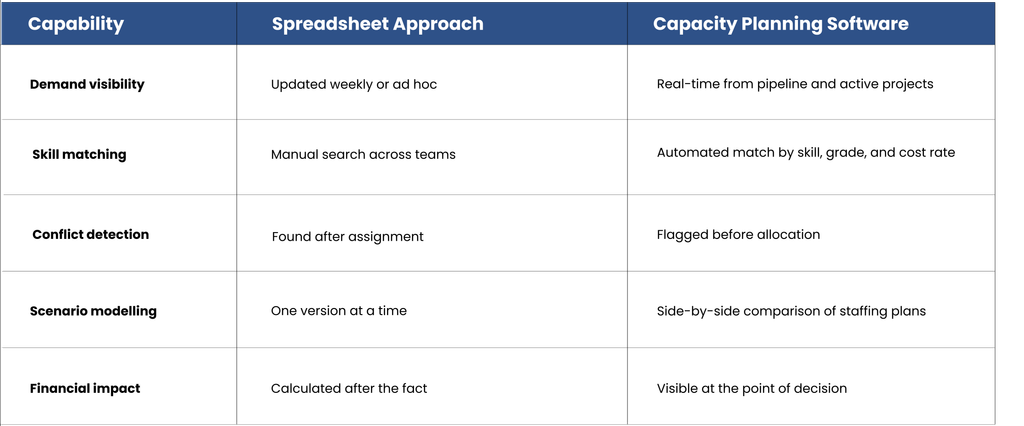
For decision makers in India and the US running delivery across time zones, this matters. A delivery lead in Bengaluru staffing a project for a US client needs cross-location availability, blended cost rates, and time-zone overlap — not a headcount number in a shared drive.
What Should You Look for in Resource Management Software?
Not every tool fits engineering firms. Generic platforms often assume uniform roles and interchangeable people. Engineering work does not operate that way. Here is what separates a useful platform from a misfit.
Skill-based matching, not just name-based allocation-The system should recognize fine technical skills such as languages, domain-specific certifications, tools and leverage them as a decisive criterion in staffing. If the platform fails to differentiate between validation engineer and a process engineer in pharma manufacturing, it will do nothing but cause more trouble than benefit.
Multi-project visibility-Engineering companies manage multiple projects at once. Your resource scheduling solution should be able to see the resource demand of your entire portfolio rather than project by project. Someone who appears free for a project maybe 95 per cent busy when you account for all their existing work.
Integrated financial data-Resource decisions are financial decisions. How you distribute resources impacts margin, billing and revenue projections. A resource management system that exists outside your financial data requires managers to switch between applications – and a staff assignment that appears profitable on a spreadsheet may wipe out margin when cost rate is included.
Demand forecasting from the pipeline-The best firms staff proactively. The system should read the sales pipeline and project the resource demand that will materialise if deals close at their expected rates. Waiting until a contract is signed to start staffing is the single most common cause of late project starts.
Contractor and bench management-Engineering firms carry a mix of permanent staff, contractors, and partners. The platform must track all three in one view. A bench of five engineers is not a problem if three of them are earmarked for a project starting next week. It is a problem if nobody knows that context.
How Does AI Improve Engineering Resource Allocation?
AI adds a layer of pattern recognition that no spreadsheet or manual process can match. In a resource management context, AI reads historical staffing data, project outcomes, and current demand to recommend allocations that balance speed, skill fit, and cost.
Three capabilities define the difference. First, AI-recommended staffing analyses skill tags, availability, cost rate, and project history to rank candidates for a role. Manual processes consider two or three variables; AI weighs all of them simultaneously.
Second, predictive alerts flag problems early. When a project’s burn rate suggests it will exhaust allocated hours three weeks ahead of schedule, AI surfaces the risk before it becomes a crisis.
Third, AI learns from outcomes. Projects that delivered on time and on margin become training data. The system improves its recommendations based on what actually worked, not just what was planned.
The PMI Pulse of the Profession 2026 report found that teams managing complexity well achieve 88 percent project success rates, compared with 14 percent for those that do not. Resource management is the largest controllable variable in that equation.
How Does Kytes Support Engineering Resource Management?
Kytes is an AI-enabled PSA and PPM platform built for project-driven enterprises, including IT and engineering services, pharma, EPC, and GCC organisations. Its resource management engine addresses the specific challenges engineering firms face.
Skills inventory and intelligent matching. Kytes maintains a searchable skills database across the organisation. When a project needs a specific capability, the system recommends candidates ranked by skill fit, availability, cost rate, and location. AI-powered knowledge intelligence extracts skills from resumes and past project assignments, keeping the database current without manual updates.
Capacity planning across the portfolio. The platform shows resource demand against supply across every active and pipeline project. Delivery leaders see where shortages will appear weeks in advance and can model different staffing scenarios with margin impact visible at the point of decision.
Financial integration. Every resource allocation in Kytes carries its cost and revenue implications. Margin per project, blended cost rates, and revenue forecasts update in real time as staffing changes. This eliminates the gap between resource planning and financial planning that traps many engineering firms.
Cross-location resource management. For firms operating between India and the US — or across any distributed delivery model — Kytes handles multi-location staffing, time-zone-aware allocation, and blended cost rate calculations. The platform connects to HR systems (SAP SuccessFactors, Workday), ERP platforms (Oracle, SAP, NetSuite), and collaboration tools (Microsoft Teams, Slack, Jira) to keep resource data synchronised.
Measurable outcomes. Engineering services clients using Kytes report 14 percent higher resource utilisation, 21 percent faster delivery cycles, and 12 percent more billable hours within the first quarter. One delivery head noted: “We stopped guessing on staffing. Kytes showed us who was available, who was the right fit, and when demand would spike — all before we asked.”
What Questions Should Decision Makers Ask Before Choosing?
Before shortlisting a platform, run this checklist.
Does it track skills at a granular, engineering-relevant level — not just job titles? Can it show capacity across the entire portfolio, not project by project? Does it integrate financials, so every staffing decision carries a margin view? Does it read the sales pipeline to forecast demand before contracts close? Does it handle a mixed workforce of permanent staff, contractors, and partners? Does it support multi-location, multi-currency staffing for India-US or global delivery models? Does the AI learn from your data, or does it rely on generic models?
If any answer is no, the platform will create workarounds instead of solving the underlying problem.
ing the dependency that concerns you most and ask to follow its impact from concept to launch.
Frequently Asked Questions