

Blog Highlights
- Automation and AI transform estimation from a static budgeting exercise into a live, data-driven forecasting system that learns from historical and real-time project data.
- Integrating HR, procurement, and finance data eliminates reconciliation delays and ensures a single version of truth for every estimate, budget, and invoice.
- Enterprises adopt structured models built on integrated data, reusable templates, effort-to-cost mapping, AI forecasting, real-time re-baselining, and automated governance.
- Analogous, parametric, bottom-up, and three-point estimation methods evolve into dynamic, AI-powered simulations that continuously refine accuracy and risk prediction.
- Kytes embeds intelligent cost estimation directly into delivery workflows—standardizing financial frameworks, automating risk buffers, and offering predictive dashboards for complete visibility.
- When delivery progress, resource utilization, and financial metrics operate in sync, cost estimation becomes a closed feedback loop that safeguards margins and drives enterprise-wide profitability.
Even small inaccuracies in cost estimation can snowball into a serious financial impact.
A delayed resource onboarding, an underestimated vendor rate, or an unaccounted currency fluctuation can push budgets off track within weeks. Delivery teams continue execution, finance teams chase real numbers, and leadership is forced to re-baseline mid-way through the project—losing both predictability and confidence.
This happens because cost estimation often remains disconnected from day-to-day project operations. While schedules, tasks, and collaboration tools have evolved digitally, estimation still depends on static spreadsheets, manual inputs, and delayed reconciliations. Each department—delivery, resource management, and finance—works with partial visibility, making consolidated cost intelligence nearly impossible.
Automation and digitization close this gap. They integrate financial logic directly into delivery workflows, allowing estimates to evolve automatically with project progress. When AI models learn from past project data and adjust based on live inputs—effort logged, rates updated, or scope changed—cost estimation stops being a periodic exercise and becomes a continuous control mechanism.
This blog explores how Kytes AI-enables [PSA+PPM] Software helps enterprises achieve accurate, connected, and predictive cost estimation, transforming financial accuracy into a competitive advantage.
Understanding Project Cost Estimation
Project cost estimation is the process of forecasting all the expenditures required to deliver a project successfully—labor, materials, infrastructure, subcontracting, overheads, and contingencies. An accurate cost estimate sets the foundation for budgeting, cash-flow planning, and profitability measurement.
In traditional project management, estimation occurs during initiation and rarely adapts as the project evolves. Modern digital ecosystems treat it differently. Cost estimation becomes a living component that interacts with time, resources, and outcomes. Each task, milestone, and change request feeds data back into the model, allowing the cost baseline to self-adjust in real time.
From a governance standpoint, cost estimation supports three crucial goals:
- Financial Feasibility: Determining whether a project is worth pursuing.
- Operational Planning: Allocating resources efficiently within financial limits.
- Performance Tracking: Measuring variance between projected and actual costs.
Digitization transforms these objectives into measurable, transparent metrics available on demand rather than at month-end reviews.
Explore the framework behind cost estimation and predictable margins with Kytes Project Financials Management.
Why Traditional Cost Estimation Falls Short
Conventional cost estimation relies on manual data entry, static assumptions, and disconnected systems. Finance teams work in spreadsheets; delivery teams operate in project tools; HR maintains rate cards separately. By the time data consolidates, it’s already outdated.
Common limitations include:
- Fragmented data: Resource costs, procurement data, and expense records live in silos.
- Human bias: Estimates often depend on optimistic assumptions rather than empirical evidence.
- Reactive updates: Scope changes trigger manual recalculations that take days.
- Limited traceability: Versioning issues and inconsistent formulas make audit trails difficult.
In global organizations, even a 2 % deviation in hourly cost assumptions can compound into millions of dollars of variance by project closure. These inefficiencies don’t just distort budgets—they delay decision-making and erode confidence. Automation corrects this by embedding financial logic directly into operational workflows.
The Shift Toward Automated and Digitized Cost Estimation
Automation brings repeatability; digitization brings structure. Together, they transform estimation into an adaptive process. Digitization ensures data—resource rates, material costs, vendor pricing—is standardized and accessible through integrated systems. Automation then applies business rules, AI models, and predictive analytics to compute real-time estimates.
Modern estimation systems continuously compare planned vs. actual performance, learn from deviations, and recalibrate forecasts automatically.
For example, if a project’s engineering phase consumes more hours than expected, the platform can instantly recalculate downstream costs and suggest scope adjustments or reallocation strategies.
In this model, the estimator becomes a strategist. Instead of manually compiling data, they evaluate financial simulations generated by intelligent algorithms. Automation doesn’t remove complexity—it makes it visible, measurable, and manageable.
Bridging Estimation Accuracy and Margin Realization
In most enterprises, cost estimation doesn’t fail because of calculation errors—it fails because the assumptions behind those calculations never get updated as projects evolve. A project that starts with 80% resource utilization may actually run at 65%, or a subcontractor’s rate may change mid-cycle. Without automated visibility, these shifts go unnoticed until margins are already compromised.
Automating cost estimation bridges this gap by making financial intelligence continuous. Every time a timesheet is approved, a resource is reassigned, or a milestone slips, the system recalculates the financial impact instantly. The result is a live cost baseline that reflects actual delivery conditions rather than planned assumptions.
By integrating estimation, tracking, and forecasting within a single ecosystem, enterprises can prevent leakage before it reaches the P&L. The outcome isn’t just tighter control—it’s sustainable margin improvement driven by precision and timing.
Framework for Automating Cost Estimation
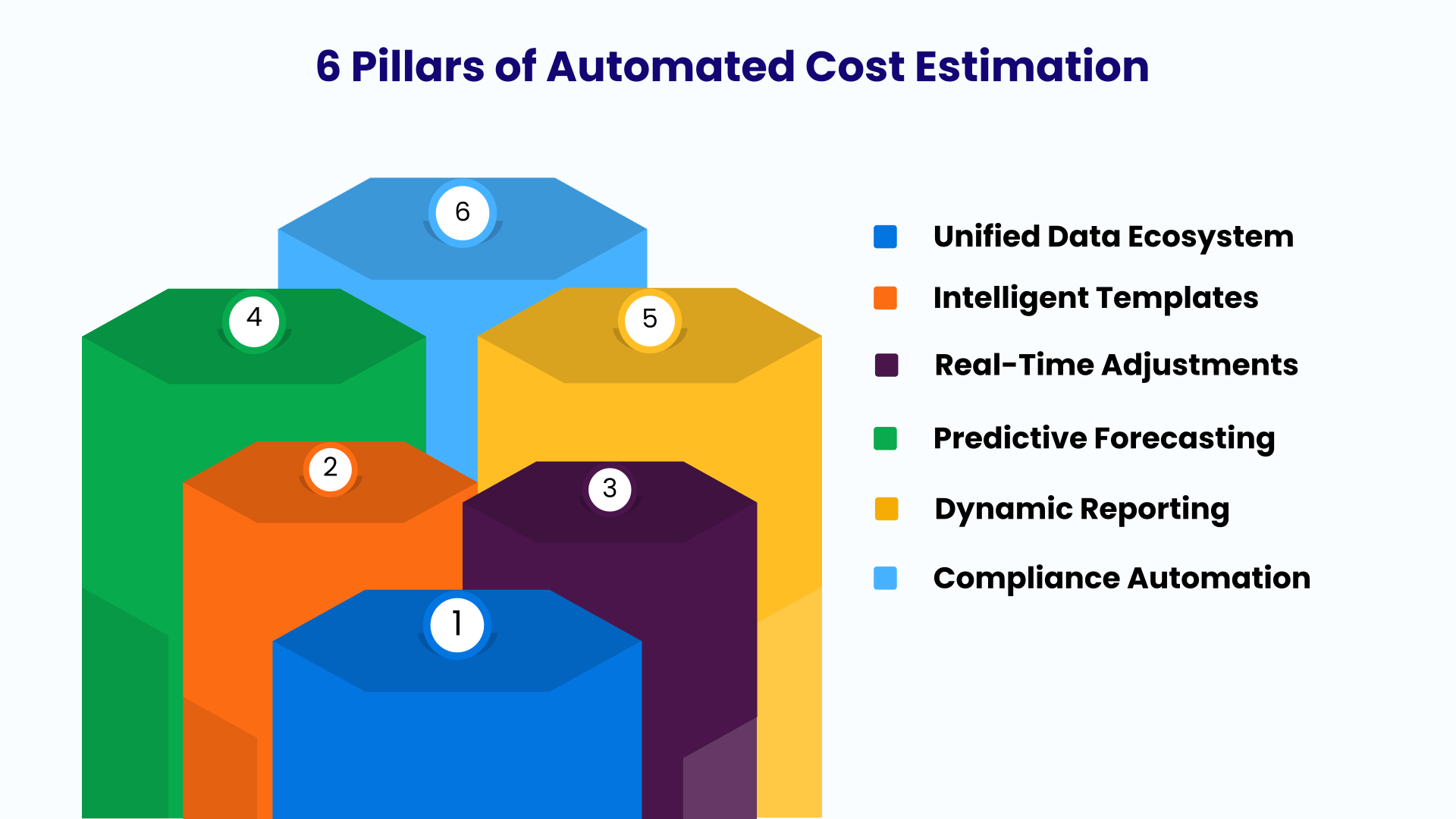
Building an automated estimation process requires a solid technical framework. Below is a structured six-step model that enterprises adopt when transforming manual estimation into a digital, self-adjusting system.
1. Data Foundation & Integration
All automation begins with unified data. HR, procurement, and finance systems must share a single schema for rate cards, vendor contracts, and project codes. This integration removes reconciliation delays and provides a real-time financial backbone.
2. Reusable Cost Models
Instead of recalculating every project from scratch, organizations create parameterized templates—by industry, contract type, or geography. Templates standardize assumptions, accelerate estimation, and ensure consistency across portfolios.
3. Effort-to-Cost Mapping
Work Breakdown Structures (WBS) connect directly to cost codes. When a resource logs time or a milestone shifts, the system automatically propagates cost impacts throughout the budget.
4. AI Forecasting & Predictive Modeling
Machine-learning algorithms analyze historical projects to anticipate probable overruns or underspends. They highlight variance patterns early, enabling preventive action rather than post-mortem correction.
5. Real-Time Re-Baselining
Budgets evolve continuously. As deliverables progress, automation recalibrates the baseline to maintain alignment with current scope, effort, and risk.
6. Automated Governance
Approval workflows, audit logs, and exception alerts ensure that financial accuracy is maintained without bureaucratic friction.
Digitizing Estimation Techniques
Automation doesn’t discard traditional methods—it enhances them with computation and context.
- Analogous Estimation- Past projects are stored in digital repositories. AI clustering identifies which historical projects resemble the new one, adjusting for size, duration, and complexity to suggest baseline estimates.
- Parametric Estimation- Automated formulas link cost drivers to measurable parameters: cost = rate × quantity × complexity factor. These equations update instantly when any input changes, maintaining mathematical consistency.
- Bottom-Up Estimation- Each task’s cost rolls up automatically to deliverable and project levels. This granular visibility is crucial for audit compliance and accountability.
- Three-Point Estimation- Systems calculate optimistic, pessimistic, and most-likely costs, then produce probability-weighted averages. This adds risk realism to forecasting.
Digitization converts these techniques from spreadsheets into dynamic simulations—interactive models that continuously learn from operational data.
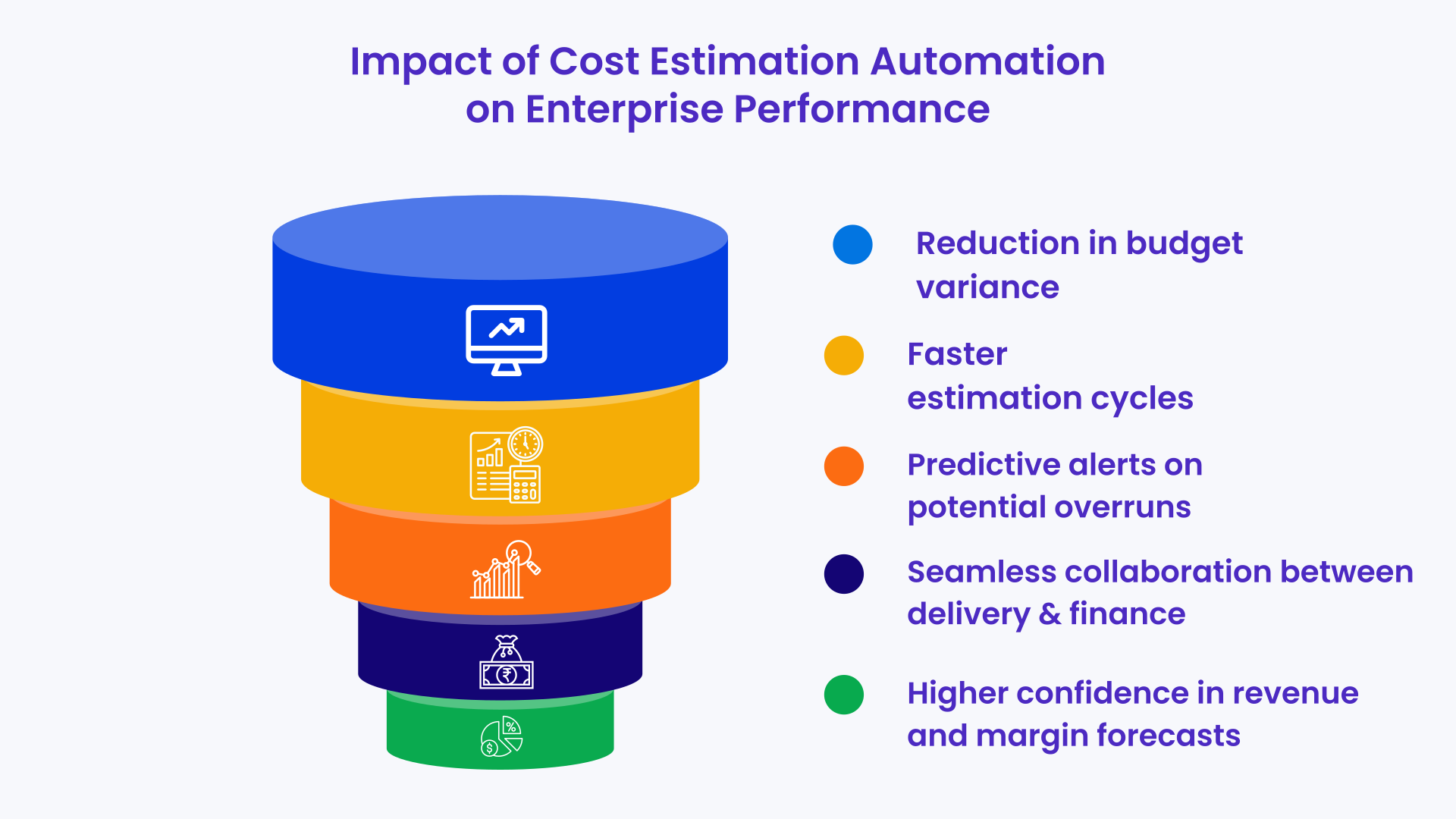
Enterprise-Level Benefits of Automation
- Accuracy & Predictability
AI-enhanced models correct human bias and adapt to real-time rate or resource fluctuations. Organizations experience tighter control over variance and better profitability forecasting. - Efficiency & Scalability
Reusable templates and auto-integration shorten estimation cycles from weeks to hours. Enterprises can scale governance across hundreds of concurrent projects. - Transparency & Compliance
All stakeholders operate from a shared data layer, enabling instant financial traceability. Every assumption, rate, and approval is logged. - Strategic Decision Enablement
Executives can run what-if simulations—changing timelines or staffing—to instantly see budgetary impact. Decision-making moves from reactive to anticipatory.
How Kytes AI-Enabled [PSA + PPM] Software Automates Cost Estimation
Kytes unifies project, resource, and financial management into one AI-driven ecosystem. For enterprises managing complex portfolios, it eliminates fragmented tools and manual reconciliations by creating an integrated estimation-to-execution loop.
- Integrated Financial Frameworks- Every cost element—direct, indirect, and overhead—is mapped to standardized financial structures. This ensures that estimates, budgets, and invoices speak the same language.
- AI Forecasting Models- Kytes AI analyzes past and current project data to predict cost deviations early. It highlights emerging risks and recommends adjustments to sustain margins.
- Dynamic Baselines- As project realities change, Kytes recalibrates cost baselines automatically. Scope shifts, resource swaps, or rate revisions trigger instant re-estimation.
- Automated Risk Buffers- The platform quantifies project complexity, geography, and contract type to propose suitable contingency margins—removing guesswork from buffer planning.
- Comprehensive Dashboards- Decision makers view live variance analysis, revenue impact, and cost trend visuals from a single console.
By embedding these capabilities across delivery workflows, Kytes turns cost estimation into a predictive intelligence layer—a continuous feedback mechanism that balances financial accuracy with operational agility.
Integrating Project Financials, Resources & Delivery
Automated cost estimation reaches its true potential only when financials, resources, and delivery operations are connected. Enterprises often treat these as independent domains; Kytes merges them into a unified fabric—a single version of truth across all project data.
- Project Financials
Budgets, invoices, and forecasts are automatically synchronized with estimation data.
Every approved change request updates revenue projections and expense allocations in real time. - Project Resource
The system links utilization, skills, and capacity to cost behavior. When bench allocation or overtime occurs, Kytes reflects its financial impact instantly, preserving both visibility and compliance across geographies. - Project Delivery
Actual progress feeds directly into cost tracking. As milestones close or tasks slip, Kytes adjusts cash-flow projections and profitability analytics, ensuring financial decisions mirror delivery realities.
This tri-layer integration, along with other tools such as ERO, CRM, and HRMS, eliminates blind spots between planning and execution. Enterprises gain a living model where each parameter—time, cost, talent—interacts seamlessly with the others.
Kytes’ domain expertise spans multiple verticals, including IT, engineering, and pharmaceuticals. Industry-specific templates embed best practices, regulatory considerations, and proven cost structures that align with global standards.
The result is operational precision: every department contributes data that sharpens financial visibility.
- Project delivery feeds real-time progress, effort hours, and milestone completion data, ensuring estimated versus actual costs are continuously reconciled.
- Resource management brings clarity on utilization, skill mix, and rate variance, aligning effort forecasting with true delivery economics.
- Financial management translates these operational metrics into cash flow, billing schedules, and margin analytics, providing an accurate picture of profitability at any moment.
When these three layers operate in sync, estimation becomes a closed feedback loop rather than a one-time event. Delivery informs finance; finance refines future estimates; and resource data optimizes both.
This interconnectedness ensures that every decision—whether assigning a resource, approving a scope change, or releasing an invoice—feeds into one continuous cycle of financial intelligence. This way, cost estimation evolves into a collective discipline that protects margins, validates pricing models, and enables strategic control over every dollar spent.
Final Thoughts
Project cost estimation is evolving from arithmetic to analytics—from historical budgeting to real-time financial intelligence. Automation ensures accuracy; digitization ensures accessibility; AI ensures adaptability. Together, they build a framework where every estimate is contextual, current, and connected.
Organizations that embrace automated estimation gain more than efficiency. They build financial resilience—the ability to predict, prevent, and respond to cost fluctuations with confidence. As enterprises scale across geographies and project complexities, connected estimation systems become the backbone of informed decision-making, optimized utilization, and sustainable profitability.
Kytes AI-enabled [PSA + PPM] software empowers enterprises to turn every estimation into a decision and every project into measurable value—enabling teams to see financial truth in real time, align operations with strategy, and drive consistent margin growth across the entire project lifecycle.