
Blog Highlights
- Project governance at scale ensures consistent oversight across large project portfolios, improving delivery stability and financial visibility.
- Strong PMO governance connects project execution, resource planning, and portfolio priorities within a unified framework.
- Predictive governance models help enterprises identify delivery risks early and protect timelines, margins, and client commitments.
- Real-time insights strengthen executive control, enabling leadership to make faster and more informed portfolio decisions.
In large enterprises, running multiple projects parallely is the norm. The part where it gets challenging is when dozens of projects run across accounts, geographies, and service lines. Each project carries commitments made during presales, and every engagement must meet delivery timelines, financial expectations, and client obligations. As portfolios expand, maintaining clarity across projects becomes increasingly difficult.
This is where project governance at scale becomes essential. Governance is not an additional reporting layer. It is a structured approach that ensures every project aligns with enterprise priorities, delivery capabilities, and financial goals. Organizations that scale governance effectively operate with stronger visibility and coordination. Delivery teams understand expectations clearly, leadership detects risks earlier, and the PMO evolves into a strategic execution function.
To understand how enterprises reach this level of control, it is important to examine how governance behaves inside large project portfolios.
The Reality of Governance in Large Project Portfolios
Project-centric enterprises operate in environments where hundreds of delivery decisions occur daily. These decisions influence margins, timelines, and customer relationships. Without structured governance, these decisions become fragmented across teams.
Delivery managers may track progress locally, while finance teams monitor revenue separately. Resource managers often rely on delayed updates. Over time, this disconnect creates operational blind spots.
Project governance at scale addresses this complexity through structured visibility and decision alignment.
In mature organizations, governance ensures:
- Standardized oversight across projects
- Consistent execution practices
- Early identification of delivery risks
- Alignment between delivery and financial outcomes
- Accountability across stakeholders
When governance works well, execution becomes predictable. Delivery leaders can trust the signals coming from project data.
Why Project Governance at Scale Matters More Than Ever
As organizations grow, project delivery becomes more interconnected. Resource dependencies increase. Financial forecasting becomes sensitive to minor execution shifts.
Without governance frameworks, small execution gaps quickly impact the broader delivery ecosystem.
Three operational realities drive the need for scalable governance.
- First, projects now operate across distributed teams. Remote delivery models require structured oversight. Informal updates no longer provide sufficient visibility.
- Second, enterprise customers demand stronger accountability. Contracts include performance commitments, compliance expectations, and governance reviews.
- Third, executive leadership expects real-time insights into delivery performance. Traditional reporting cycles no longer support strategic decision-making.
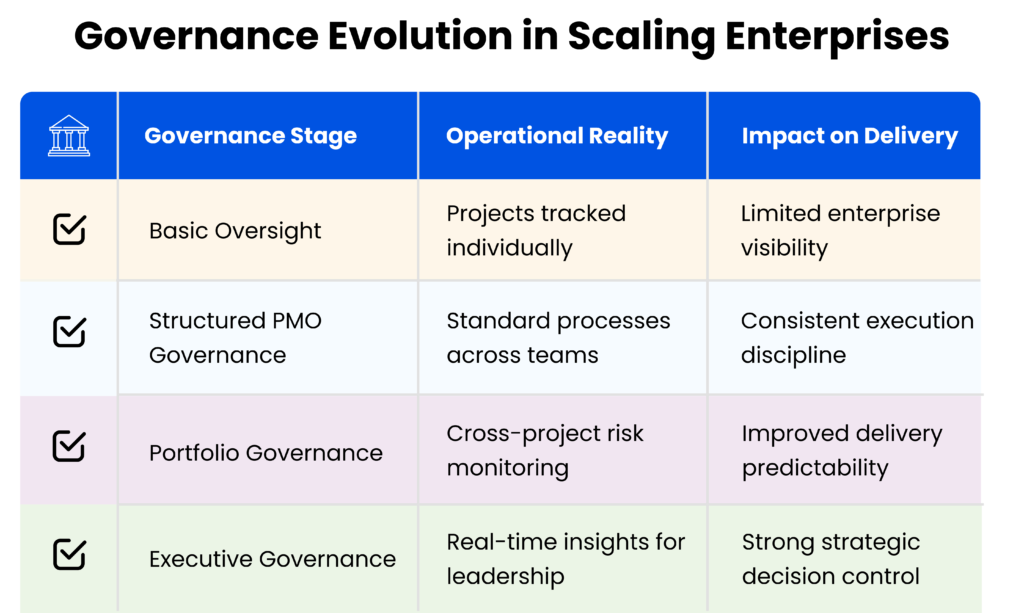
This is where PMO governance plays a defining role. The PMO transitions from coordination to enterprise execution control.
The Expanding Role of PMO Governance
In many organizations, the PMO initially focuses on templates, reporting formats, and project tracking guidelines. While necessary, these responsibilities only represent early governance maturity.
At scale, PMO governance becomes responsible for aligning delivery execution with business outcomes.
High-performing PMOs operate across several dimensions.
They define governance frameworks that standardize how projects start, operate, and close. They monitor execution signals that reveal delivery risks early. They also support leadership decisions with reliable delivery intelligence.
A mature PMO governance model typically includes:
- Portfolio-level project visibility
- Risk and issue escalation structures
- Financial performance tracking
- Resource governance across engagements
- Compliance with enterprise delivery standards
This shift transforms governance from operational reporting into a strategic capability.
Executive Control in Project-Centric Organizations
Executive leaders do not need more dashboards. They need reliable signals that support timely decisions.
Executive control within governance structures ensures that leadership understands delivery performance without operational delays. This control depends on three foundational capabilities.
Unified Visibility
Executives must see the full delivery landscape. This includes project status, financial performance, and emerging risks across portfolios. Fragmented tools often prevent this level of clarity.
Governance Alignment
Delivery teams, PMOs, and leadership must operate within the same governance framework. When governance standards vary across departments, execution becomes inconsistent.
Early Risk Detection
Executive control requires early identification of issues that could affect revenue, timelines, or customer commitments.
Organizations that achieve this level of governance operate with confidence during complex delivery cycles.
Also watch:
The Operational Mechanics of Project Governance at Scale
Governance becomes effective when it integrates directly into project execution. It cannot remain an external review process.
Operational governance typically includes several structured mechanisms.
Governance Reviews and Checkpoints
Projects require defined checkpoints where progress, risks, and financial performance are evaluated.
These reviews maintain alignment across stakeholders.
Risk and Issue Management
Governance frameworks ensure risks are documented, assessed, and escalated appropriately.
This prevents unresolved issues from affecting delivery outcomes.
Change Governance
Scope changes must follow controlled processes. Governance ensures that delivery commitments remain aligned with approved changes.
Financial Monitoring
Projects must remain financially viable throughout execution. Governance tracks effort variance, cost drift, and margin health.These mechanisms allow organizations to maintain consistent delivery standards across growing project portfolios.
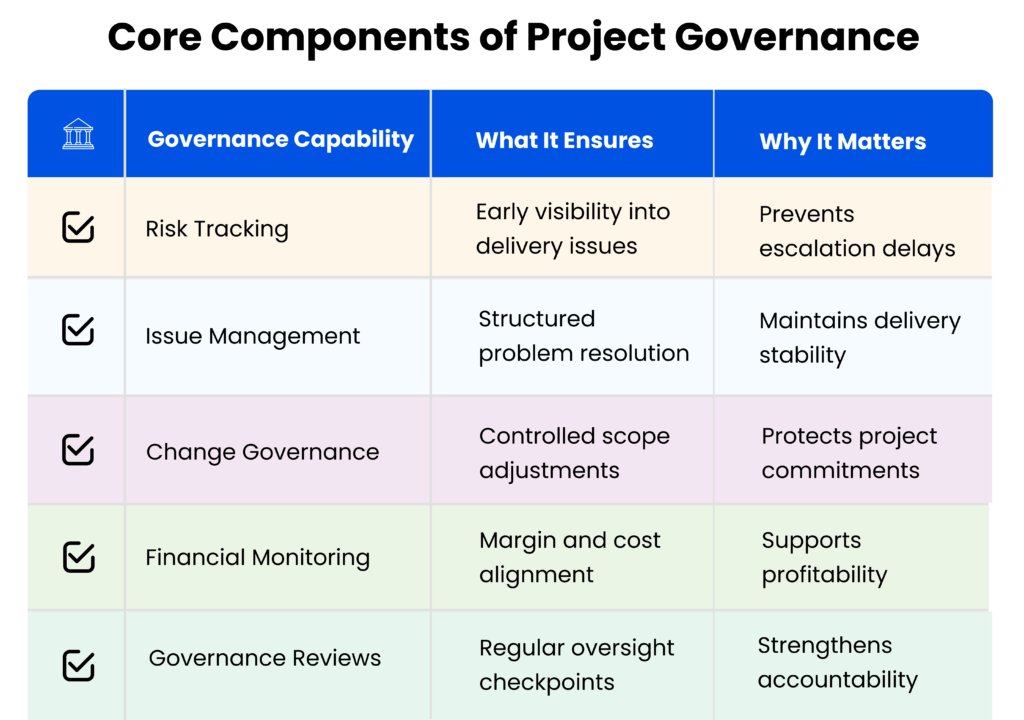
These elements create the structural backbone of scalable governance.
Challenges Organizations Face When Scaling Governance
Despite understanding governance principles, many enterprises struggle with execution.
Several barriers commonly appear during governance expansion.
Disconnected systems often limit real-time visibility. Delivery data exists across spreadsheets, PM tools, and financial systems. Governance teams spend significant time consolidating information.
Resource governance becomes difficult when multiple projects require overlapping skill sets. Without structured oversight, resource conflicts delay execution.
Another challenge emerges in financial governance. Delivery leaders may not see cost implications until late stages of execution.
Finally, governance fatigue can occur when processes become overly manual. Teams begin to treat governance as administrative overhead rather than operational support.
These challenges highlight the need for governance systems that integrate directly with delivery operations.
How Technology Strengthens Governance
Technology plays a defining role in modern governance frameworks. Manual governance methods cannot support enterprise-scale project delivery.
Organizations now require systems that unify delivery data, automate governance processes, and provide actionable insights.
This shift allows PMOs to move beyond administrative monitoring.
Modern governance platforms enable:
- Automated governance workflows
- Real-time portfolio visibility
- Integrated financial and delivery tracking
- Data-driven executive insights
- Scalable compliance management
These capabilities ensure governance becomes a natural part of execution rather than a separate reporting effort.
Project Governance and the Opportunity-to-Cash Lifecycle
Governance should not begin during project execution. It must start earlier within the Opportunity-to-Cash lifecycle. Sales commitments influence delivery plans. Resource allocations affect financial performance. Governance ensures these elements remain aligned.
When governance is embedded across the lifecycle, organizations gain several advantages.
Project initiation becomes more structured. Delivery planning becomes realistic. Financial forecasting improves accuracy.
Most importantly, leadership gains visibility into how opportunities translate into actual project performance.
This alignment strengthens enterprise delivery maturity.
Also watch:
How Kytes Enables Governance at Enterprise Scale
Kytes enables organizations to operationalize project governance across large delivery environments.
Kytes AI-enabled PSA + PPM platform makes project management intelligently simple. The platform digitizes and automates project management end-to-end. It creates a single version of truth across delivery, resources, and financials. The solution is purpose-built for enterprises managing complex project portfolios.
With Kytes, governance becomes embedded within execution rather than operating separately.
The platform supports:
- Structured governance workflows
- Real-time project visibility
- Risk and issue monitoring
- Financial tracking aligned with delivery milestones
- Executive-level reporting and insights
Kytes also shifts governance from reactive monitoring to predictive and prescriptive execution intelligence.
For enterprises scaling project delivery, this transformation strengthens decision-making, improves accountability, and enhances overall execution maturity.
Where Enterprise Governance Is Heading
Many enterprises are strengthening governance through predictive models that identify delivery risks early. These insights allow leadership teams to act before timelines shift or margins begin to erode. Governance signals now support both operational decisions and long-term portfolio planning.
At the same time, PMO governance is becoming a strategic function within the organization. The PMO connects delivery execution, financial oversight, and portfolio priorities through a unified governance framework. This alignment helps projects operate with clear accountability while supporting enterprise growth.
Strong governance also enables better executive control. Leadership gains real-time visibility into delivery performance, enabling faster decisions and stronger prioritization across projects.
Project governance at scale ultimately determines how well enterprises deliver across complex project ecosystems. Organizations that treat governance as a strategic capability build more resilient and predictable delivery operations.