
Blog Highlights
- Software project management methodologies structure every activity, directly influencing delivery speed.
- Core activities—planning, execution, monitoring, QA, and risk management—are executed differently across predictive, adaptive, and hybrid methodologies.
- Adaptive and hybrid frameworks generally reduce time-to-market by enabling faster iteration and early defect detection.
- Common pitfalls include misuse of Agile rituals, overplanning in Waterfall, and hybrid confusion.
- AI-enabled project management tools like Kytes optimize methodology execution, improving speed and visibility.
- Strategic methodology selection considers project complexity, team experience, compliance needs, and delivery cadence.
IT organizations often face a familiar tension: the promise of rapid delivery clashes with the reality of software complexity. Deadlines slip, teams scramble, and stakeholders grow impatient. The speed of project delivery is rarely a matter of sheer effort; it hinges on the methodology guiding the work. Choosing the right framework shapes not just timelines, but team collaboration, risk management, and ultimately, the quality of software delivered.
In practice, IT organizations operate in environments full of uncertainty—shifting requirements, resource constraints, and competing priorities. Yet, the conversation around software project management methodologies often reduces to simplistic debates about Agile versus Waterfall. That narrow focus misses the deeper operational truths: how methodologies affect every activity in software development, the bottlenecks they introduce or remove, and the precise ways they influence delivery speed.
This article goes beyond surface-level comparisons to reveal how methodology choice shapes real outcomes in IT services. It also explores how intelligent project management software can accelerate delivery without compromising quality.
Understanding Software Project Management Methodologies
A software project management methodology is more than a framework; it is a blueprint for organizing work, assigning responsibilities, and structuring decision-making. It dictates how teams plan, execute, monitor, and adjust their efforts throughout a project’s lifecycle.
While many discussions default to Agile and Waterfall, the landscape is broader:
- Predictive Methodologies focus on detailed upfront planning and sequential execution. The entire project is mapped out at the start, with clearly defined phases, milestones, and deliverables. Waterfall is the classic example, where each stage—requirements, design, development, testing, and deployment—follows a strict order. This approach provides predictability and control, making it easier to track progress, but can slow down delivery if changes arise mid-project.
- Adaptive Methodologies embrace iterative development, continuous feedback, and flexibility. Frameworks like Scrum and Kanban break work into short cycles, allowing teams to adjust priorities and incorporate stakeholder input regularly. These methodologies enable faster delivery of usable software, reduce the risk of late-stage rework, and improve responsiveness to evolving requirements.
- Hybrid Methodologies combine elements of both predictive and adaptive approaches. They provide structured planning for complex or regulated aspects of a project while allowing iterative cycles where flexibility is needed. This balance helps organizations maintain control over critical deliverables without sacrificing speed or adaptability in other areas.
The real value of these frameworks lies in their operational impact. How a methodology structures work determines how quickly teams can respond to change, detect defects, and deliver working software to users.
Core Activities in Software Project Management Methodologies
Every software project, regardless of methodology, involves a set of essential activities. What differs is how these activities are executed, coordinated, and optimized:
- Planning – Defining scope, objectives, timelines, and resources. Planning establishes the roadmap for the project, ensuring that teams understand priorities, dependencies, and expected outcomes. It sets the foundation for alignment across stakeholders and allows for realistic scheduling.
- Execution – Implementing the development work while maintaining alignment with requirements. Execution turns plans into functional software, translating designs into working code while keeping track of feature completion and interdependencies.
- Monitoring and Controlling – Tracking progress, identifying risks, and making adjustments. This activity ensures that projects remain on track, deviations are addressed early, and necessary course corrections are implemented without impacting delivery deadlines.
- Quality Assurance – Testing, reviews, and validation to ensure standards are met. QA ensures that each increment meets functional, performance, and security standards, reducing rework and preventing delays later in the project lifecycle.
- Stakeholder Communication – Providing visibility and managing expectations. Regular updates, demos, and feedback loops keep teams and stakeholders aligned, prevent misunderstandings, and support faster decision-making.
- Risk Management – Identifying potential blockers and planning mitigations. Proactively managing risks minimizes disruptions, allows for contingency planning, and ensures smoother progress throughout the project.
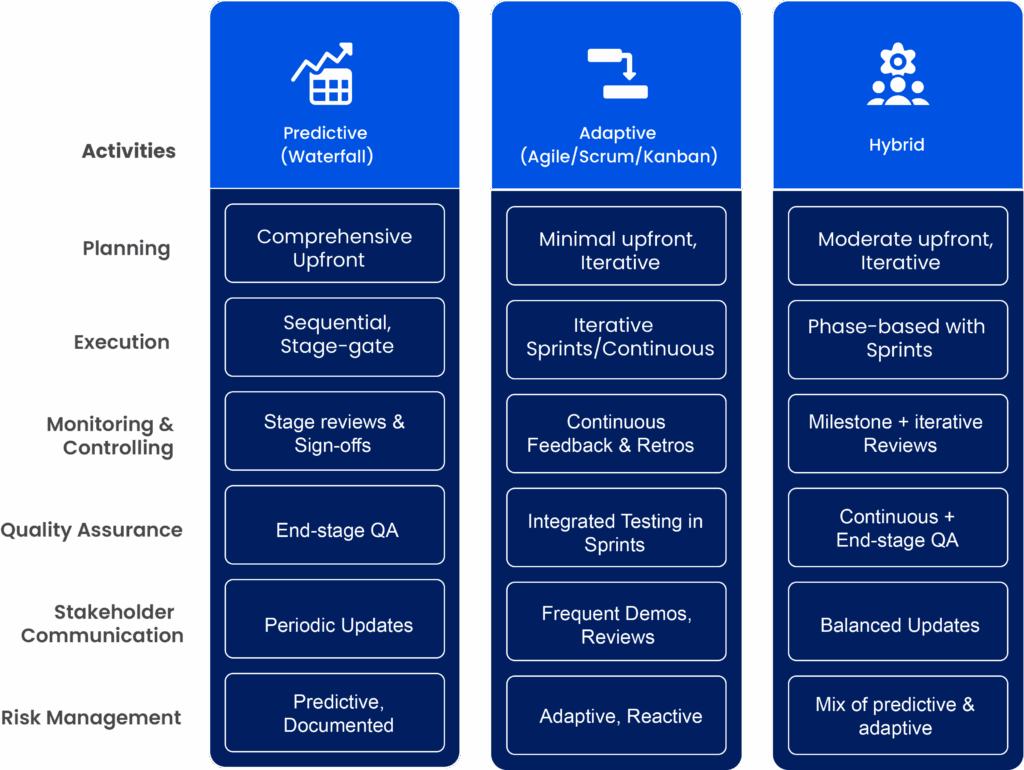
This table illustrates that delivery speed is not just about methodology labels—it is about how these activities are structured and prioritized.
How Methodology Choice Impacts Delivery Speed
Methodology choice directly influences the pace of delivery. Consider these operational realities:
- Iteration Speed – Adaptive methodologies enable shorter release cycles, allowing teams to deliver incremental functionality quickly. Frequent feedback loops let developers identify issues early, make adjustments, and continuously improve the product. Predictive methods, on the other hand, follow longer, sequential cycles. While this approach improves predictability and helps plan resources in advance, it slows the delivery of visible results and delays feedback.
- Bottleneck Identification – In predictive frameworks like Waterfall, testing and validation often occur toward the end of the project. This can lead to late discovery of defects, making fixes costly and time-consuming. Adaptive approaches, such as Scrum or Kanban, integrate testing throughout the development cycle. Continuous review exposes bottlenecks earlier, allowing teams to address problems before they escalate.
- Resource Allocation – Methodologies influence how teams are structured and how resources are assigned. Predictive frameworks can create idle periods between sequential phases, leaving resources underutilized. Iterative and adaptive approaches promote dynamic allocation, enabling team members to shift between tasks based on priority, maximizing efficiency and reducing downtime.
- Change Management – Software projects rarely proceed exactly as planned. Adaptive and hybrid methodologies accommodate evolving requirements and unexpected challenges without significant disruption. This flexibility reduces wasted cycles, helps maintain momentum, and ensures delivery schedules remain realistic even in the face of change.
Operational insight from multiple IT services firms shows that teams using hybrid or adaptive methods with disciplined activity tracking can reduce delivery time by 15–30%, depending on project complexity.
Metrics That Matter: Measuring Methodology Effectiveness
While choosing the right methodology is critical, IT leaders also need a way to measure whether it’s actually improving delivery speed. Without clear metrics, methodology becomes an abstract concept rather than a driver of performance. Key indicators to track include:
1. Cycle Time – The time it takes for a feature or task to move from development start to completion. Shorter cycles indicate that the team is efficiently turning work into deliverables.
2. Lead Time – Total time from initial request to deployment. Tracking lead time helps assess overall process efficiency and identify bottlenecks in approvals or handoffs.
3. Sprint Velocity – In iterative methodologies, velocity measures the amount of work completed per sprint. Consistent or improving velocity shows that the team is operating predictably.
4. Defect Density – Number of defects per module or feature. Lower defect density signals that QA and development processes are effective, preventing rework that can slow delivery.
5. Release Frequency – How often functional software is delivered to stakeholders. Higher frequency is a sign of an adaptive, responsive process and helps accelerate time-to-value.
6. Resource Utilization – How effectively teams are allocated and productive across phases. Poor utilization can indicate idle time or bottlenecks caused by rigid methodology enforcement.
Tracking these metrics provides insights into both speed and quality. Adaptive or hybrid methodologies often show faster cycle and lead times, but only if team activity is disciplined and monitored. Predictive frameworks may demonstrate stable velocity and low defect density, but may lag on release frequency.
Common Pitfalls and Misconceptions
Leaders often misunderstand methodology choice, introducing hidden delays:
- Agile Misuse – Simply adopting Agile ceremonies like daily stand-ups, sprint planning, and retrospectives does not guarantee faster delivery. Without discipline and clear purpose, these rituals can become time-consuming events that distract teams from actual development work. When deliverables are not well-defined or priorities shift constantly without proper governance, Agile can slow progress rather than accelerate it.
- Waterfall Overplanning – Predictive methodologies rely heavily on upfront planning and documentation. While detailed design reduces uncertainty, excessive focus on planning can delay the delivery of the first usable product. Stakeholders may wait weeks or months to see tangible results, and any late-stage requirement changes can trigger costly rework, affecting both speed and responsiveness.
- Hybrid Confusion – Combining elements of predictive and adaptive approaches can offer flexibility and structure, but only if clearly defined. Ambiguous roles, inconsistent processes, or unclear guidelines can create friction between teams, duplicate efforts, and slow execution. Without governance and alignment, the benefits of hybrid methodologies can be undermined by operational confusion.
Integrating Project Management Software with Methodologies
Software project management tools bridge methodology and execution. Their value is magnified when aligned with chosen methodologies:
- Automated Tracking – Modern project management tools automatically record task completion, sprint velocity, and dependencies in real time. This reduces manual reporting and gives project managers immediate visibility into progress. Teams can spot delays or bottlenecks early, making it easier to maintain delivery speed without micromanaging.
- Predictive Insights – AI-enabled PSA and PPM systems go beyond tracking by analyzing historical performance and current project data. They forecast delivery timelines, highlight potential risks, and suggest adjustments before problems impact deadlines. This predictive capability allows IT leaders to plan proactively rather than reactively.
- Workflow Optimization – Tools can enforce methodology-aligned workflows, ensuring that tasks, handoffs, and approvals follow the chosen framework efficiently. By automating routine processes and providing clear guidance on task sequencing, teams spend more time on productive work and less time navigating administrative friction.
- Collaboration – Centralized dashboards and communication features connect distributed teams, providing a single source of truth. Visibility into progress, dependencies, and responsibilities improves accountability, aligns stakeholders, and reduces misunderstandings, all of which contribute to faster, more reliable delivery.
Incorporating intelligent project management software is no longer optional. It directly influences delivery speed, reduces human error, and enables IT leaders to make informed decisions without micro-managing.
Explore how Kytes AI-enabled [PSA + PPM] software optimizes methodology execution to accelerate project delivery.
Choosing the Right Methodology for Your IT Project
Selection should be strategic, not habitual. Key considerations include:
- Project Complexity – Projects with highly interdependent modules, complex architecture, or critical integration points often benefit from predictive or hybrid frameworks. These approaches provide structured oversight for dependencies while still allowing flexibility where needed.
- Team Experience – The skillset and familiarity of the team with iterative practices matter. Teams experienced in Agile can fully leverage adaptive methodologies, maintaining fast delivery cycles and continuous improvement. Less experienced teams may require more structured approaches to avoid chaos.
- Regulatory Requirements – Certain projects, especially in finance, healthcare, or government, demand strict documentation, traceability, and approvals. Predictive methodologies often support these requirements better, ensuring compliance without compromising accountability.
- Delivery Cadence – Projects with tight timelines or frequent release expectations favor iterative methodologies. Short cycles allow incremental releases, early feedback, and faster time-to-value for stakeholders.
- Stakeholder Expectations – Transparent reporting, visibility, and early involvement influence methodology suitability. If stakeholders need frequent updates and active participation, adaptive or hybrid approaches facilitate engagement and alignment while maintaining pace.
A practical approach is to map project constraints against methodology characteristics, producing a guided decision framework that balances speed, quality, and risk.
Case Insights
Several IT service projects highlight the tangible impact of methodology alignment:
- A mid-sized SaaS company shifted from Waterfall to a hybrid model. By redefining activity sequences and using an AI-enabled PSA system, the first release went out 25% faster, with post-release defects reduced by 18%.
- An enterprise integration project adopted Agile with strict sprint discipline. Real-time dashboards allowed the project manager to reallocate resources dynamically, compressing delivery by 3 weeks without increasing team load.
Future-Proofing Project Delivery
Methodology adoption is evolving:
- Hybrid Approaches – Many organizations are moving toward combining predictive rigor with adaptive flexibility. This approach applies structured planning to critical or high-risk areas while allowing iterative cycles where requirements are uncertain. The result is a balanced methodology that maintains control over essential deliverables while enabling faster response to change.
- AI-Assisted Planning – Modern AI-enabled project management systems use historical data and real-time metrics to forecast bottlenecks, optimize task allocation, and provide early warnings for potential timeline risks. By anticipating issues before they occur, teams can adjust schedules and resources proactively, reducing delays and improving overall delivery speed.
- Automated Reporting – Generating status reports manually can consume valuable development time. Automated reporting tools streamline this process, producing real-time dashboards and insights for stakeholders. This allows teams to focus on delivering features rather than spending hours documenting progress.
- Continuous Learning – Post-project reviews are no longer static exercises. AI systems can analyze lessons from past projects, track recurring issues, and suggest process improvements. This creates a feedback loop that incrementally enhances methodology execution, efficiency, and speed for future projects.
Organizations that integrate methodology selection with intelligent project management tools are positioned to maintain delivery speed while adapting to evolving IT landscapes.
Conclusion
Software project management methodologies are far more than labels—they define how work flows, how risks are managed, and how quickly software reaches users. Misalignment between methodology and project realities introduces delays, inefficiencies, and frustration. The real advantage comes from combining methodology discipline with intelligent software that tracks, predicts, and optimizes every activity.
Kytes AI-enabled [PSA + PPM] software empowers IT leaders to match methodology with operational needs, accelerate delivery, and maintain quality standards. By aligning teams, tools, and processes, Kytes transforms methodology from a conceptual framework into measurable speed and efficiency gains. Schedule a demo with Kytes to see how methodology-aligned project management accelerates delivery in practice.