
Blog Summary
- The DNA of the best agile project management software lies in adaptability, visibility, and collaboration.
- Agile project management requires multi-methodology support across Scrum, Kanban, and hybrid approaches.
- Agile project management requires multi-methodology support across Scrum, Kanban, and hybrid approaches.
- The best software for agile project management integrates PSA and PPM for holistic visibility.
- Tools should be judged by outcomes—speed, predictability, and efficiency—not feature checklists.
- Agile software development tools succeed only when fully integrated into enterprise systems
- Decision-makers must evaluate based on adaptability, integration, and predictive insights.
Agile has become one of the most casually used words in business vocabulary. Every project management tool today seems to claim it, every software brand insists it was “built with agility in mind.” Yet when teams put these tools into practice, the experience often feels anything but agile. Workflows get rigid, reporting becomes a burden, and adaptability is lost in translation.
In 2025, enterprises need more than cosmetic “agile” features. They need project management platforms that embody the principles of agility at their core—tools that not only keep up with changing demands but anticipate them. The question is no longer whether to choose an agile approach. It is how to identify the best agile project management software—the kind that delivers adaptability, clarity, and results without compromise.
This blog explores that question in depth. Instead of checklist comparisons or superficial feature reviews, it examines what truly distinguishes the best in its class.
Why Agile Matters in Modern Project Management
The roots of Agile trace back to software development, where speed to market and iterative releases became a necessity. Over the last decade, however, agility has moved far beyond IT departments. Professional services firms, construction companies, creative agencies, even public sector organizations—every industry grapples with complexity, shifting priorities, and the need for faster outcomes.
Traditional project management tools—built around static timelines and rigid hierarchies—fall short in these contexts. They lock teams into linear processes when reality demands flexibility. Research underscores this shift: recent surveys show that over 70% of organizations now adopt agile practices across at least some business functions, not just IT.
What explains this adoption? Agility answers a growing demand:
- Adaptability when market conditions change mid-project.
- Visibility across multi-project portfolios.
- Efficiency in resource allocation when budgets tighten.
- Resilience when disruptions arise.
To support these realities, software must be more than a digital version of Gantt charts. It must internalize agile principles and make them operational for diverse industries.
Defining “Truly Agile” Project Management Software
Not every tool that markets itself as agile is built for agility. Some provide task boards labeled “Kanban.” Others allow sprint creation without flexibility to mix methodologies. These may look like agile software development tools, but in practice, they constrain rather than liberate teams.
A truly agile project management software must enable:
- Flexibility
Plans rarely survive unchanged. Priorities shift, client expectations evolve, and unforeseen dependencies arise. The software must allow adjustments without dismantling existing structures. True flexibility means teams can reallocate resources, adjust timelines, or pivot strategy without losing cohesion. - Transparency
Agility thrives on shared understanding. Stakeholders—whether executives seeking portfolio overviews or teams managing daily tasks—must have visibility into progress, risks, and dependencies. Transparency is not about flooding users with data but about presenting the right information to the right people at the right time. - Iterative Delivery
Agile is built on the principle of steady progress, not grand reveals. The software must support incremental delivery, enabling teams to release value early, gather feedback, and refine continuously. Iteration keeps momentum alive while reducing the risk of late-stage surprises.
Collaboration
Agility cannot survive in silos. The best tools weave communication, documentation, and accountability into a single ecosystem. By linking discussions with tasks, aligning updates with deliverables, and centralizing knowledge, collaboration becomes effortless rather than an afterthought.
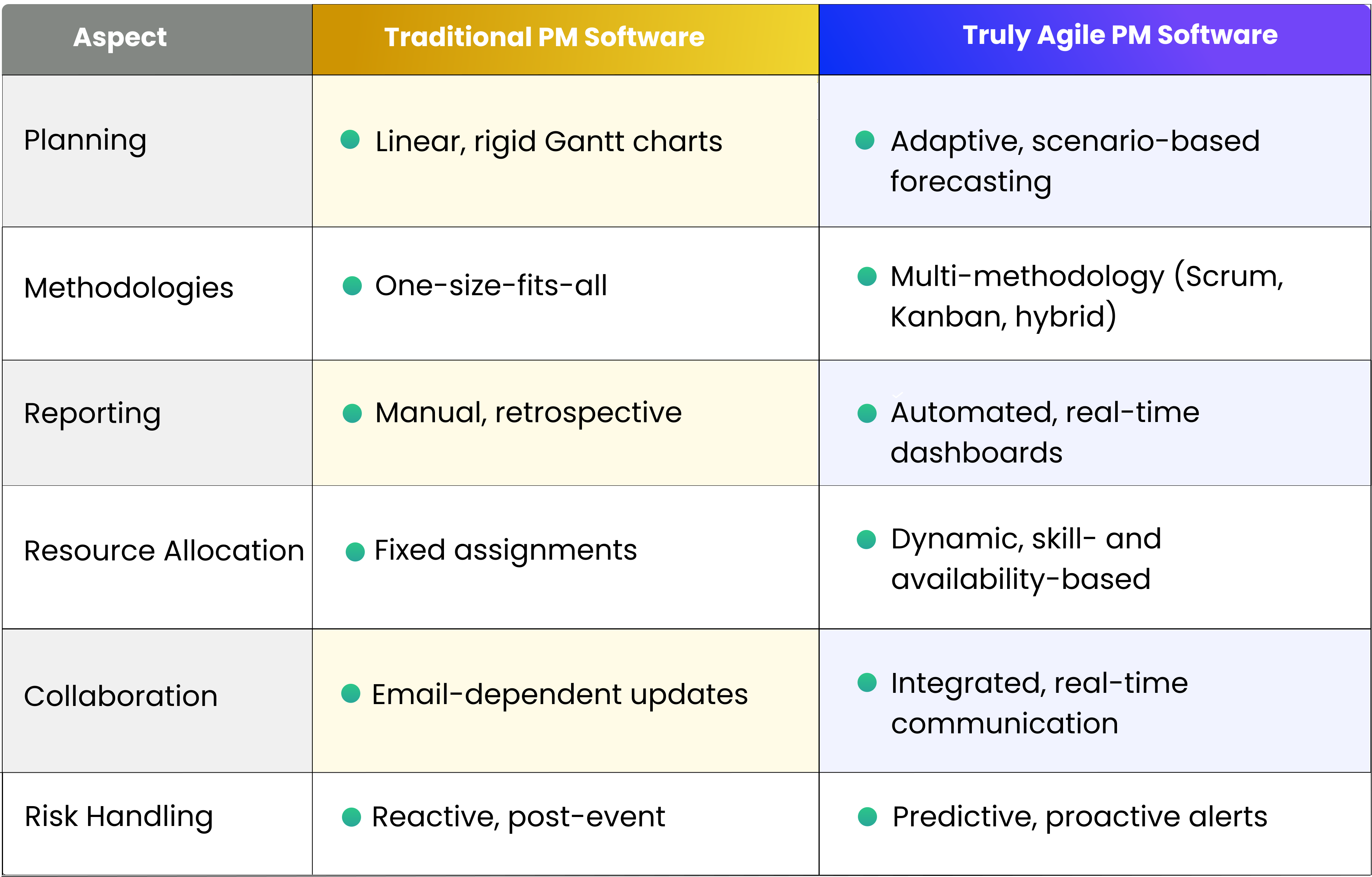
Core Capabilities of the Best Agile Project Management Software
Agility becomes real only when capabilities align with principles. The best software for agile project management is defined less by labels and more by how it enables organizations to deliver outcomes.
a. Adaptive Planning & Forecasting
Projects rarely go as planned. Market shifts, resource changes, or client priorities can derail timelines overnight. Agile software must allow for scenario planning—shifting tasks, reallocating capacity, and forecasting outcomes dynamically. Teams should not have to rebuild plans from scratch each time change arises.
b. Multi-Methodology Support
No two teams work alike. While developers may prefer Scrum, creative units lean on Kanban, and consulting teams often need hybrid approaches. The best tools support multiple methodologies simultaneously, enabling each team to work their way while keeping leadership visibility intact.
c. Integrated Resource Management
Agility falters when resources are overlooked. Without insight into who is available, overcommitted, or underutilized, agility is reduced to theory. Advanced tools align skills, availability, and costs, ensuring teams can respond to new priorities without burning out individuals.
d. End-to-End Visibility
Agility demands transparency. Dashboards must not only show task progress but connect project status with broader business objectives. Predictive analytics—forecasting delays, budget overruns, or capacity issues—move software beyond reporting into decision support.
e. Collaboration & Knowledge Sharing
Agile thrives on collaboration. Yet too many tools reduce communication to comment threads. The best systems go further, providing documentation, integrated chat, version control, and seamless connection to external applications—ensuring knowledge flows without silos.
f. Automation & AI Support
Administrative overhead undermines agility. The software must automate recurring tasks—status reporting, reminders, resource matching—while leveraging AI to surface insights: potential risks, workload imbalances, or optimization opportunities.
Collectively, these capabilities distinguish true agility from surface-level mimicry.
Evaluating Agile Software Development Tools: Beyond Features
Enterprises often fall into the trap of checklist evaluation—comparing whether a tool offers boards, timelines, or dashboards. But the best software for agile project management is not defined by the presence of features, but by the outcomes it enables.
The real evaluation lens should focus on:
Delivery Speed
Agile is ultimately about getting value into users’ hands faster. The right software accelerates delivery not by pushing teams harder, but by removing friction—streamlining task handovers, clarifying priorities, and automating repetitive updates. If deadlines are consistently met without exhausting resources, that is a stronger signal of agility than any feature checklist.
Predictability
Agility is not chaos; it is disciplined adaptability. The best software ensures sprint plans and release timelines align closely with reality. This means teams can forecast more accurately, stakeholders gain confidence in commitments, and surprises are minimized. A predictable system reflects how well the software supports planning, visibility, and proactive adjustments.
Efficiency
Agile software should optimize resource use—time, skills, and budget. Instead of overloading certain individuals while others remain underutilized, it balances workloads intelligently. Efficiency is not just about cost savings; it ensures projects move forward smoothly, with the right people on the right tasks at the right time.
Morale
The human factor is often overlooked in evaluations. Software that creates extra admin work or requires constant manual reporting undermines morale. The best tools free teams to focus on meaningful work, offering clarity instead of clutter. When people feel supported rather than burdened by their systems, motivation and productivity rise in tandem.

The Strategic Role of Integration in Agile Success
Even the most advanced project management tool fails if it operates in isolation. Agility is not only about managing tasks; it is about connecting the moving parts of an enterprise so that decisions can be made with speed and confidence. That requires seamless integration.
When software is disconnected, teams are forced into silos—finance prepares budgets without real-time project data, HR manages capacity without visibility into demand, and developers track progress in tools that executives never see. The result is duplication, blind spots, and slow responses to change.
Integration is therefore not a convenience. It is the nervous system of enterprise agility. Finance leaders need live visibility into budgets and burn rates; HR requires workload insights to allocate talent wisely; developers and product managers must link code commits directly to tasks. The best agile project management software does more than centralize—it synchronizes these functions, ensuring that every decision is grounded in shared, up-to-date information.
When systems are connected, organizations move from reactive problem-solving to proactive strategy. Integration turns project management from a reporting layer into the operational backbone of agility.
Real-World Examples & Industry Use Cases
Agility looks different across industries, yet its value is universal.
Technology & Software Development
In software, speed to market often defines competitiveness. Agile tools accelerate releases by making backlogs transparent, aligning sprint priorities with product strategy, and providing visibility into dependencies that might delay delivery. Predictability improves not just in terms of sprint velocity, but also in how product roadmaps evolve in response to customer feedback.
Consulting & Professional Services
For services firms, every hour counts. Agile project management enables real-time allocation of consultants, ensuring the right expertise is deployed at the right time. It increases billable utilization without overloading teams, while providing clients with transparent progress updates—building trust alongside efficiency.
Construction & Engineering
Large projects face shifting schedules due to supply chain constraints, weather disruptions, or regulatory changes. Agile tools help leaders re-sequence tasks, reassign resources, and keep subcontractors aligned. The ability to adapt plans quickly ensures projects stay viable even when external pressures mount.
Creative & Marketing Teams
Campaigns involve multiple channels, assets, and approvals—all prone to last-minute changes. Agile project management supports marketing teams by tracking deliverables in real time, clarifying ownership, and enabling swift iteration. The result is campaigns that remain cohesive despite rapid shifts in market conditions or client direction.
These examples highlight a common thread: agility is not limited to IT. It is a discipline every industry benefits from when software enables it meaningfully.
Key Evaluation Checklist for Decision Makers
For leaders evaluating options, a checklist distills the discussion into practical criteria:
- Adaptive, Scenario-Based Planning
The software should allow leaders to adjust plans in response to changing priorities without disrupting the entire system. Scenario modeling—what happens if resources shift, or deadlines move—shows how resilient the platform truly is. - Multi-Methodology Flexibility
Agile does not look the same everywhere. One team may work in Scrum, another in Kanban, while leadership requires portfolio-level views. The right tool accommodates these variations without forcing uniformity, ensuring agility scales across the organization. - Predictive Analytics and Risk Alerts
Agility is proactive, not reactive. A best-in-class tool surfaces risks before they become roadblocks—flagging capacity issues, potential delays, or budget concerns early enough to act. Predictive intelligence separates advanced platforms from basic tracking systems. - Seamless Enterprise Integration
No project exists in a vacuum. Finance, HR, CRM, and development tools must connect effortlessly. Integration ensures decisions are informed by complete, real-time data, making the software a central hub rather than an isolated dashboard. - Scalability with Growth
What works for a 20-person team should not collapse under the weight of 2,000 users. Leaders should look for platforms that scale—supporting growth in projects, users, and complexity without requiring constant tool changes. - Reduction in Administrative Load
Agile software should reduce friction, not add to it. If reporting, updates, or approvals take more effort than before, agility is compromised. The best systems automate routine tasks and let teams focus on meaningful work.
The answers determine whether a tool is agile in name or in practice.
Conclusion
In 2025, agility has moved from methodology to necessity. The best agile project management software is no longer about offering a set of features but about enabling organizations to adapt, deliver, and thrive amid uncertainty.
True agility is reflected in how seamlessly teams can pivot, how transparently they can operate, and how confidently leaders can make decisions. The best in class software grows with the organization, not against it.
If your organization is exploring how to achieve this level of agility, consider how platforms like Kytes bring it to life. As an AI-enabled [PSA + PPM] solution, Kytes blends professional services automation with project portfolio management—creating visibility across resources, projects, and outcomes.Kytes embodies the principles discussed here: adaptability, integration, AI-driven insights, and scalability. It represents not just software, but a refined approach to enterprise agility. Discover how Kytes helps enterprises deliver with agility. Book a personalized demo today.