
Blog Highlights
- Automotive programs are complex. Thousands of parts, teams, and suppliers work on the same vehicle.
- Many OEMs still rely on spreadsheets and emails. This scatters project data and slows decisions.
- Project management software for automotive industry brings everything into one place. Teams can finally see the full complete project.
- Tools like gantt charts, kanban board, and task management help track work and adjust due dates quickly.
- Built-in collaboration tools, knowledge bases, and time tracking improve teamwork and accountability.
- Platforms like Kytes PSA + PPM help OEMs manage projects better, reduce delays, and launch products faster.
An automotive program rarely moves in a straight line.
- A tooling supplier pushes a delivery by three weeks.
- Engineering revises a component drawing after validation testing.
- Procurement reopens negotiations because the vendor changed the quote.
By the time the weekly program review begins, half the timeline needs adjustment. Anyone who has worked inside an OEM program office knows this pattern well. The work itself is rarely the problem. Coordination is.
Many automotive companies still attempt to manage projects using spreadsheets, email chains, and fragmented project management tools. These methods work in the early stages of growth. They start collapsing when the organization scales.
A modern project management software for automotive industry creates a different operating model. It brings project timelines, documents, suppliers, and teams into a single environment. Decisions become faster. Data becomes reliable. And teams finally see the entire complete project rather than isolated tasks.
The Reality of Automotive Program Management
Automotive development is unlike most other product industries.
A single vehicle platform might involve five thousand components. Many arrive from suppliers located across different countries. Each part goes through design iterations, validation tests, and manufacturing readiness checks.
Every milestone matters. Missing a validation gate can delay an entire launch. A tooling delay can affect assembly trials. A small documentation mistake can halt regulatory approval.
Project management in this environment is less about tracking tasks and more about maintaining visibility across the entire ecosystem. Without the right system, information scatters across departments. Program managers start chasing updates instead of leading the program.
Typical Lifecycle of an Automotive Development Program
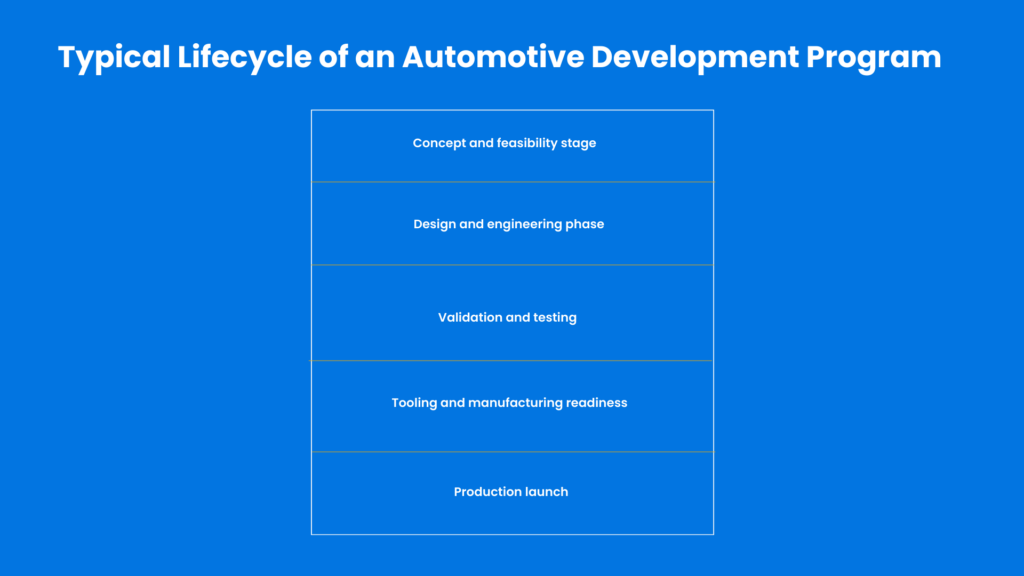
- Concept and feasibility stage. Teams evaluate market demand, cost targets, platform architecture, and regulatory requirements before committing resources.
- Design and engineering phase. Engineers develop CAD models, refine component specifications, and begin prototype development.
- Validation and testing. Vehicles undergo safety checks, durability testing, emissions validation, and regulatory compliance assessments.
- Tooling and manufacturing readiness. Production tooling, moulds, and assembly processes are prepared to support large-scale manufacturing.
- Production launch. Final vehicles move into assembly lines while suppliers scale deliveries and plants prepare for full production.
Where Automotive OEMs Struggle Without Structured Systems
Even experienced OEM organizations encounter recurring operational challenges. These challenges rarely appear as dramatic failures. They emerge slowly through inefficiencies.
Evaluating New Product Ideas
Every program starts with a concept. Before development begins, leadership teams must evaluate product feasibility, market potential, technical requirements, and manufacturing readiness.
In many organizations, this evaluation still happens through spreadsheet models and long email discussions. The problem is not the tools themselves. The problem is fragmentation. Important assumptions disappear inside attachments. Feedback arrives late. Decision makers see partial project data rather than the full picture.
A centralized project management software for automotive industry allows leaders to evaluate proposals through structured workflows. Inputs from engineering, finance, procurement, and marketing stay visible in one place. The result is better investment decisions and fewer risky programs.
Early Warning Signs Your Automotive Project Management System Is Breaking
- Teams maintain separate spreadsheets for the same vehicle program. Each department updates its own version, and numbers rarely match during reviews.
- Weekly meetings turn into status collection exercises. Program managers spend more time chasing updates than solving issues.
- Supplier delays appear suddenly. Tooling milestones slip because vendor updates never entered the main project schedule.
- Teams discover design changes too late. Manufacturing and procurement continue working on outdated specifications.
- Leadership sees fragmented reports. By the time data reaches decision makers, the situation on the ground has already changed.
Pressure to Reduce Development Cycles
The development cycle of cars is becoming shorter and shorter.
The pressure to introduce new cars with electric mobility, new software features, and new government regulations is mounting. The competitive advantage is with the first mover.
However, many OEMs face the challenge of monitoring the progress of the development schedule using disparate tools. Teams maintain local spreadsheets. Managers compile status reports manually. Information travels slowly across departments.
A unified platform can change the game in many ways. For example, the schedule can be monitored using gantt chart views, and the workflow can be managed using Kanban board views. Additionally, the dependency between the tasks can be managed using drag and drop functionality. If the schedule changes due to any reason, the timeline will be automatically updated. Stakeholders see the impact immediately.
Managing Suppliers and Tooling Development
Tooling and mould development often determine the pace of a vehicle program.
- Components such as injection molds, stamping tools, fixtures, and assembly jigs take a long time to procure. These components are usually procured from external vendors.
- If the communication with the vendors is not part of the main project schedule, it is difficult to track the changes.
- Using advanced project management tools, the purchase order can be part of the main project schedule. The vendors’ schedule can be part of the main project schedule, and the progress can be monitored in real-time.
This allows teams to track supplier progress in real time and intervene before delays escalate.
Portfolio Prioritization Across Multiple Programs
Automotive OEMs rarely focus on a single development effort.
- Companies run multiple vehicle programs simultaneously while managing upgrades to existing platforms.
- Regulatory compliance projects often run parallel to innovation programs.
- Leadership teams constantly review project priorities.
Without strong systems, communicating these priority changes becomes difficult. Teams continue working on outdated timelines.
A modern project platform distributes updates instantly. Adjusted priorities reflect across all related tasks and updated due dates. Everyone sees the same direction.
Table 1: Traditional Project Management vs Digital Project Management
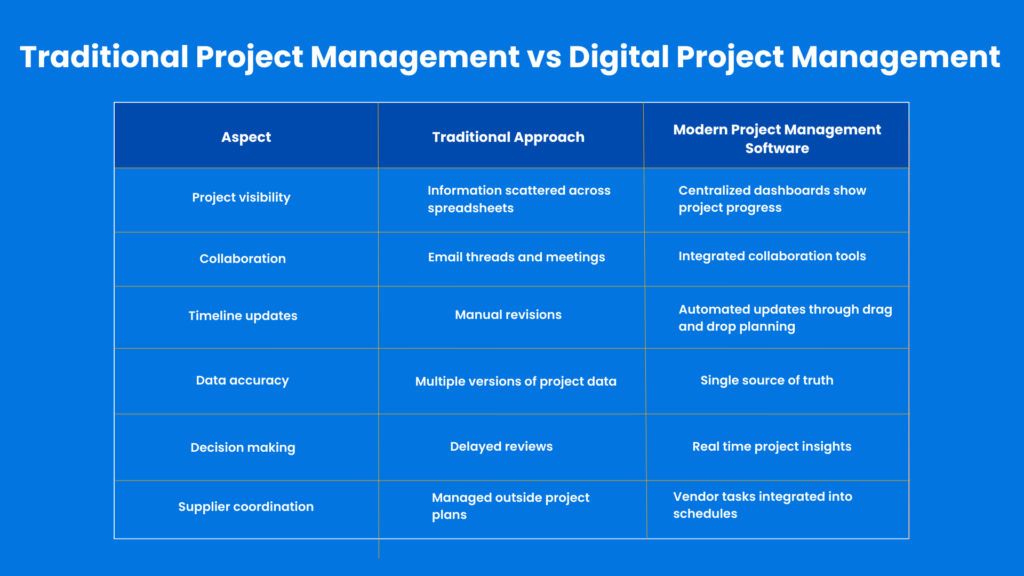
The difference may look operational on the surface. In reality, it transforms how programs run.
The Role of Collaboration in Automotive Programs
Automotive engineering has always depended on teamwork.
A powertrain engineer cannot work in isolation from manufacturing teams. A body structure design must consider tooling limitations. Procurement must coordinate with design revisions.
Despite this interdependence, communication often flows through scattered channels. Teams rely on calls, emails, and informal chats to resolve issues.
Modern project platforms embed collaboration tools directly within project workflows. Discussions occur alongside tasks. Documents stay linked to relevant milestones.
This creates a shared workspace rather than a collection of disconnected updates. Over time, these conversations also build valuable knowledge bases. Future programs can reference past decisions and lessons.
The Importance of Data Integrity in Automotive Projects
Automotive programs generate enormous volumes of technical documentation. Specifications evolve. Drawings undergo multiple revisions. Test reports accumulate during validation cycles.
When this information lives outside the project system, teams risk working with outdated documents.
Strong project management software integrates documentation management with project workflows. Engineers access the latest version of files directly within task environments. This improves accuracy and reduces costly mistakes.
Table 2: Key Features Automotive OEMs Should Expect
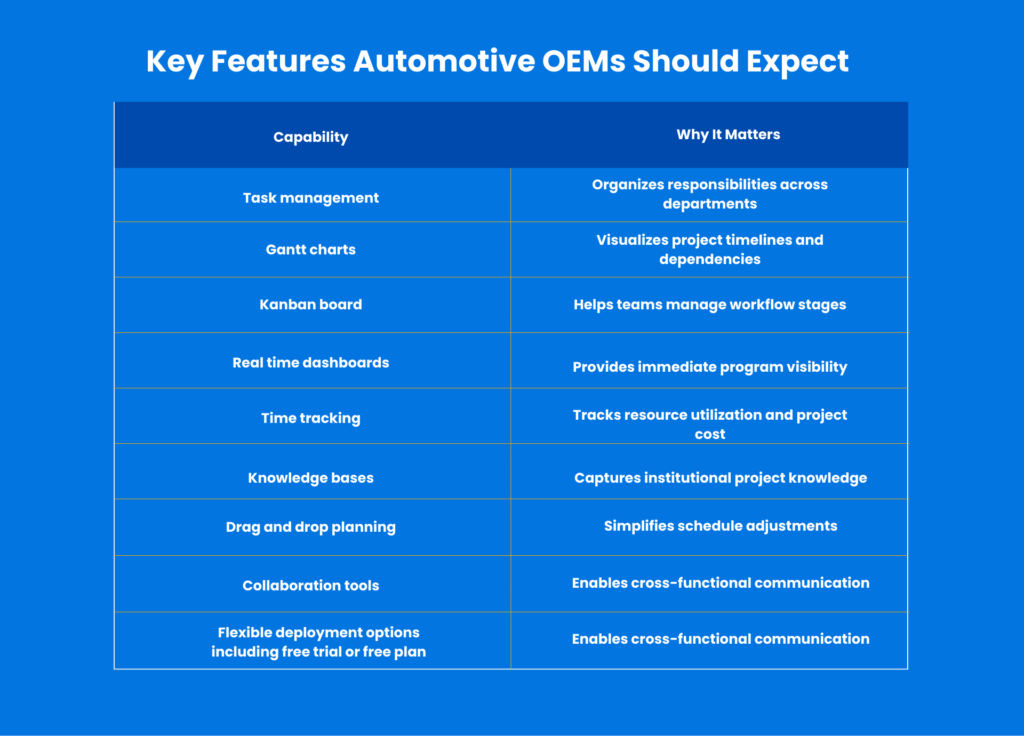
These features of project management software determine how effectively teams can coordinate complex programs.
Operational Impact of Strong Project Management Systems
When implemented well, the impact becomes visible across the organization.
Faster Program Execution
Program managers gain clear visibility into dependencies. Delays become visible early. Teams respond faster.
Improved Governance
Leadership teams gain consistent reporting across programs. They can review project status without waiting for manual updates.
Better Cross-Functional Alignment
Engineering, procurement, manufacturing, and quality teams operate within a shared system.
This alignment reduces friction and accelerates decision making.
Stronger Financial Discipline
Built-in time tracking and resource monitoring allow companies to understand program costs more accurately.
Better planning leads to better financial outcomes.
Why Generic Tools Often Fail in Automotive Programs
Many organizations experiment with popular project tools designed for software teams. These platforms offer useful capabilities. However, automotive programs involve additional layers of complexity.
Supplier coordination, tooling management, engineering validation cycles, and manufacturing readiness milestones all require specialized workflows.
A system designed specifically for project management software for automotive industry accommodates these realities. It understands the structure of automotive development programs.
Conclusion
Automotive programs have always demanded discipline. Today the demands are greater. Vehicle architectures grow more complex. Electrification introduces new technologies. Software now defines a large part of the driving experience.
In this environment, managing development programs through scattered tools creates unnecessary risk.
Modern project management software helps automotive OEMs bring structure to complexity. It connects teams, suppliers, timelines, and data within a unified environment.
Organizations that adopt these systems gain stronger visibility, faster development cycles, and better control over program execution.
About Kytes
Kytes [PSA + PPM} is designed for organizations that manage complex enterprise programs.
- The platform provides support for structured planning via gantt charts, workflow visibility via kanban board views, and intuitive scheduling adjustments via drag and drop planning.
- The platform also provides support for team collaboration via integrated collaboration tools, team insights via shared knowledge bases, and team performance via real-time dashboards.
- Kytes provides OEMs in the automotive industry with the tools required to execute every stage of a complete project with confidence.
For OEMs in the complex process of developing a new vehicle, Kytes is the digital backbone required for modern program execution. Book a demo to see it in action.