
Blog Highlights
- Project execution reveals hidden operational challenges like misaligned resources, dependencies, and technical debt that often break delivery.
- Key focus areas during execution include resource alignment, milestone tracking, risk escalation, stakeholder communication, and quality checks.
- A well-crafted project executive summary provides actionable insights on milestones, risks, blockers, and forecasted mitigations.
- IT leaders can fix failing projects through real-time visibility, proactive risk management, prioritization, and managing technical debt.
- Operational realities often go unnoticed: metrics can mislead, delays are subtle, and excessive documentation can slow execution.
- Kytes AI-enabled PSA + PPM software enhances execution with dashboards, predictive insights, centralized communication, and AI-driven task prioritization.
Project execution often feels like a battlefield in IT services. You start with a detailed plan, milestones mapped, resources allocated, and stakeholders aligned. Yet, weeks into execution, progress slows. Features stall, teams work in silos, and deadlines become aspirational rather than factual. For IT leaders, the challenge is not just to deliver but to maintain visibility, control, and predictability while execution unfolds.
Understanding why projects fail at this stage is critical. Unlike planning, which is largely hypothetical, project execution exposes operational realities. Every overlooked dependency, misaligned resource, or hidden technical debt comes into sharp focus. And while these issues are not always visible in standups or status reports, they accumulate, eroding timelines, increasing risk, and sometimes derailing entire projects.
This blog dissects the operational truths behind IT project execution, highlights common failure points, and shows how leaders can regain control. We will explore focus areas, executive summaries that provide real insight, and interventions that turn faltering projects around.
Understanding Project Execution in IT Services
Project execution is the phase where plans turn into deliverables. In IT services, this phase involves far more than task assignment; it encompasses active coordination of teams, real-time monitoring of work, and continual alignment with business goals.
Key activities include:
- Resource allocation and management: Ensuring that the right skills are applied to the right tasks.
- Task tracking and milestone monitoring: Using dashboards, task boards, or project management tools to measure progress.
- Stakeholder engagement: Providing accurate, actionable updates rather than superficial reports.
- Risk identification and mitigation: Detecting early warning signs and taking corrective action.
- Quality assurance and compliance checks: Ensuring deliverables meet technical and business standards.
The execution phase is inherently dynamic. Plans often diverge from reality due to unforeseen dependencies, delayed deliverables, or shifting client requirements. Unlike planning or closure, execution requires leaders to constantly observe, adjust, and intervene without losing overall focus.
Why Project Delivery Breaks
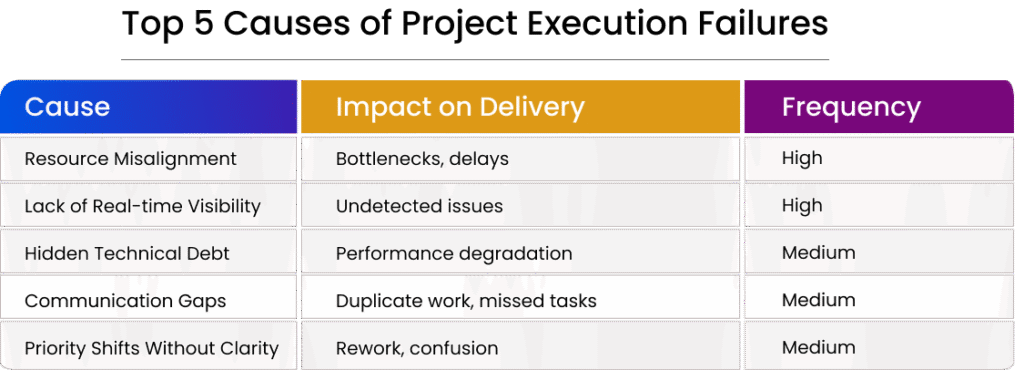
Even well-structured projects often encounter execution breakdowns. These failures are rarely random—they are symptoms of operational gaps.
- Resource misalignment: Teams may be overburdened or under-skilled for specific tasks. Over-reliance on a few key resources creates bottlenecks.
- Lack of real-time visibility: Without dashboards or timely reporting, issues remain undetected until they escalate.
- Hidden technical debt: Legacy systems, unrefined code, or incomplete integrations slow progress in subtle, compounding ways.
- Communication gaps: Misalignment between developers, QA, and operations leads to duplicate work, missed dependencies, and unreported blockers.
- Shifting priorities without clarity: Frequent changes without structured impact analysis destabilize task sequencing and planning.
For example, in a mid-sized IT services company, a software rollout stalled for weeks because QA was unaware of a critical dependency on an API that developers had modified. On paper, all milestones appeared on track, but execution visibility was lacking.
Primary Focus Areas During Project Execution Phase
When projects falter, leaders often ask, “what is the primary focus area during project execution phase?” The answer is not singular. Successful execution demands a balance across multiple domains.
Critical focus areas:
- Resource utilization and skill alignment: Constantly monitor whether tasks match team capacity and expertise.
- Progress tracking vs milestones: Ensure that task completion reflects actual output and dependencies are resolved.
- Risk and issue escalation: Track potential blockers proactively; encourage teams to surface issues early.
- Stakeholder communication: Provide concise, actionable insights rather than just reporting percentages.
- Quality and compliance checkpoints: Integrate testing, code reviews, and compliance audits within sprints rather than at the end.
Each area reinforces the others. For instance, without tracking milestones accurately, resource alignment cannot be verified, and risk management becomes reactive.
Crafting a Project Executive Summary That Actually Works
A project executive summary is often treated as a formality. Most summaries list tasks completed or percentages achieved without providing insight. In reality, a technically valuable executive summary allows leaders to make decisions and anticipate risks.
Essential elements of an actionable executive summary:
- Key milestones achieved: Highlight critical deliverables that directly impact project timelines.
- Resource and risk overview: Show where skill shortages, capacity issues, or dependencies might cause delays.
- Pending blockers: Clearly identify tasks that require immediate attention.
Forecasted delivery risks and mitigations: Include projections, not just status.
How IT Leaders Fix Broken Projects
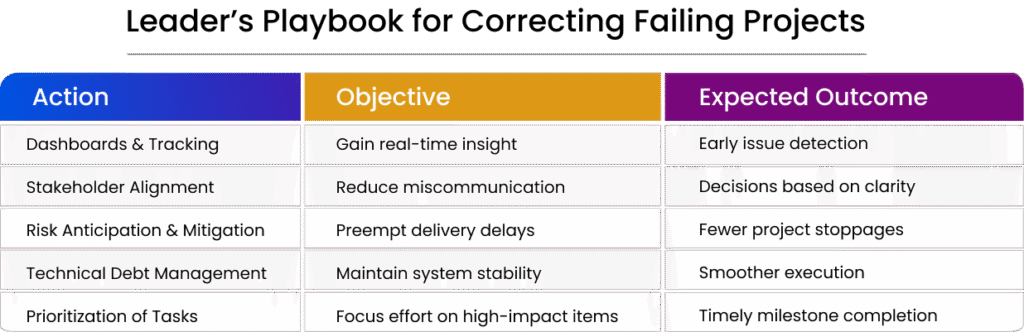
Leaders do not just react—they intervene strategically to restore execution rhythm.
Tactical interventions:
- Real-time visibility via dashboards: Track tasks, dependencies, and risks continuously.
- Continuous alignment with stakeholders: Regular check-ins with actionable reporting prevent miscommunication.
- Proactive risk management: Anticipate potential delays and plan mitigations before they escalate.
- Reducing technical debt dynamically: Refactor code or adjust integrations as work progresses.
Prioritization frameworks: Distinguish urgent vs important tasks to focus effort effectively.
See how Kytes enables seamless project execution with AI-powered dashboards and real-time insights.
Operational Truths Leaders Rarely Hear
Execution exposes realities often overlooked:
- Delays are rarely obvious: Daily standups can hide cascading issues.
- Metrics can mislead: Percent completion or story points may not reflect actual progress.
- Risk is cumulative: Small issues grow exponentially if not addressed immediately.
- Documentation compliance slows action: Overemphasis on reporting can distract from execution.
Kytes AI-enabled tools reveal these hidden dynamics, allowing leaders to intervene before minor issues escalate.
Leveraging Data-Driven Metrics to Predict Project Health
In IT project execution, visibility alone is no longer enough. Teams often notice issues only when they have already impacted delivery. The most effective leaders use data to anticipate problems, turning insights into preventive action rather than reactive firefighting.
Key metrics can act as early warning signals:
- Task velocity and completion trends: A slowdown in task throughput or repeated delays in specific modules can indicate deeper issues with team capacity or dependencies.
- Resource load variance: Monitoring over- or under-utilized team members helps identify potential bottlenecks before deadlines are affected.
- Defect and rework patterns: Rising bug counts or repeated rework in certain components often highlight technical debt or process inefficiencies that need immediate attention.
- Dependency and blocker frequency: Tracking tasks that frequently get blocked or delayed reveals hidden process or integration challenges.
Predictive analytics goes beyond visibility. By analyzing historical project data—task completion rates, issue resolution times, and team performance—leaders can forecast risks and timeline deviations. This enables proactive actions, such as reassigning resources, adjusting sprint scopes, or escalating dependencies early.
Decision dashboards convert these metrics into actionable insights. Visual indicators, trend lines, and predictive alerts give leadership a clear view of project health, allowing decisive action before issues surface.
Integrating data-driven monitoring into execution helps teams move from reactive problem-solving to continuous optimization, ensuring more predictable and controlled project delivery.
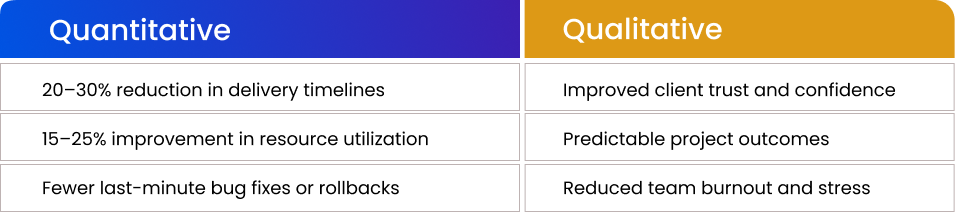
Real-World Impact of Strong Project Execution
Effective execution translates directly into measurable outcomes:
Conclusion
Project execution is where plans meet reality, and success depends on visibility, alignment, and proactive management. Understanding why delivery breaks, focusing on critical areas, and leveraging actionable executive summaries gives leaders the tools to regain control.
Technology is a force multiplier in this phase. Systems like Kytes AI-enabled PSA + PPM software provide real-time dashboards, predictive risk insights, and execution visibility, allowing IT leaders to transform fragile plans into predictable, successful deliveries.
About Kytes
Kytes is designed for IT leaders who need clarity and control across every stage of project execution. By combining AI-driven dashboards with advanced [PSA + PPM] capabilities, Kytes turns complex project data into actionable insights.
Key capabilities include:
- Real-Time Visibility: Track progress, dependencies, and risks as they happen.
- Predictive Insights: Identify potential delays and resource constraints before they impact delivery.
- Centralized Communication: Align development, QA, and operations teams in one platform.
- Actionable Executive Summaries: Generate summaries that provide decision-ready insights, not just status updates.
- Adaptive Prioritization: Focus effort on high-impact tasks with AI-assisted task ranking.
Experience Kytes AI-enabled PSA + PPM software and take control of your IT project execution today.